
- Locations
- Interviews
- Luxury Home
- Luxury Lifestyle
- Luxury Travel
- Luxury News
- Events
- More
- Magazine

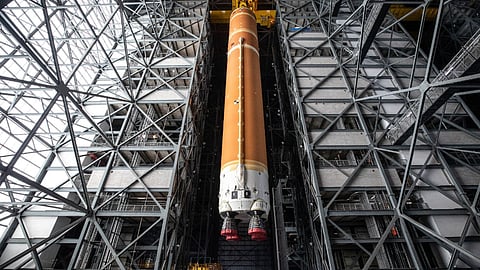
NASA no longer flies solo. Its Apollo-era mystique may still dazzle, but the Artemis program signals something very different. Artemis is not just about going back to the Moon. It’s about going back to stay. The mission stretches beyond symbolic landings—it sets the stage for a permanent lunar base, a stepping stone to Mars, and a long-overdue redefinition of human presence in deep space.
But NASA cannot get there alone. What’s changed since the ‘60s? Nearly everything. And that includes the introduction of serious private money. SpaceX, Blue Origin, and a growing roster of private players now co-author our space future. NASA leads the blueprint, but billionaires fund the architecture. The result is a public-private hybrid mission where capital and capability collide. This isn’t exploration as we once knew it. It’s exploration reimagined for a world where tech ambition, not just national pride, sets the pace.
Elon Musk doesn’t just want to be part of Artemis. He wants to own the infrastructure. And NASA, surprisingly or not, gave him the chance. In 2021, SpaceX was awarded the Human Landing System contract, a watershed moment that would’ve been unthinkable a generation ago. The contract entrusts Musk with delivering astronauts to the Moon using a custom version of Starship, a fully reusable rocket that dwarfs even the Saturn V.
For Musk, Artemis isn’t the goal; it’s the rehearsal. His ambitions lie far beyond the Moon, and Starship is his interplanetary ticket. Artemis provides him scale, credibility, and hardware validation he needs. It’s a win-win. NASA gets a bold, fast-moving partner. Musk gets a test lab for Mars. But make no mistake, his priorities are not confined to government contracts. Artemis fits into a broader narrative where Mars isn’t just possible—it’s inevitable. And Starship, not SLS, is the chosen vessel.
Jeff Bezos may not match Musk’s media fireworks, but he’s equally committed to a lunar future. His company, Blue Origin, lost the first Artemis lander contract, a blow that briefly put it on the defensive. But Bezos doesn’t retreat; he recalibrates. NASA later awarded Blue Origin a second lander deal, affirming its place in the Artemis ecosystem. Unlike Musk’s brute-force velocity, Bezos plays a long game focused on infrastructure, sustainability, and permanence. His vision centers around building a full economic loop in space, beginning with the Moon and extending outward.
That includes Blue Moon, the company’s own lander platform, and orbital habitats designed for long-term habitation. Bezos even paused Blue Origin’s headline-grabbing space tourism program to redirect resources toward Artemis. It’s a quiet power move, signaling that prestige projects are giving way to permanent positioning. If Musk is racing to plant the flag, Bezos is sketching blueprints for what comes after the dust settles.
Artemis reflects a profound shift in how we explore. Where Apollo was wholly government-owned, Artemis is built on a complex network of partnerships. NASA is still the commander, but the engine room is full of private engineers, commercial contracts, and VC-fueled ambitions. The public sector provides purpose. The private sector supplies propulsion.
This hybrid model has sparked both innovation and concern. On one hand, companies like SpaceX bring speed, cost reduction, and iterative design that traditional contractors simply can’t match. On the other hand, the reliance on private entities raises questions of control, equity, and long-term governance. Will national space agencies remain stewards of humanity’s ambitions, or merely become tenants of privately built empires? Artemis doesn’t answer that yet. But it sets the precedent. What’s clear is that exploration now requires collaboration. And collaboration means compromise, complexity, and shared credit. In the new space age, no one goes it alone, not even NASA.
The Moon was once the finish line. Today, it’s the launchpad. Artemis isn’t just reviving human presence on the lunar surface; it’s making the Moon into a waypoint, a basecamp, a platform. That distinction matters. A return to the Moon is not for nostalgia or flag-waving. It’s about learning to live off-world. It's about mastering resource extraction, infrastructure assembly, and long-duration survival. The south pole, with its shadowed craters and possible water ice, could one day host refueling depots or research stations.
Musk sees this as a necessary practice for Mars. Bezos sees it as the foundation of a permanent in-space economy. Either way, the Moon is no longer the endgame. It’s a frontier being redefined by both public desire and private will. Artemis is the engine that makes that redefinition possible. And its success could determine whether our species learns to thrive beyond Earth or remains bound to it.
This moment is not just another lap around the Earth. Artemis represents the convergence of old institutions and new empires. It’s NASA’s boldest mission in decades—and one powered not just by taxpayer dollars but by the ambitions of the wealthiest individuals on the planet. That reality is thrilling and sobering. Progress is happening at a pace NASA alone could never match. Yet the values, priorities, and motivations of these private players will inevitably shape the future of exploration. Artemis, in many ways, is a test.
Not just of technology or human endurance, but of partnership itself. If successful, it proves that public and private sectors can co-create something historically significant. If not, we’ll be left with fragmented ambitions and a Moon too expensive to hold. For now, though, the rockets are built, the astronauts are training, and the countdown is real. The Moon is calling again. This time, we might actually stay.
Inspired by what you read?
Get more stories like this—plus exclusive guides and resident recommendations—delivered to your inbox. Subscribe to our exclusive newsletter
The products and experiences featured on RESIDENT™ are independently selected by our editorial team. We may receive compensation from retailers and partners when readers engage with or make purchases through certain links.