
- Locations
- Interviews
- Luxury Home
- Luxury Lifestyle
- Luxury Travel
- Luxury News
- Events
- More
- Magazine

For teams managing multiple campaign assets simultaneously, Adobe Firefly's AI is another reference point worth exploring alongside Pollo AI, particularly if your workflow includes enterprise-level compliance requirements around commercially safe image generation.
The compounding effect is significant: fewer rounds of revision means faster time-to-launch, lower production cost per asset, and less opportunity for brand drift to accumulate across the revision cycle.Brand consistency sounds like a principle everyone agrees on in theory. In practice, it breaks down constantly — and it usually breaks down at scale, exactly when a campaign is expanding across channels and the pressure to move fast is highest.
The product hero image on the website looks slightly different from the paid social creative. The email header has a different feel from the landing page. The Instagram post was approved on Monday; by Friday the concept has drifted through four rounds of revisions and three different file versions. None of this is negligence. It is what happens when visual production scales faster than the systems designed to manage it.
The root cause is almost never a lack of brand guidelines. Most teams have brand books. The problem is that guidelines do not generate assets — people do, working under time pressure, across tools, often without a single source of truth to anchor each iteration.
When a brief goes from strategist to designer to art director to vendor, each handoff is an opportunity for interpretation drift. A "warm, confident, premium" brief means something slightly different to every person who reads it. By the time the sixth asset is in production, "warm" has shifted three degrees toward orange.
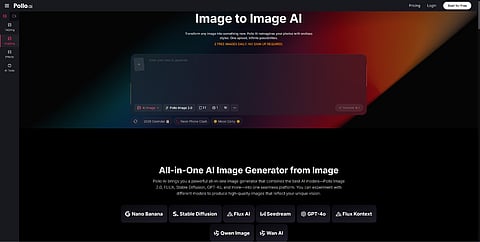
Pollo AI addresses this by making the reference image — not the written brief — the source of truth. The Image to Image AI tool from Pollo AI means that when you start from an existing approved visual and use a text prompt to describe the variation you need, you are not asking someone to reinterpret a mood board. You are asking the model to transform a specific input into a specific output. The parameters are tighter, and so is the result.
The platform supports models including Pollo Image 2.0, FLUX, Stable Diffusion, and GPT-4o, with more than 2,000 LoRAs available for style-level control. This breadth matters for brand teams because different campaign moments often call for different aesthetic registers — a product launch has a different visual temperature than a sale event — while still needing to feel like they come from the same brand.
The core capability that makes image-to-image useful for brand consistency is the ability to hold the subject constant while changing everything around it.
Say your campaign hero image features a product in a natural setting — forest light, earthy tones, soft shadows. That image performs well on organic social. Now you need a version for a paid ad unit: higher contrast, cleaner background, more direct. With a reshoot or a blank-canvas generation, you are starting from scratch and hoping the result lands close to the original. With image-to-image, you upload the approved hero and prompt for the variation. The product stays. The environment changes.
This subject-preservation capability is particularly valuable for campaigns that need:
Seasonal variants — same product, different environmental mood for spring versus fall
Audience variants — same product, slightly different lifestyle context for two different demographic targets
Format variants — same composition re-rendered for vertical mobile, square social, and wide display without losing the core visual identity
Tone variants — aspirational for brand campaigns, direct for promotional pushes
Each of these is a variation on a known approved visual, not a new creative direction. That is what makes them manageable at the volume campaigns actually require.
Two tools give brand teams consistent outputs at the model level: model choice and LoRA selection.
Model choice affects the overall rendering character. Some models favor photorealism; others excel at stylized or illustrative outputs. Choosing and fixing the model for a given campaign type — and documenting that choice — means that all assets generated within that campaign share an underlying aesthetic architecture, even when they differ in subject or context.
LoRA selection allows even finer control. With more than 2,000 LoRAs available, teams can identify and reuse the specific LoRA that defines a campaign's visual signature. If a skincare brand's winter campaign uses a LoRA that emphasizes clean, minimal product photography with cool neutral tones, every asset in that campaign can reference the same LoRA. The style becomes a parameter you can apply consistently rather than a description you hope someone interprets correctly.
Document both choices — the model and the LoRA — in your campaign brief template, alongside the source image. This is the practical version of a "visual system" that actually governs output rather than just aspirationally defining it.
One of the hidden costs in brand campaign production is the review cycle. Assets go to stakeholders, come back with comments, go back to designers, and the process repeats. Each round introduces both delay and the risk of further drift from the original approved direction.
Image-to-image generation compresses this loop in a specific way: it makes generating a revision faster than communicating the revision brief. When a stakeholder says "can we see this with a brighter background and slightly warmer tones," the answer used to involve a designer queue. Now it involves a prompt. The iteration happens in the room, or in the async comment thread, at a speed that matches the pace of feedback rather than the pace of production.
For teams managing multiple campaign assets simultaneously, Adobe Firefly's AI is another reference point worth exploring alongside Pollo AI, particularly if your workflow includes enterprise-level compliance requirements around commercially safe image generation.
The compounding effect is significant: fewer rounds of revision means faster time-to-launch, lower production cost per asset, and less opportunity for brand drift to accumulate across the revision cycle.
Different placements have different visual requirements, and managing those requirements across a campaign is where brand consistency most often fails in execution.
For paid social, the need is for high attention-capture in the first half second — typically through contrast, color temperature, and a clear focal point. Image-to-image lets you generate a version of your approved hero optimized for that register without rebuilding the asset from scratch.
For landing pages, the need is for visual harmony with the ad creative that drove the click, combined with enough space for text and CTA overlays. A version of the hero with extended neutral zones and consistent color treatment serves both.
For organic social and editorial, the tone can be warmer and more contextual. The same subject, shifted to a lifestyle environment rather than a clean background, maintains the brand identity while fitting the platform's aesthetic expectations.
The key is to treat the approved hero as the anchor and image-to-image as the adaptation mechanism — not as a separate creative tool that produces unrelated outputs. The brand system is the source image plus the prompt template. If both are consistent, the outputs will be too.
Inspired by what you read?
Get more stories like this—plus exclusive guides and resident recommendations—delivered to your inbox. Subscribe to our exclusive newsletter
The products and experiences featured on RESIDENT™ are independently selected by our editorial team. We may receive compensation from retailers and partners when readers engage with or make purchases through certain links.