
- Locations
- Interviews
- Luxury Home
- Luxury Lifestyle
- Luxury Travel
- Luxury News
- Events
- More
- Magazine
- Contact Us

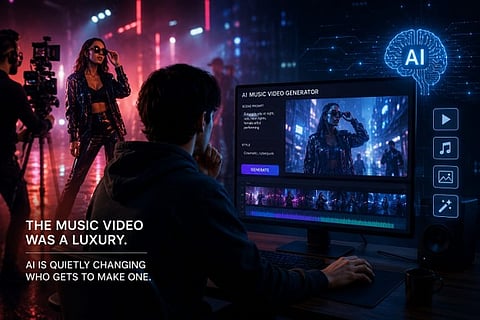
For most of its history, the music video has been a rich artist's privilege. A single polished visual could cost as much as a small film, and the budget came from a label that expected to recoup it. Independent musicians made do with a static cover image on a streaming upload, or a friend with a camera and a weekend. The gap between what an established act could put on screen and what everyone else could was one of the most visible dividing lines in the industry.
That line is starting to blur, and the reason has less to do with cameras than with a class of software that did not exist in usable form two years ago. AI video generation has moved from a curiosity that produced five seconds of melting faces into something a working artist can actually build a visual around. The most talked-about of these tools right now comes from ByteDance, the company behind TikTok, and it is worth understanding what it does before deciding how much it matters.
The technical story is simpler than the marketing around it. Early AI video models could hold a coherent image for only a few seconds before the picture began to drift, faces rearranging, backgrounds warping, the whole thing dissolving into the uncanny. That short ceiling is why the first wave of AI music visuals looked like fever dreams. They were made of fragments stitched together, and the seams showed.
ByteDance's Seedance 2.0 pushed that ceiling higher, generating clips of four to fifteen seconds at up to 1080p, which was enough for a looping backdrop but still short of a real scene. The newer Seedance 2.5 is the meaningful jump. It renders a single continuous thirty-second shot at native 4K, with sound generated alongside the picture rather than layered on afterward, from one written prompt or a single reference image. Thirty unbroken seconds is not a technical footnote. It is roughly the length of a hook, a verse, the segment of a track an artist would actually want to put a picture to.
The other change matters just as much for anyone working in music. Seedance 2.5 accepts up to fifty reference inputs in a single generation, where Seedance 2.0 topped out at twelve. Those references can be images, video, and audio, and it is the audio that changes things for music: a musician can feed the model the track itself and ask for visuals that move with it. The result is less a matter of describing a vague mood and hoping, and more like handing a director a reference folder and a rough brief.
The practical consequence is not that anyone can now make a Hype Williams video from a laptop. It is that the floor has risen. The visual that used to be out of reach for an unsigned act, a proper thirty-second piece with a consistent look and a deliberate camera move, is now something they can attempt without a production company or a five-figure invoice.
Consider the release cycle most independent musicians live inside. A single drops, and it needs a visual presence: something for the streaming canvas, a clip for a Reel, a teaser for the week before release, a lyric moment for the chorus. None of these individually justified a shoot, so most artists simply went without, and their releases looked quieter than they were. Generating those pieces from the track and a few reference images collapses a job that used to take a budget into one that takes an afternoon and some patience.
There is a creative argument here as much as an economic one. When the cost of a visual attempt drops to almost nothing, artists can try ideas they would never have gambled a real budget on. A surreal concept for a B-side. Three different visual directions for the same hook, tested before committing. The music does not change, but the number of ways an artist can present it multiplies, and for a scene built on standing out, that range is the point.
None of this replaces a real shoot when a real shoot is what the work needs. An artist with a specific human performance in mind, a choreographed piece, a narrative that depends on an actor's face doing something exact, still needs people in a room and someone directing them. Anyone claiming a prompt can substitute for that is selling something.
The models also have tells if you look closely. Hands still betray them in certain frames. Emotional acting, the flicker of a real expression, remains the hardest thing for any of these systems to fake convincingly, and it is precisely what a lot of music video work lives on. The honest way to think about the technology is as a new tool on the shelf rather than a replacement for the ones already there. It is remarkably good at atmosphere, motion, and place, and still weak at the specific magic of a performance.
There is a cost discipline the demos rarely mention, too. Length and resolution are what consume credits, so a full thirty-second 4K render is not free, and generating at maximum quality on a first attempt is how artists watch their idea come out wrong at full price. The workflow that keeps this affordable is unglamorous: draft the shot short and at low resolution, correct one thing at a time, and only pay for the finished 4K version once the cheap draft already works.
Step back from the specifications and the interesting part is who this reaches. For decades, the visual language of pop music was controlled by whoever could afford to produce it, which meant labels, which meant a filter on which artists got to look the part. Tools like Seedance 2.5 do not erase the advantages of a real budget, and they will not turn a laptop into a studio. What they do is hand the smallest acts a version of a capability that used to sit exclusively at the top.
The music industry has been here before, in a way. Home recording software did not end professional studios, but it did mean a compelling record could come from a bedroom, and a great deal of the last fifteen years of music came from exactly there. The visual side has lagged behind the audio side for the obvious reason that pictures were harder and more expensive to make than sound. That gap is now closing, and the artists who understand it first will be the ones whose releases stop looking like they were made on a smaller budget, even when they were.
Whether that produces a wave of genuinely interesting work or simply more content is the open question, and it is the same question every democratizing tool has raised. The answer, as always, will come down to the people using it rather than the software itself. But the barrier that kept most musicians from putting a real picture to their music has quietly come down, and that is worth paying attention to.
Inspired by what you read?
Get more stories like this—plus exclusive guides and resident recommendations—delivered to your inbox. Subscribe to our exclusive newsletter
The products and experiences featured on RESIDENT™ are independently selected by our editorial team. We may receive compensation from retailers and partners when readers engage with or make purchases through certain links.