
- Locations
- Interviews
- Luxury Home
- Luxury Lifestyle
- Luxury Travel
- Luxury News
- Events
- More
- Magazine

Lifestyle brands have always lived or died on atmosphere. A candle company is not really selling wax; it is selling a specific Sunday morning. A skincare label is selling the feeling of a bathroom with good light in it. The product is the excuse, the mood is the offer.
That has made video the natural medium and, until recently, the most expensive one. A single well-lit thirty-second spot could absorb a quarter's entire content budget: location, stylist, model, crew, edit, colour. Brands responded by making one hero film a year and stretching it across every channel until it wore thin.
The arrival of capable AI video generation has not replaced that hero film. What it has done is fill the eleven months in between.
Most lifestyle brands do not suffer from a shortage of big ideas. They suffer from a shortage of executions. Marketing wants a seasonal story, three product-specific cutdowns, a set of vertical clips for social, and something for the newsletter all from a budget that realistically funds one shoot.
AI video sits precisely in that gap. It is not the right tool for the flagship brand film, where a director's eye and a real human performance still carry the emotional weight. It is very much the right tool for the twenty supporting pieces that surround it, where speed and volume matter more than auteurship.
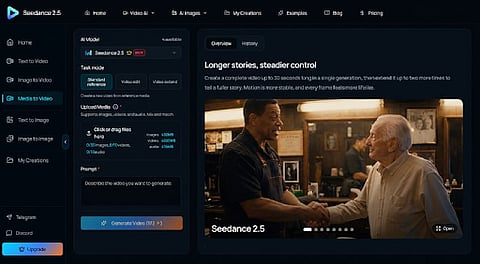
Teams working this way typically build the visual language once, then generate variations against it. A tool like Seedance 2.5 supports this because it accepts up to 50 multimodal references in a single generation of your actual product photography, a colour palette, a clip that establishes the camera's mood, an audio bed that sets tempo. The output inherits the world you have already built rather than inventing a new one each time.
The most underrated use is not publishing at all. It is pre-visualisation.
Traditionally, a lifestyle campaign moves from mood board to storyboard to shoot day, with the first moving images arriving after the money is spent. That sequence puts the riskiest decision: does this concept actually work in motion? at the point of no return. Everyone in the room has seen a beautiful deck become a mediocre film.
Generating rough moving versions of three competing concepts before the shoot changes the conversation. The creative director can see whether the slow push-in on the product genuinely feels intimate or merely slow. The founder can see the vertical crop and notice that the logo sits badly. These are cheap corrections at concept stage and expensive ones on set.
Because clips can now run up to 30 seconds in a single pass rather than a handful of disjointed seconds, a previsualisation is long enough to reveal pacing problems which is where most short-form campaigns actually fail.
The second workflow is extension. You shot the summer range in March. In July, three colourways sell out, two new SKUs arrive, and a retail partner wants channel-specific assets by Friday. Nobody is flying the crew back.
Image-to-video handles a meaningful share of this. Feeding existing product photography in as reference and generating short motion sequences around it produces material that sits comfortably alongside the original shoot, because it is literally built from the original shoot.
Sharper detail on products and close-up subjects is the specific capability that makes this viable a lifestyle brand cannot use a clip where the stitching goes soft or the label smears.
Output options matter here too. Generating natively at the aspect ratio each channel wants 9:16 vertical, 1:1 for grid, 16:9 for the site avoids the reframing crop that quietly ruins a carefully composed shot.
It would be dishonest to present this as effortless. Three things separate lifestyle brands who use AI video well from those whose output looks generic.
The first is reference discipline. Brands that feed in their own photography, their own palette, their own textures get results that look like them. Brands that write a text prompt and hope to get results that look like everyone else's text prompt.
The second is restraint with motion. The instinct is to ask for dramatic camera moves because the tool can do them. Lifestyle photography has spent a decade learning that stillness reads as premium. The most effective generated clips are usually the quietest: a slow drift, a slight parallax, light moving across a surface.
The third is honesty about what is being shown. If a generated clip implies a product performs in a way it does not, the problem is not the technology it is a claim your brand cannot support. Use generation for atmosphere, context, and mood; use real capture for anything that functions as evidence.
Pick one recurring deliverable, the weekly social clip, the product-launch teaser, the newsletter header and run it through this process for a month. Build a reference folder from assets you already own. Draft at lower resolution to test timing, then finalise at 1080p. Keep the pieces that clear your normal quality bar and discard the rest without sentiment.
At the end of the month you will know two useful things: how many hours it actually saved, and whether your audience noticed any drop in quality. Those two numbers are a better guide to whether an AI video generation platform belongs in your workflow than any demo reel, and they are the only ones your finance director will care about.
Inspired by what you read?
Get more stories like this—plus exclusive guides and resident recommendations—delivered to your inbox. Subscribe to our exclusive newsletter
The products and experiences featured on RESIDENT™ are independently selected by our editorial team. We may receive compensation from retailers and partners when readers engage with or make purchases through certain links.