
- Locations
- Interviews
- Luxury Home
- Luxury Lifestyle
- Luxury Travel
- Luxury News
- Events
- More
- Magazine

Ask ChatGPT or Gemini to recommend a company in your industry in Malaysia, and you'll usually get three or four names. If yours isn't one of them, it's tempting to blame your website. Maybe the copy is thin, or the schema is missing. Sometimes that's the cause. Often, though, the real gap is off your site, in how few credible places mention you at all. That's why third-party brand mentions have become one of the most practical levers in GEO.
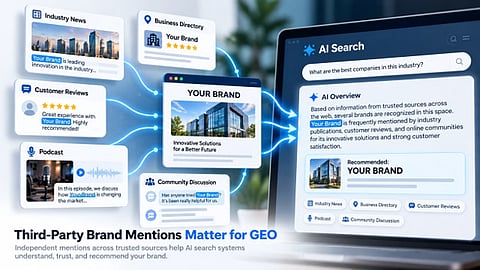
Third-party brand mentions are references to your business on websites you don't own, such as news articles, directories, review platforms, industry blogs, podcasts and forums. They may or may not include a link. For GEO, they work as independent evidence that your brand exists, does what it says and is known for particular topics.
AI tools build answers from many sources, not just your homepage. When several independent sites describe your business in a consistent way, the system has more reason to treat that description as reliable. A claim that appears only on your own website is easier to overlook.
Think about how people hire. A company's own pitch is useful, but a referral from someone else carries more weight. Retrieval-based tools like Perplexity and Google's AI Overviews show the pages they draw from, so you can often see which sources are feeding an answer. Language models also pick up associations between brand names and topics from text across the web.
One caveat: nobody outside the AI platforms knows exactly how these signals are weighted, and the platforms change. Treat mentions as an important signal, not a switch you can flip.
Mentions are one part of a bigger job. GEO builds on SEO rather than replacing it. You still need clear pages, direct answers, sound technical foundations and consistent business information. Mentions are the external proof layer on top: on-site work makes you easy to understand, and off-site mentions make you easier to believe.
If you want to see how these pieces connect in a full programme (audits, entity work, content, brand mentions and tracking), this overview of generative engine optimisation is a useful reference.
People often treat these as the same thing. They overlap, but they aren't identical.
The best outcome is a mention that names you, links to you and says clearly what you do.
Relevance beats volume. Ten mentions in places your customers and your industry actually read are worth more than a hundred on random sites. Good places to look:
Industry and business publications: features, interviews and expert quotes in outlets such as The Edge Malaysia or respected trade sites in your sector.
Directories and professional bodies: member listings from associations, chambers of commerce and credible industry directories.
Review platforms and Google Business Profile: reviews written in customers' own words often describe your services better than your own copy does.
Podcasts, webinars and event pages: speaker bios and show notes name your business and your area of expertise.
Community discussions: forums and groups where real people recommend providers to each other.
This is the part most businesses skip. If one directory lists your registered company name, another uses an old trading name, and a third describes services you stopped offering two years ago, AI tools may read that as mixed signals.
Write a short standard description of your business: the exact name, location, main services and who you serve. Then use it everywhere you have a profile. It's boring work, but it's the kind of consistency that helps AI tools connect the dots correctly.
Test what AI says now: Ask ChatGPT, Gemini and Perplexity five or six questions your customers would ask, such as "who should I hire for [service] in [city]?" Note which brands appear.
Check the sources: Where the tool shows citations, see which sites keep coming up. Those are the places already shaping answers in your category.
Fix what you control: Update profiles, directory listings and your Google Business Profile so the details match.
Offer something worth quoting: Journalists and bloggers cite original data, clear explanations and expert opinions, not generic company announcements.
Ask for reviews properly: Make it easy for happy customers to describe what you did for them.
Repeat the test: Run the same prompts monthly and track which mentions and sources change.
Chasing links only: A brand name in a trusted article can matter even without a link.
Buying mentions in bulk: Low-quality placement networks rarely build real credibility, and they can create a messy footprint.
Ignoring relevance: A mention on a site unrelated to your industry says little about what you're known for.
Inconsistent naming: Different names and descriptions across the web dilute your identity.
Expecting quick wins: Mentions accumulate over months, and AI answers can shift for reasons outside your control.
Here's a hypothetical example. Say a Penang commercial cleaning company tests a handful of prompts and finds that AI tools keep recommending two competitors. Looking at the cited sources, it sees that both appear on a local business directory and a regional trade site where the cleaning company is missing or listed with an outdated address.
The fix isn't glamorous. It claims and corrects the listings, secures a short expert feature with a local publication, and asks recent clients for detailed reviews. Then it re-tests every month. It can't guarantee a result, but it's working on the evidence AI tools appear to rely on instead of guessing.
A small team can handle the audit and profile clean-up in-house. Outreach, PR relationships and tracking across several AI platforms take more time and know-how. If you decide to bring in a specialist, look for an SEO agency Malaysia businesses can brief on both Google rankings and AI visibility, and ask how they measure mentions and citations rather than rankings alone.
They can. AI tools read text, not just links, so a mention that names your brand next to a service or topic can help connect the two. Linked mentions are still more useful because they also give tools and readers a path to your site.
No, they work together. Your own pages explain what you do, and third-party mentions give independent support for those claims. Weak on-site content with strong mentions, or the reverse, leaves a gap.
It varies. It depends on your industry, your competition, how often AI tools refresh their sources and how credible the new mentions are. Anyone promising a fixed timeline or guaranteed citations is overselling.
Paid placements exist, such as sponsored features and advertorials, and they're legitimate when clearly labelled and published on credible sites. Avoid bulk packages from low-quality networks. Earned and genuinely relevant mentions are the safer long-term bet.
Run the same set of customer-style questions on ChatGPT, Gemini and Perplexity, and record which brands and sources appear. Repeat monthly. Dedicated AI visibility tracking tools can automate this if you need to monitor many prompts.
Your website tells AI tools who you say you are. Third-party brand mentions help confirm it. Businesses that earn consistent, relevant mentions across publications, directories, reviews and communities give AI tools more to work with when someone asks for a recommendation.
A good starting point costs nothing: run the prompt test, see who's being named and note where those names are mentioned. If the gaps look bigger than you can close alone, a GEO audit is a sensible next step.
Inspired by what you read?
Get more stories like this—plus exclusive guides and resident recommendations—delivered to your inbox. Subscribe to our exclusive newsletter
The products and experiences featured on RESIDENT™ are independently selected by our editorial team. We may receive compensation from retailers and partners when readers engage with or make purchases through certain links.