
- Locations
- Interviews
- Luxury Home
- Luxury Lifestyle
- Luxury Travel
- Luxury News
- Events
- More
- Magazine

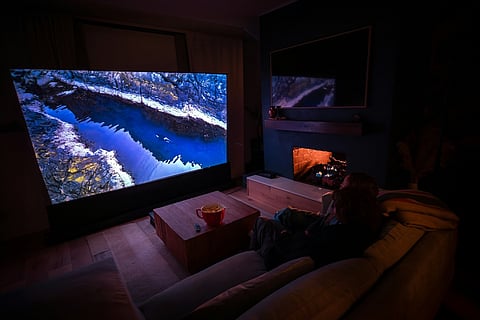
A big screen changes a room. The projector that throws the image, and the screen it lands on, get most of the credit, and most of the attention when people plan a home theater. The piece of furniture that holds the projector gets the least, which is odd, because it is the part that decides whether the whole thing keeps working a year later.
Ultra-short-throw projectors are the fastest-growing part of the category, and for a good reason. They sit a few inches from the wall instead of across the room, so they drop into living rooms that could never host a long-throw setup. But that placement creates a problem the projector alone cannot solve: the image has to be positioned with unusual precision, the machine has to breathe, and the cables have to go somewhere. The cabinet underneath is not storage for the projector. It is part of the optical system. A CINÈST UST projector cabinet treats the job that way, and understanding why that matters is the difference between furniture that supports a cinema and furniture that slowly works against it.
This is what to look for when you shop for one, whether you already own a projector or are planning around a future purchase.
Ultra-short-throw projection works because the light comes out at a steep angle. A projector designed to sit nine inches from the wall and five inches off the floor cannot just be placed anywhere and nudged until it looks right. A few millimeters of error at the source becomes several inches of distortion on a 120 inch screen. The geometry, the keystone, the sharpness, all of it starts at the point where the projector sits.
That is why the first thing to check in a cabinet is not the wood or the finish, it is whether the projector can be positioned and held exactly where it needs to be. Fixed shelves fail here more often than people expect, because the correct position depends on the projector model, the screen, and the ceiling height, and all three vary from one room to the next. A cabinet with motorized adjustment in both the vertical and horizontal directions, a platform that raises and lowers and moves forward and back, turns a one-model furniture purchase into a piece that fits the projector you own and most of the ones you might buy later.
The second part of positioning is memory. A platform that moves is only useful on the day you set it up. A platform that remembers where it was set is useful every evening after that, because the picture comes back square without anyone touching it. Look for a cabinet whose platform returns to a remembered position each time it opens rather than one you have to re-aim by hand.
Heat is the silent failure mode of home cinema. A projector running a two hour film produces real heat, and when it is parked inside a closed cabinet it is sitting in its own exhaust. The common result is a machine that throttles, dims, or ages faster than it should, and the problem is invisible until the projector starts misbehaving months later. The reason so many people miss it is that the projector does not complain loudly; it simply performs a little worse each month, and the cabinet, not the projector, is where the damage actually happens.
A cabinet designed for the job handles heat as part of its function rather than as an afterthought. The useful signs to look for are specific: temperature-controlled fans that switch on above a set point and off below it, perforated fabric or mesh panels that let warm air leave while keeping equipment out of sight, and doors or panels that can open to add dissipation area while the projector runs. The numbers matter less than the fact that the cooling is automatic. If you have to remember to open a door or prop a panel, the cabinet is not doing its job.
A projector is never alone. It arrives with a receiver, a streaming box, a games console, a soundbar, and a tangle of cables that in most living rooms ends up piled behind the television. A cabinet that only holds the projector leaves all of that on the floor, and the room never feels finished.
Look for power inside the cabinet, not just a shelf. Built-in outlets and USB ports mean the projector and the rest of the gear plug in where they live, and nothing has to snake across the wall to reach a distant socket. A removable back panel sounds like a small thing until you try to install a deep receiver, and then it is the difference between a clean setup and a frustrating afternoon. And if a soundbar sits in the cabinet, the panel in front of it has to be acoustically transparent, or you trade a tidy room for muffled dialogue.
The parts of a cabinet you never think about in the store are the parts that decide whether you still like it in two years. Doors that stop the moment they meet resistance, so a curious hand or a wandering pet does not get pinched. A physical reset if the mechanism ever behaves strangely, so the answer is one press instead of a support call. Wood that is certified and finished with water-based coatings, so the piece sits in a living room without smelling like a workshop. A warranty that covers the moving parts, not just the surface.
None of these make the spec sheet exciting. Together they are the difference between a cabinet that hosts a projector and one that survives it.
The most practical test of a projector cabinet is this: when the projector is eventually replaced, does the cabinet get replaced with it? If the answer is yes, you did not buy furniture, you bought a fixture. The better purchase is the one that keeps working through the next projector and the one after that, because the geometry, the power, the cooling and the cable management all still apply no matter which model sits on the platform.
That is the point of buying the cabinet right the first time. The projector is the part that changes. The cabinet is the part that should hold up, keeping whatever projector you choose performing at its best, today and on the day you replace it.
The order in which people buy a home theater usually runs backwards. They pick the projector first, then the screen, then they measure the room, and only at the end do they ask what the whole thing sits on. By then the budget is spent and the furniture gets whatever is left over, which is exactly how a good projector ends up on a wobbling shelf with a power strip taped underneath it.
Reversing that order changes the outcome. Measure the wall and the seating distance first, because those decide the screen size, and the screen size decides the projector, and the projector's throw geometry decides the cabinet. The cabinet is not the last accessory in the chain, it is the foundation the chain is built on. When it is chosen with the same care as the lens, the entire system holds up; when it is an afterthought, the whole thing leans on the one part that was never designed to carry it.
Inspired by what you read?
Get more stories like this—plus exclusive guides and resident recommendations—delivered to your inbox. Subscribe to our exclusive newsletter
The products and experiences featured on RESIDENT™ are independently selected by our editorial team. We may receive compensation from retailers and partners when readers engage with or make purchases through certain links.