
- Locations
- Interviews
- Luxury Home
- Luxury Lifestyle
- Luxury Travel
- Luxury News
- Events
- More
- Magazine
- Contact Us

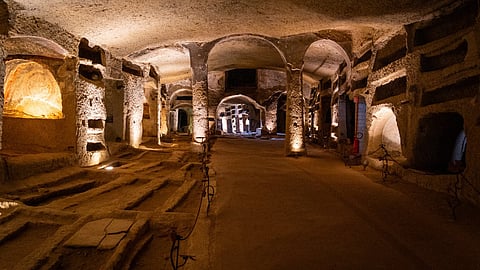
Down in the basement, mummified nobles are put back into the clothes of a century before. Dark underground tunnels stretch out beneath the spin and chaos of today’s streets, where scooters and markets and pedestrians swarm. For the most part, there’s no attempt at the theatrical. Often, even today, they are more about religious observance or reminders of the dead or local significance than about circulating tourists.
The most powerful cluster is found between Naples and Palermo, with Rome the logical high road into the whole underground history of the south. You can make the journey without a car, especially since you can reliably use the rail network to reach the key destinations within the region. Again, Rome to Naples is made easy with italotreno.com, and you can get a fast connection with plenty of time for an afternoon out.
Most of the catacombs around Rome are located on the Appian Way beyond the city’s outskirts. The Catacombs of San Callisto and San Sebastiano are the two most well-known, and both provide interesting experiences.
San Callisto’s galleries feel vast and ordered, made up of layers of narrow lava-cut passageways and the burial chambers of early Christians. The guided tours work on a tight schedule in part because the ventilation in the passageways is so efficient that things remain cool and cramped all year-round.
The experience at San Sebastiano is much more tranquil. Far fewer people opt for this site to begin their mornings, particularly early or late in the summer season. If visiting San Sebastiano, don’t shortchange the church that stands above ground as well.
You don’t have to go hiking to get to either point. Bus 118 from the city center takes you close to each. Wear sturdy shoes rather than investing in expensive gear: after rain, the Roman basoli get horribly slippery.
Close to Via Veneto, the Capuchin Crypt offers something different. Thousands of bones line the walls in symmetrical designs in the crypt beneath the church of Santa Maria della Concezione. Chandeliers, arches, patterns of flowers, all made from human remains. Some visitors spend 10 minutes there. Others devote up to an hour to admiring the details.
Be ready for photography rules, which usually ban visitors from taking photos in Rome’s crypts and catacombs. Show a respectful attitude towards the deceased, keep your phone out of sight and follow staff instructions unobtrusively.
Naples handles its subterranean side with greater fervor than most. The relationship between the living and the dead has always been closer here, and myths of the afterlife thrive, especially in the centro storico.
The star site is the Catacombs of San Gennaro, beneath Rione Sanità, southern Italy’s most important historic burial site, where long passages, early Christian frescoes and layers of burials are more impressive than most Roman examples. The accompanying tours really do illuminate the cults and history of the city without resorting to spectacle.
The Catacombs of San Gaudioso are closer to home, rather more intimate, and a little creepy, but still a mix of frescoes, skulls and burial niches, with obvious connections to all those noble early medieval Neapolitan families.
And then there’s the Fontanelle Cemetery.
A vast ossuary of thousands of skulls, split over caves carved out of volcanic rock. In times gone by, Neapolitans “adopted” an anonymous skull, keeping it clean and minding it for eternity in exchange for protection, luck or favor. Good fortune died hard in a city like this one, and traditions to preserve it often went further than you might think. And Naples excels at not scrubbing away its rough edges.
The underground Naples, or Napoli Sotterranea, is part of an entirely different itinerary through the city. The Greek foundation, the Roman aqueducts, and the blitz-defeating air raid shelters are all under the city streets choked with Vespas and laundry lines. The noise and the silence contrast sharply and form some of the best memories. Until you come back.
Metro Line 1 will connect up to almost everything, as will the buses. But there are way worse things you could find yourself doing on a luxury trip to Naples than spending extra time in Rione Sanità. Getting coffee nearby rather than bouncing between sights will be time very well spent.
Europe knows about Palermo’s Capuchin Catacombs because the bodies buried here wear clothes.
The 8,000 or so preserved bodies lined along its hallways date back to the sixteenth century, and include priests, doctors, children and nobles. None occupies the same crypt as another. Some seem mostly shorn of flesh, others still possess facial features, hair and clothing.
The experience tends to divide people very firmly into two very different camps. While some are deeply touched by the experience, overwhelmed by its sheer human-ness, others flee from the site, disturbed after just a few minutes. Both groups are fairly easy to understand.
Local buses leave from Palermo city center, taking under half an hour to arrive. Get there in the morning before the group buses do. They run only a few degrees cooler in the Catacombs than out of them, but the humidity is often very high down there in the tombs, particularly in the heat of the afternoon of the summer months.
Matera’s rock churches and catacombs are an essential pause for Basilicata passers-through. The Palombaro Lungo cistern and cavitated chapels take visitors through an underground complex that reflects the city’s earliest life in caves.
The Museo Faggiano in Lecce unwittingly exposes centuries of archaeology beneath an ordinary family house, unearthing tombs and a medieval hall during a plumbing job. In southern Italy, we are masters of the accidental find.
Bring a sweater, even in the summer. Underground temperatures drop, especially in the catacombs of Rome.
There will be steep stairs, there will be uneven ground, and there will be tight spaces. Underground accessibility is all over the map in southwestern Italy.
The cathedrals are quiet, and you should be too. Modest dress is a must at a few of these holy sites. The underground ratio. Plan to visit one or two crypts a day. That should suffice before you want to pop back into the sunlight or enjoy a coffee with sirens buzzing by.
Naples is best approached as an open-ended adventure. All you need are a few euros for coffee, comfortable shoes, and the time to follow any street that catches your eye.
Inspired by what you read?
Get more stories like this—plus exclusive guides and resident recommendations—delivered to your inbox. Subscribe to our exclusive newsletter
The products and experiences featured on RESIDENT™ are independently selected by our editorial team. We may receive compensation from retailers and partners when readers engage with or make purchases through certain links.