
- Locations
- Interviews
- Luxury Home
- Luxury Lifestyle
- Luxury Travel
- Luxury News
- Events
- More
- Magazine

The Greeks settled this coast. The Romans retired here. The Venetians built on top of both and left their stone everywhere. Croatia’s Central Dalmatia absorbed all of it without losing the essence that made it worth settling in the first place. The water, the food, the particular quality of life that convinced an emperor to build his home here and never leave. The towns still belong, in some fundamental way, to the people who live in them.
Split is where you land. Roman Emperor Diocletian built his retirement palace here in the fourth century, and the city grew around it. People live inside Roman walls, lean against ancient columns, and drink coffee in a square that was once a peristyle. It's one of the few places in the world where antiquity is neither a museum piece nor a performance. It's just where people live.
Fans of Game of Thrones will recognize the palace cellars. The underground halls that Diocletian built as storage and service corridors stood in for the dungeons of Meereen. Its cellars are worth seeing on their own terms. A Roman structure preserved almost entirely intact beneath a living city. Free of theatrical lighting, exactly as they have been for seventeen centuries.
The old town's streets today hold family-run wineries and restaurants opened inside spaces that were once Roman storage rooms, courtyards, and living spaces. But outside the palace walls stands the Riva, a broad seaside promenade facing open water. It’s the people-watching spot of the city that comes alive in the afternoons and evenings, regardless of the season. But don’t be surprised if you have to look twice to find a table, even during working hours; the locals enjoy their time in the sun.
West of the center, Marjan forest park rises above the city. The trails are easy. The climb is fulfilling. The view from the top is worth it. The whole arc of the Central Dalmatian islands laid out across the water makes you understand immediately why people have been fighting over this coast for two thousand years.
Split is also Croatia's main port. Ferries and catamarans run daily to Hvar, Brač, Vis, and Korčula, making it the base from which the rest of this coast becomes reachable. It's also the second largest city in Croatia, connected by direct flight to New York. You land here, and everything opens up from there.
Croatia has more than a thousand islands. The majority of them are in Dalmatia, and Hvar, Brač, and Vis, clustered around the central coast, are among the most visited in the Mediterranean for good reason.
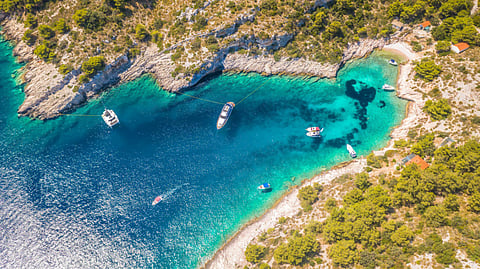
Sailors have been navigating these waters for centuries, and the cruising grounds between the islands remain some of the most sought-after in Europe for yachting and nautical tourism. The distances are manageable, the harbors are well-protected, and the seas between the islands run clear enough to see the seabed from the deck.
Straight from the boat, the summer life welcomes you. This region has produced beaches that appear on every serious list of Europe's best. Zlatni Rat on the Island of Brač extends into the sea like a narrow white horn, its tip visibly shifting direction with the current. A beach that moves, which is not something most coastlines can claim. Punta Rata in Brela sits inside a protected pine forest that kept the development at bay for decades; Forbes named it the most beautiful beach in Europe in 2004, and the forest is a large part of why that still holds. On the Island of Vis, Stiniva beach is the most dramatic of the three. A pebble cove enclosed by limestone cliffs so narrow that only small boats can pass through. Getting there is part of the experience. By foot, it's a twenty-minute descent, demanding enough that the beach rewards those who make it. By boat, you approach through the cliffs from the water, which is the way most people do it in summer. Either way, you earn it. Three beaches, three completely different ways the coast invites you.
Hvar leads the coast with around 2,800 hours of sunshine per year, and the rest isn’t far behind. Summers are long, dry, and reliably warm. But the better-kept secret is the shoulder seasons: April and May, when the sea is warming up, or October, when the light turns amber, the summer crowds are gone, and the restaurants are cooking for people who live there. Central Dalmatia is a coast that welcomes you year-round.
The food here is more than just nutrition. UNESCO protected, it follows the landscape: olive oil, fresh fish, locally grown vegetables, and wine. The cooking is simple in the way that things are simple when the ingredients are the point.
Central Dalmatia is also an established wine region, and an increasingly recognized one, with some unexpected links to the USA. Crljenak Kaštelanski, grown on the slopes above Kaštela since the Middle Ages, was confirmed by DNA research to be genetically identical to Zinfandel. The grape traveled from this coast to America centuries ago and built a wine culture that now accounts for millions of bottles a year. The original vines are still here and are still creating the magic that once made them travel across the ocean.
The Romans called it the most beautiful coast in the empire. The Venetians built their most elegant stone on it. Diocletian chose it over Rome. A grape grown on a hillside above the Adriatic turned out to be the ancestor of one of California's most planted varieties. A cave five kilometers offshore reveals an electric, impossible blue. Central Dalmatia has always been the place that gives out its best details quietly, on its own terms. Some places you visit. Some places become part of how you see everything after.
Inspired by what you read?
Get more stories like this—plus exclusive guides and resident recommendations—delivered to your inbox. Subscribe to our exclusive newsletter
The products and experiences featured on RESIDENT™ are independently selected by our editorial team. We may receive compensation from retailers and partners when readers engage with or make purchases through certain links.