
- Locations
- Interviews
- Luxury Home
- Luxury Lifestyle
- Luxury Travel
- Luxury News
- Events
- More
- Magazine

When planning an island vacation, diving trip, or snorkeling getaway, many travelers want to bring their own underwater scooter. The device itself is usually not the main obstacle. What determines whether it can fly is the lithium battery's capacity, whether the battery is installed or removable, and the airline's own policy.
The short answer is that some underwater scooters can travel as passenger baggage, but not every model qualifies. Even when a battery falls within federal limits, the airline may require advance approval or apply rules that are stricter than the general U.S. requirements.
Before buying or packing a sea scooter for a flight, check the watt-hour rating on the battery label before looking at top speed or underwater runtime.
The Federal Aviation Administration uses watt-hours, or Wh, to determine how rechargeable lithium batteries may be transported in passenger baggage.
If the battery does not list Wh directly, use this formula:
Watt-hours (Wh) = voltage (V) x amp-hours (Ah)
For example, a battery labeled 25.2V and 5Ah has a capacity of:
25.2 x 5 = 126Wh
If the label lists milliamp-hours, or mAh, divide that figure by 1,000 to convert it to Ah before multiplying by the voltage.
Under FAA passenger battery guidance updated in August 2026:
A battery in the 101-160Wh range is not automatically approved. It is simply eligible for the airline to consider. The carrier can refuse it or impose limits on quantity, packaging, or where it must be packed.
An underwater scooter typically consists of the main device and a removable battery. The two parts do not always follow the same baggage rules.
Once a lithium battery is removed from the device, it is treated as a spare battery. The FAA requires spare lithium batteries to travel in carry-on baggage rather than checked baggage. For batteries rated between 101 and 160Wh, a passenger may carry no more than two, and airline approval is required.
Each battery must also be protected against short circuits. Common methods include:
Covering the terminals with the original protective cap
Applying insulating tape over exposed contacts
Packing each battery in its own protective pouch
Keeping batteries away from keys, tools, and other metal objects
Protecting them from crushing and impact inside the bag
If the battery remains installed, the device must be completely powered off and protected against accidental activation and physical damage. Some airlines may still require the battery to be removed, so general FAA guidance should not be the only basis for packing.
The scooter body, once the battery is removed, can often be handled as ordinary sports equipment. It still remains subject to the airline's weight, size, and special-item policies.
Do not wait until you reach the airport counter to ask. For any battery over 100Wh, contact the airline's dangerous-goods or special-baggage department as early as possible after booking.
Have the following information ready:
Device name and model
Battery chemistry
Voltage, amp-hours, and watt-hours
Whether the battery can be removed
Number of batteries being carried
Whether each item will be in carry-on or checked baggage
Dimensions and weight of the device body
A photo of the product manual or battery label
Describe the item as a "battery-powered underwater scooter" or "personal underwater propulsion device." Calling it only a "scooter" can cause confusion with a land-based electric scooter or mobility device, which may be handled under different rules.
After receiving approval, keep the airline's email, customer-service record, or reservation note. Airport staff may inspect the item again, but written confirmation helps show that it was declared in advance.
Passing TSA screening does not guarantee that the airline will accept the equipment. TSA handles security screening, while the airline determines whether dangerous goods and special baggage meet its transport policy.
Underwater scooters are routinely exposed to saltwater, pool chemicals, and sand, so the return trip can create more packing problems than the outbound flight.
After use, rinse the device with fresh water as directed by the manufacturer and let the battery, charging area, and connectors dry completely. Do not charge the battery while the connections are damp, and do not seal a freshly removed wet battery inside luggage.
Before packing, check whether:
The battery is swollen, cracked, or deformed
The terminals show corrosion, salt, or moisture
The housing has suffered an impact
The device can be fully powered off
The battery label remains readable
A damaged, swollen, water-compromised, or recalled lithium battery should not be handled as ordinary baggage. Stop using it and contact the manufacturer or a qualified local recycling service rather than attempting to take it through airport security.
Pack the charger separately from the scooter and confirm the plug type and voltage at the destination. The return flight requires the same battery review as the outbound trip. Approval from one airline does not automatically apply to another carrier on the way home.
Flights within the United States must follow FAA and Department of Transportation requirements. International itineraries may also be affected by the rules of the departure country, connection airport, destination, and operating airline.
Codeshare flights deserve special attention. The airline that sells the ticket may not be the airline operating the aircraft, and the operating carrier's dangerous-goods policy will generally control.
For a multi-segment trip, confirm:
Which airline operates each flight
Whether each carrier accepts batteries in the 101-160Wh range
Whether separate approval is required for each segment
Whether checked baggage must be reclaimed and rechecked during a connection
Whether the destination restricts the import or use of underwater propulsion devices
Do not conceal the device type or describe it inaccurately to avoid review. A denied boarding decision is only one possible consequence; an improperly packed lithium battery also presents a genuine fire risk.
Frequent flyers need to balance performance against ease of transport. A larger battery may provide longer runtime, but it may also exceed passenger baggage limits. A removable battery can be easier to protect and declare, yet it still needs a clear capacity label and airline approval when required.
Weight and size also affect the trip. Even if the battery qualifies, an oversized scooter body may trigger extra baggage charges. For beach, resort, and snorkeling travel, a design that is easy to dry, disassemble, and repack may be more practical than one built only around maximum speed.
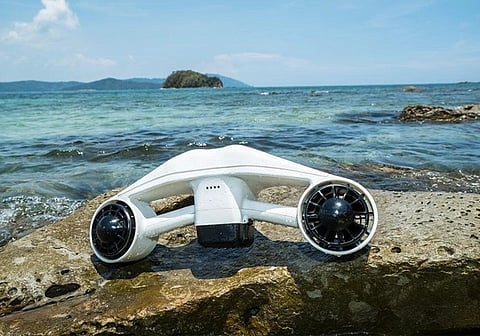
The ASIWO MANTA provides a useful example. Its current specifications list a removable 25.2V, 5Ah battery, which equals 126Wh, and a total device weight of about 7.7 pounds including the battery. Because 126Wh falls within the FAA's 101-160Wh range, it may be accepted with airline approval, but travelers should not assume they can carry it without confirmation.
Whether an underwater scooter can go on a plane ultimately depends on its battery capacity, packing condition, and the operating carrier's policy, not the product name alone. Calculate the watt-hours first, obtain approval when required, and pack a removable battery according to spare-battery rules before heading to the airport.
Inspired by what you read?
Get more stories like this—plus exclusive guides and resident recommendations—delivered to your inbox. Subscribe to our exclusive newsletter
The products and experiences featured on RESIDENT™ are independently selected by our editorial team. We may receive compensation from retailers and partners when readers engage with or make purchases through certain links.