
- Locations
- Interviews
- Luxury Home
- Luxury Lifestyle
- Luxury Travel
- Luxury News
- Events
- More
- Magazine

A beautiful, wonderful wedding can still leave a bad taste in your guests’ mouths—if it leaves them hungry.
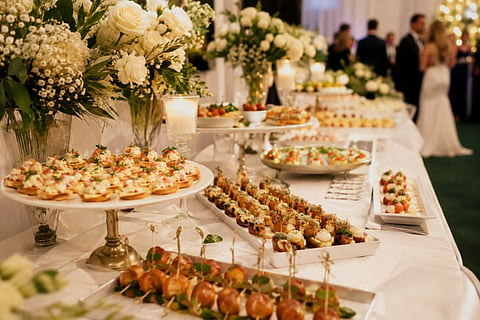
Because the truth is, what most people tend to remember best about any event is the food. Not the custom monogram on the cocktail napkins or the imported peonies. Not even the dress, sometimes. Food.
And that’s partly why food has become such a major focus this year. Couples are putting more thought into what guests actually experience over the course of six or seven hours rather than concentrating every decision around a handful of photographs.
As a result, most weddings this summer (as well as last summer) feel more personal and less predictable. And, perhaps more importantly, much more fun for the guests than they were a decade ago.
Until relatively recently, wedding food typically followed a universal script.
You chose chicken, fish, or beef, added a salad, and rolled out a slice of cake around 9 p.m. Neat and sweet. Also... forgettable, to say the least.
Now, of course, that formula still exists, but fewer couples are interested in it. Instead, menus increasingly borrow from family traditions, favorite restaurants, cultural backgrounds, or places that matter to the couple. Maybe the first date happened at a tiny taco spot; have tacos at the wedding. One side of the family has been making the same dish for three generations? Serve it at the wedding.
These details now show up on wedding menus all the time. Why? Well, firstly, because they carry meaning for the couple. Secondly, guests notice when a menu has fingerprints on it, and they remember it.
This sounds obvious, but it's surprising how often people overlook it.
Summer naturally offers ingredients that need less manipulation. Tomatoes are so much better, and so is stone fruit. Herbs, too. Use that to your advantage.
And there's another reason local sourcing keeps gaining traction. Guests have become more aware of where food comes from. Not obsessed with it, necessarily, but curious. A menu that incorporates regional ingredients feels connected to the location rather than parachuted in from a generic luxury event template.
A lot of wedding trends come and go because they photograph well.
But, for example, interactive food stations have stuck around. Why do you think that is? Simple: people genuinely enjoy them.
Give guests a fresh pasta station, a raw bar, a live-fire grilling setup, or a chef assembling small plates to order, and watch the magic unfold: people start talking and connecting to each other. Even strangers.
This is particularly valuable at weddings, where half the room often arrives without knowing the other half. Food really is an icebreaker. Nobody announces it that way, but that's often what it's doing.
A few years ago, many signature cocktails were basically renamed versions of existing drinks. The "His & Hers" cocktail trend became so common that it started feeling obligatory (some may even say dumb).
Now, beverage programs are becoming more thoughtful. For instance, many couples now build cocktail menus around meaningful destinations. Others feature non-alcoholic pairings that receive the same attention as the wine list.
The latter is especially thoughtful because guest expectations have changed. People who don't drink increasingly expect options beyond sparkling water with a lime wedge floating around in it.
There's a flip side to personalization: namely, the more customized a wedding becomes, the harder it is to execute well. Formulas exist for a reason, after all.
But that doesn't mean formulaic and generic is the way to go. Why would you, when there are plenty of experienced catering teams nowadays who can help create that "unforgettable dining experience"?
For example, Culinary Crafts has built its business model around that approach. The goal isn't simply to serve excellent food. It's to create dining experiences that feel connected to the couple, the location, and the overall atmosphere of the event without making any of it feel forced.
That's harder than it sounds. Most guests will never see the planning required to pull it off, but that's usually a sign that things went according to plan.
The truth is, wedding trends change every year. Even food trends change every season. But there's one thing that stays remarkably consistent: guest psychology.
People enjoy feeling considered. They appreciate thoughtful choices. And they remember moments that feel personal rather than mass-produced.
That's why so many summer weddings are moving toward dining experiences that reveal something real about the couple instead of chasing whatever happens to be trending online that month.
Of course, a great meal won't replace meaningful relationships, good music, or a packed dance floor. But it has a wonderful ability to tie everything together.
Inspired by what you read?
Get more stories like this—plus exclusive guides and resident recommendations—delivered to your inbox. Subscribe to our exclusive newsletter
The products and experiences featured on RESIDENT™ are independently selected by our editorial team. We may receive compensation from retailers and partners when readers engage with or make purchases through certain links.