
- Locations
- Interviews
- Luxury Home
- Luxury Lifestyle
- Luxury Travel
- Luxury News
- Events
- More
- Magazine

Dave Tourjé doesn't talk about collecting the way most collectors do.
For him, it was never really about ownership. It was about noticing things before other people did — objects, artists, ideas, entire scenes — and understanding why they deserved to stick around.
Think about what a concert poster is before anyone decides it matters. It's paper. A customized car is just transportation. A guitar is a tool. Graffiti gets painted over. The artist working three blocks outside the mainstream might be beloved on his street and completely unknown to the institutions that eventually get to decide what belongs in the historical record.
Then a decade goes by. Two decades. The poster becomes a collector's item. The underground band ends up on a museum wall. The throwaway thing develops a provenance and an auction price.
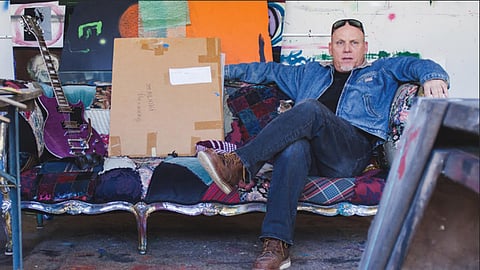
Dave Tourjé — Los Angeles artist and cultural preservationist — has spent most of his career living in that earlier moment, before any of that flipping happens.
He collects, sure. Artwork, guitars, music memorabilia, automotive culture, architecture, film, archives — his world covers a lot of ground. But ask him why any particular thing caught his attention and the answer almost never has to do with rarity or investment potential. It's the story behind it. The culture that built up around it over time.
The collections that actually mean something aren't just expensive things lined up in a room. They're a point of view.
Growing up in Southern California, Tourjé was surrounded by places where different creative worlds ran into each other constantly. Fine art, surf shops, punk venues, skate culture, hand-lettered signs, custom cars, record sleeves, graffiti, garage rehearsals — museums kept those things in separate categories. Out on the streets of Los Angeles, they were always mixing.
His own work reflects that. Symbols, figurative images, surfing references, graphic marks, lettering, geometric shapes, nods to subcultures that don't always get written into the official art history — it doesn't sit neatly in any one box. Neither does his collection.
Paintings live next to guitars because, to Tourjé, they come from the same place. The point isn't any single object. It's the thread between them.
He once said he feels a genuine need to be surrounded by great art. Not "enjoy" or "appreciate" — need. That's the word he used. He keeps the work close because it keeps something running in him. A lot of collectors keep their best pieces at arm's length. Tourjé does the opposite, because for him the whole point is what happens when the work is right there.
At some point, anyone who collects seriously enough runs into a question they weren't expecting: okay, you own this thing — now what do you owe it?
Tourjé's career keeps landing on that question from different directions.
Through the Chouinard Foundation, he has worked on preserving the legacy of the Chouinard School of Art — one of the most influential art schools in American history — and its founder, Nelbert Chouinard. His films have documented artists and musicians who might otherwise drop out of the record entirely. His architectural projects have included significant Southern California properties. And the California Locos, which he helped found, brought together artists from graffiti, rock graphics, performance, surf culture, and the broader visual history of Los Angeles into one shared contemporary space.
Every one of those projects runs on the same instinct. Find something that matters, figure out where it came from, protect the story, and then work out how to keep it moving.
That's a different thing from nostalgia. Nostalgia wants things frozen. What Tourjé does keeps asking how something from the past stays genuinely alive right now — not behind glass, but out in the open and still doing something.
Take something from an underground scene, hang it in a museum, and the object is exactly the same as it was. Everything else around it — the frame, the audience, what it means — that's what shifts.
That's what's happening in May 2027, when the Fullerton Museum Center presents LOCOS X, bringing the California Locos together with legendary Los Angeles punk band X. Historic and new artwork, archival material, live music, hot rods, and lowriders — all in the same space.
Here's the thing though — these cultural forms didn't just arrive at a museum on their own merit. Most of them spent years being shoved aside by the official art world, treated as too street-level, too commercial, too underground to take seriously.
Punk flyers weren't designed to be archived. Custom cars weren't built for white gallery walls. Surf and skate graphics were commercial work before anyone thought to call them culturally significant. Graffiti had its own long and complicated road toward any institutional recognition at all.
But time reshuffles those judgments. It always does.
Tourjé has spent his career working right in that gap — between when something gets made and when the institutions finally come around. LOCOS X isn't a victory lap. It's just where the process has gotten to.
The collectors actually worth paying attention to got there first. They knew why something mattered before the price moved, before anyone wrote about it, before the art world decided it was safe to care about.
You can look at market prices, check the provenance, read the auction history. None of that gets you to why something actually matters. That's a different kind of knowledge altogether — built from years of being inside a scene, not reading about it afterward.
Tourjé's feel for Southern California culture came from inside it. He played in the Los Angeles underground music scene. He made art. He spent real time around surfers, skaters, designers, builders, musicians — back when most of those scenes were just scenes, not heritage.
That's where his eye comes from. And it's why things that seem completely unrelated can end up belonging together in his world. A painting, a guitar, a hot rod, a piece of music memorabilia — different histories, different markets, but one cultural story running underneath all of them.
A collection built that way starts to feel like a record of what someone actually paid attention to. Not what they could buy. What they chose to notice.
There are two versions of luxury and they're moving further apart.
One is easy to read — price, rarity, craft, exclusivity. You know it on sight.
The other one is harder to spot. Caring about something before anyone told you to care about it. Knowing the actual history behind an object rather than just what it sold for last time. Sitting with something privately for years and working out when the right moment comes to bring it somewhere bigger.
Tourjé has been building that second version for a long time. The paintings continue. So does the music, the films, the preservation work, the California Locos exhibitions. Underneath all of it is a personal archive of Southern California culture that keeps growing because he genuinely doesn't want it to disappear.
Maybe that's why the word collector never quite fits him.
Collectors accumulate objects. What Tourjé has been building is something closer to a network of connections — art to music, streets to institutions, artists to audiences, the past to whatever is still coming. That might actually be the harder thing to put together.
Inspired by what you read?
Get more stories like this—plus exclusive guides and resident recommendations—delivered to your inbox. Subscribe to our exclusive newsletter
The products and experiences featured on RESIDENT™ are independently selected by our editorial team. We may receive compensation from retailers and partners when readers engage with or make purchases through certain links.