
- Locations
- Interviews
- Luxury Home
- Luxury Lifestyle
- Luxury Travel
- Luxury News
- Events
- More
- Magazine

At a Glance
The Frick Collection opens Kent Monkman: Officer and Laughing Girl on November 12, an installation of five new paintings by the Cree artist that respond to one of the museum's three paintings by Johannes Vermeer. The series hangs in the intimate Cabinet Gallery through February 22, 2027, and Vermeer's Officer and Laughing Girl (ca. 1657) stays on view nearby in the permanent collection galleries, so a single visit takes in both.
Monkman (b. 1965) builds his practice around historic European art and the narratives it carries, read from an Indigenous perspective. Here he returns Vermeer and his contemporaries to the context they actually worked in: a period of avid global trade and colonization.
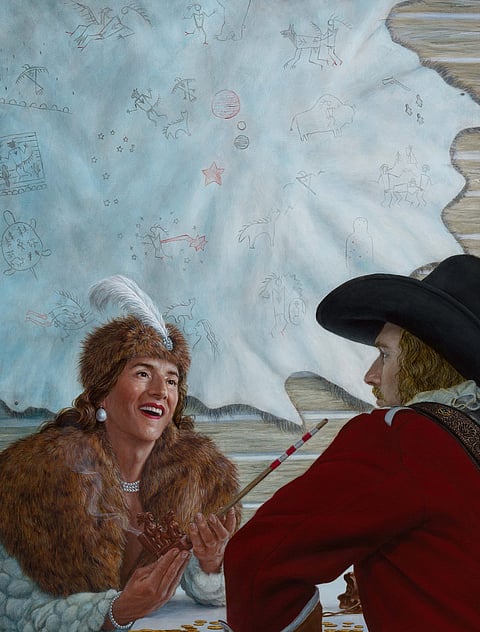
The series is carried by Monkman's alter ego, the time-traveling, shapeshifting, gender-fluid Miss Chief Eagle Testickle, whose name plays on the words mischief and egotistical. In every painting she sits in a room much like the one in Vermeer's canvas and presents a carved pipe to a male sitter across the table.
Monkman inverts the figures and puts an Indigenous perspective at the center of the exchange. Each work takes a century, from the 1600s to the present, and the palette warms from cool to hot tones as the series advances, a reflection of rising global temperatures.
I have long admired how Kent brings lesser-known histories to light in his art, which grapples with complex topics while celebrating beauty, irreverence, and humanity's critical connections with each other and with the earth.
Aimee Ng, Peter Jay Sharp Chief Curator, The Frick Collection
Symbols of exchange run through all five canvases: animal skins, beads, feathers, coins, guns, gold, trade silver, a red point blanket, a crucifix and a handheld glass silhouette that recalls an iPhone.
New Amsterdam opens the series and follows Vermeer's composition most closely. Miss Chief, adorned with furs and pearls, faces a Dutch officer in a beaver-felt hat who offers gold coins in the capital of New Netherland, on the southern tip of Manhattan Island. Where Vermeer hung a map, Monkman hangs a Winter Count, the pictographic record kept by the Lakota and other Plains nations, in which elders choose one event to stand for each year.
New France brings in a figure resembling Samuel de Champlain, who carries a musket and gunpowder. The chart on the wall is a modified 1722 French map of Hudson Bay, its outline exaggerated with Monkman's humor. Miss Chief wears seven trade-silver beaver pendants, and a red point blanket from the Hudson's Bay Company drapes her shoulder.
In Black Hills, Miss Chief appears in the red dress of a nineteenth-century saloon girl opposite a man who resembles General George Armstrong Custer, with a small gold-framed portrait of Sitting Bull in view. The gold nuggets on the table point to the 1874 discovery of gold in the Black Hills and the conflict that followed in 1876.
Reservation represents the twentieth century, with a Catholic priest holding a gold crucifix, an image that evokes the history of Christian residential schools. Manhattan closes the series in a sweltering present-day interior, where a nameless tech executive, drenched in sweat, holds a glass rectangle that resembles a cellphone.
In the Cabinet Gallery the five paintings hang against a "Beaver Baroque" wallpaper that Monkman designed and had hand-printed in Brooklyn. Its beavers enjoy a glass of wine, paint figures and dance.
I hope these paintings inspire curiosity and fill in some of the missing narratives in our shared histories.
Kent Monkman
The animal is the thread that ties Monkman's series to Vermeer's painting. The Dutch traded and shipped the American beaver to Europe, where it had been hunted to near extinction, and it became the most significant resource extracted from New Netherland. That haul peaked in 1657, around the time Vermeer painted Officer and Laughing Girl.
A bilingual English and Canadian French catalogue accompanies the exhibition, published by the Frick in association with D Giles Limited. It includes contributions by Monkman, Aimee Ng and Emma Hassencahl-Perley, Curator of Indigenous Art at the Beaverbrook Art Gallery, along with extracts from The Memoirs of Miss Chief Eagle Testickle by Monkman and Gisèle Gordon.
Public programs include a lecture by Monkman, a library workshop, and close-looking conversations and studio sessions led by Frick educators. After New York, the series travels to the Beaverbrook Art Gallery in Fredericton, New Brunswick, in spring 2027.
The Frick Collection, at 1 East 70th Street, is open Wednesday through Monday from 10:30 a.m. to 5:30 p.m. Timed tickets are recommended, pay-what-you-wish admission is offered Wednesdays from 1:30 to 5:30 p.m., and only visitors ages 10 and older are admitted. Details are at frick.org.
Inspired by what you read?
Get more stories like this—plus exclusive guides and resident recommendations—delivered to your inbox. Subscribe to our exclusive newsletter
The products and experiences featured on RESIDENT™ are independently selected by our editorial team. We may receive compensation from retailers and partners when readers engage with or make purchases through certain links.