
- Locations
- Interviews
- Luxury Home
- Luxury Lifestyle
- Luxury Travel
- Luxury News
- Events
- More
- Magazine

In the early 2000s, Vanessa Getty, a San Francisco native and philanthropist with decades of experience in animal welfare, began paying closer attention to what was actually happening inside Northern California county shelters. What she found was sobering: euthanasia rates were skyrocketing upwards of 90 percent in some places due to overpopulation. Shelters were bursting at the seams, struggling to find resources, and more animals were dying.
She zeroed in on the Sacramento County shelter, where the problems of overcrowding were a systematic issue, fueling the highest euthanasia rates. It provided a real snapshot into how broken the system had become. In addition to high kill rates, there was evidence of adoptable animals being sold to UC Davis for research.
"It was heart-wrenching," Getty recalled. "If there was an animal with a red X on its cage, it meant that specific animal was not available for adoption to the general public and would likely be euthanized. Only certain rescue groups would be allowed access to these animals. The criteria for an animal failing an assessment was often something as simple as a mother dog who growled when someone grabbed her puppy in a high-stress environment. Most animals never made it out of there."
Getty started the dog rescue program at Pets Unlimited in San Francisco with the belief that when given the chance, most of these animals were highly adoptable. She drove up to Sacramento to gauge the situation firsthand, and what she saw was devastating. The animals were in serious crisis, suffering unnecessarily while living in deplorable conditions.
She was spurred into action and immediately began mobilizing with Pets Unlimited to rescue as many animals as possible. Along with a crew of veterinarians and volunteers, they focused on pulling those animals labeled as "unadoptable"—the ones who didn't have a chance. Eventually, her work was profiled in an exposé by the San Francisco Chronicle that called attention to the reality of what was really happening to the shelter animals of Sacramento County. As a result, many animals were successfully adopted, and the Sacramento shelter was put in the spotlight for its deplorable conditions and for selling adoptable animals for research.
Though the story brought much-needed attention to the plight of shelter animals, Getty was already thinking further upstream. A single news story could only move the needle once.
So she started asking a different question: where does the problem actually begin?
The answer, she concluded, was helping to prevent the unwanted births that lead to overpopulation in already crowded shelters with exploding euthanasia rates. The financial barrier was preventing many from being able to spay and neuter their pets, so she decided to start at the beginning.
Spaying or neutering a pet in the Bay Area routinely costs $400 or more, not including vaccinations. For many pet owners, particularly in lower-income communities, it was cost-prohibitive, and in many cases, geographically difficult to access veterinary care. Without affordable access to spaying and neutering, many animals would continue to remain unsterilized. Litters multiplied. Shelters filled up. The cycle continued.
What also didn't exist, Getty noticed, was any kind of mobile outreach to meet the needs of those who had no way to physically access or afford veterinary care. In order to address the issue of inaccessibility, you would need to find a way to bring help directly to these communities.
In 2005, Getty founded San Francisco Bay Humane Friends under the umbrella of the Peninsula Humane Society. She immediately got to work raising money to purchase and outfit a mobile veterinary vehicle. The program did exactly what she envisioned: it drove into communities all over the Bay Area, bringing outreach to those who needed it most. They would alert a community in advance as to when the mobile medical unit would arrive, and SF Bay Humane Friends would cover the cost of spaying, neutering, and vaccinating their animals.
"We would advertise when we were coming, and people would be lined up by the time we arrived," Getty said. "There was so much need."
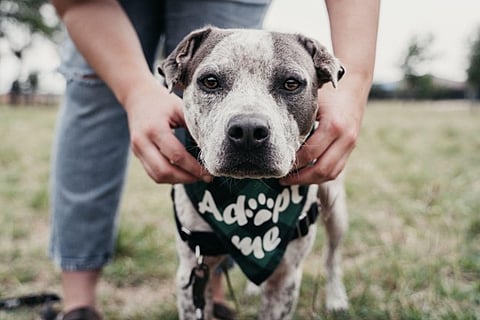
Positive results came quickly. In San Francisco, the number of pit bulls being surrendered to SF Animal Care and Control began to fall, illustrating the importance of community outreach in spaying and neutering. It was helping to tackle the problem before it could begin, by preventing the birth of more unwanted animals who would otherwise end up being euthanized at California shelters.
One thing Getty understood early was that animal welfare has many facets, and if you are striving for sustainable impact, you need to understand how all the pieces fit together.
County shelters often find themselves at the center of the problem. Anytime a stray is found, it must be processed through the county shelter before it can be adopted out to any rescue organization or private shelter. Often, private rescue groups are the animal's only chance for adoption. Depending upon the capacity of an already overcrowded shelter, and in addition to undergoing a stressful, split-second assessment to determine their fate, these animals are precluded from being available for adoption to the general public — and more often than not, it results in an automatic death sentence for them.
"You can't necessarily simply walk in and adopt any dog," Getty explained. "Shelters may determine an animal is 'unadoptable' even though it might be the sweetest, most gentle thing, and in those cases, only a rescue group can adopt them."
Getty chose to work with the Peninsula Humane Society because it acts as more than just an average county shelter. They also rescue and adopt out wildlife, and take in animals displaced by natural disasters. When Hurricane Katrina hit in 2005, the Peninsula Humane Society took in planeloads of displaced animals from the Gulf Coast. They consistently maintain high adoption rates and do not euthanize adoptable animals. Getty is currently working with PHS on building an animal sanctuary in Half Moon Bay that aligns with her mission to save as many animals as possible while expanding the definition of what makes an animal adoptable.
The Peninsula Humane Society is fortunate to have access to resources that many shelters do not, due to a lack of funding. To understand the system is to identify its limits. And those limits, Getty discovered, were being tested most acutely far outside San Francisco.
Getty has recently turned her attention to California's Central Valley, home to some of the most under-resourced animal shelters in the state, where many lack veterinary care and transportation infrastructure. Many of these shelters are remote, making their work with rescue groups even more difficult.
She is now working with the San Francisco SPCA to support those Central Valley shelters by providing much-needed medical care and facilitating the transfer of animals up to the Bay Area, where adoption rates are dramatically higher and infrastructure is stronger. The most recent effort brought roughly 100 animals up from the Central Valley.
"We are fortunate the circumstances are so much better up here," she said. "Some of these shelters are so remote and lack the funding for medical care and transport."
Getty's goal is to help create more reliable pathways between rescue groups and rural shelters, extending spay-neuter services further into communities where the need is great but access is limited. A single sterilization surgery costing $400 might feel more like $4,000 in a community where veterinary care is hours away and household budgets are already exhausted.
It would be easy to describe Vanessa Getty's role in Bay Area animal welfare as that of a generous donor and capable fundraiser. That framing isn't wrong. She has raised substantial amounts for these causes, creating events that directly benefit animal charities, including the luxury PURR resale events that generated hundreds of thousands of dollars to fund the mobile spay-neuter program at its inception, along with hosting various events and doing active board work. But it undersells something important.
Getty is not one to work the charity circuit and simply write checks. Instead, she has quietly been building a network to help animals for over twenty years. From starting the dog rescue program at Pets Unlimited before it was bought and converted to a private pet hospital, to filling the gaps in mobile veterinary access by building a vehicle-based outreach program with the Peninsula Humane Society, she continues to expand her work—helping to build a large animal sanctuary with PHS while also working with the SPCA to help animals in California's Central Valley.
For Getty, philanthropy is not a hobby. It is a lifelong commitment to helping animals, and one that continues to expand.
"I was agonizing over all the ones we couldn't save," she said, reflecting on the early days of learning how shelters worked.
The answer she landed on was helping to provide greater accessibility to spaying, neutering, and vaccines. It is one of the most effective ways to combat the growing number of unwanted animals being euthanized at such an alarming rate. As the geography of her outreach has expanded, the complexity of the problems has grown. The logic, however, remains the same: find the earliest point of intervention and provide the necessary resources.
Getty has five rescue animals of her own. She talks about them with the same warmth, humor, and casual intimacy one might use to talk about family members. Her philanthropic work sustains her in a way that is hard to manufacture.
"This is something that really fills me up," she said. "Helping in a hands-on way makes me feel good. It will always be a driving force in my life."
For the Bay Area's animal welfare community, that quiet motivation has made a concrete and lasting difference. Fewer animals are dying in shelters than would have without the mobile spay-neuter program she helped create, and more animals and their owners are being helped in under-resourced communities.
Over the past twenty years, Vanessa Getty has worked hard to build a network dedicated to saving more animals. And she hopes to help many, many more. She is just getting started.
Inspired by what you read?
Get more stories like this—plus exclusive guides and resident recommendations—delivered to your inbox. Subscribe to our exclusive newsletter
The products and experiences featured on RESIDENT™ are independently selected by our editorial team. We may receive compensation from retailers and partners when readers engage with or make purchases through certain links.