
- Locations
- Interviews
- Luxury Home
- Luxury Lifestyle
- Luxury Travel
- Luxury News
- Events
- More
- Magazine

At a Glance
For designer and entrepreneur Adriana Castro, every creation tells a story. Rooted in her Colombian heritage and brought to life through the hands of artisans around the world, her namesake brand celebrates the beauty of craftsmanship, the power of memory, and the lasting connection between objects and the people who treasure them.
Adriana Castro’s journey into design was anything but conventional. After studying Economics at Purdue University, she pursued accessory design in Miami, discovering a creative language that would ultimately bring together her love of culture, craftsmanship, and storytelling.
“I began Adriana Castro because I wanted to bring Colombian artisan work into objects that could transcend time, tell stories, and be carried for generations,” says Castro, who was born in Colombia and has lived in the United States since 2000. Today, her life unfolds between Miami and New York, where she continues to build a brand deeply connected to her roots while embracing influences from around the world.
“Colombia has always been present in what I create,” she explains. “My Colombian upbringing shaped my sensibility; living abroad and traveling expanded it.”
At the heart of Adriana Castro is a profound appreciation for the relationship between craftsmanship, place, and cultural identity. The brand encompasses handbags, accessories, and home pieces created in collaboration with artisans in Colombia, Spain, Italy, and India, with each tradition bringing its own perspective to the work.
“Colombian culture is the starting point,” Castro says. “What makes its craftsmanship unique to me is the relationship between the hands, the land, and the stories behind each technique. Natural fibers and distinctive patterns carry knowledge passed down through generations. They hold the identity of the communities that create them.”
Her designs are equally informed by personal memories and the cultural richness of her upbringing. “Many memories eventually became an inspiration for my designs and shapes. The landscapes I grew up with, music, literature, and family stories found their way into the pieces. Creating became my way of expressing that sensitivity and giving each object a personal touch.”
That emotional connection is central to the brand’s identity. Rather than designing simply to make a statement, Castro hopes her creations become meaningful companions in the lives of those who own them.
“I want people to feel drawn to a piece before they can quite explain why,” she says. “It may be the relationship between a shape and a texture, the depth of a color, or the way a material feels in their hands. As they live with it, I hope that first attraction becomes affection and part of their being, something intimately connected to their identity and their life.”
For Castro, beautiful objects possess an emotional presence that extends far beyond their original purpose. “We associate them with people, places, and particular chapters. My hope is to continue to create pieces that invite that attachment, becoming more meaningful through the years and the memories they hold.”
Her creative sensibility has been shaped by literature and music as much as by fashion and design. One of her most significant influences is Colombian Nobel laureate Gabriel García Márquez, whose magical realism brings extraordinary experiences into the fabric of everyday life.
“I am fascinated by the paradoxes in his work: solitude and love, the familiar and the fantastical, the way a memory can feel more present than the moment we are living,” she says.
The poetry of vallenato, a musical tradition from Colombia’s Caribbean region, also informs her work, alongside the colors, textures, and landscapes she remembers. Travel has further expanded her perspective, introducing new ideas through architecture, art, and other cultures.
“Designing allows me to give these impressions a form,” Castro explains.
That distinctive point of view is particularly evident in the brand’s Zenú collection, a family of bags and accessories inspired by the sombrero vueltiao, a traditional Colombian hat woven from caña flecha, a locally grown plant fiber. The hat reflects the ancestral weaving knowledge of the Zenú Indigenous people, whose patterns carry cultural meaning and identity.
“Working with Zenú artisans, I have explored how that heritage can take new shapes while preserving its connection to its origins,” she says. “The artisans I have grown fond of are essential to the process. Their knowledge gives depth to what I imagine and create.”
It is this balance between honoring tradition and exploring contemporary design that helps distinguish Adriana Castro in the luxury market. Her approach is deeply personal, yet grounded in an enduring philosophy: create thoughtfully, respect the hands behind the work, and make pieces that remain relevant over time.
“I also design with a long life in mind,” she says. “Proportion, function, materials, and finishing matter because I want each piece to remain relevant as it is used, loved, and passed from one generation to another.”
Storytelling is woven into the brand in more intimate ways, too. La Marguerite carries the memory of her grandmother Margarita, while El Río de la Vida draws inspiration from Colombia’s Magdalena River, with fishing nets and boats informing the construction and shapes of the pieces.
“Storytelling is part of how I create. It gives an idea its emotional foundation,” Castro says. “I like that a story can be present quietly. You can appreciate a piece for its beauty and later discover what inspired it.”
For her, the creative process does not end when a design leaves the studio. In many ways, that is when its next story begins.
“A handbag leaves our hands and begins to hold another person’s memories. That continuation is one of the most beautiful aspects of creating objects.”
Building a luxury brand around such a personal artistic vision has also taught Castro important lessons about entrepreneurship. Among them is the importance of protecting her creative identity, particularly in an industry where not every idea will resonate with every audience.
“When your work is personal, rejection can feel personal too,” she reflects. “Early on, I had to learn that one buyer or one opinion could not define the value of what I was creating. You keep learning, refining, and finding the people who understand your vision.”
She has also come to appreciate the importance of time, both in craftsmanship and in life. Handmade work requires patience, experimentation, and an openness to possibilities that cannot always be anticipated. Her background in Economics provides a practical foundation for running the business, but she believes creative freedom depends on respecting the process.
“I begin with the creative intention: what I want to express and what makes a piece worth creating,” she says. “The balance comes from caring for the whole process. I want to create with freedom while making thoughtful decisions that allow the work, and the people behind it, to continue.”
Today, Castro is increasingly exploring the relationship between fashion, interiors, and the spaces people inhabit. A sculptural handle, a woven surface, a textile, or an object for the table can share a common sensibility even when serving very different purposes.
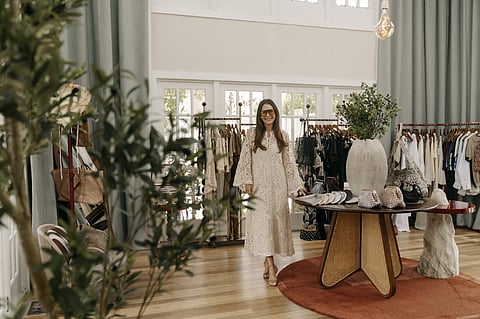
That vision came to life at Chez Adriana Castro in Southampton, created in collaboration with Bea Pernía. The space brought together handbags, home pieces, textures, and collected objects, allowing visitors to experience the brand as a broader creative world rather than simply a fashion label.
“I am drawn to the relationship between objects and the spaces we inhabit,” Castro says. “Exploring those connections has opened up another dimension of my work.”
She continues to find inspiration in unexpected places. “A song, an aroma, a landscape, a feeling, personal circumstances. Inspiration often begins before I know what it will become.”
Looking back, Castro points to several milestones that have helped define her journey. Receiving the key to the city of Miami was particularly meaningful, representing the connection she had developed with the place where she pursued her dream. Another unforgettable moment came when five of her handbags appeared in Sex and the City 2.
“At the premiere in New York, I watched pieces brought to life with our artisans become part of a world I had admired on screen,” she recalls. “It was extraordinary to see how far an idea could travel.”
Early recognition through the Audience Fan Favorite award at the Independent Handbag Designer Awards also encouraged her to continue developing her vision. Beyond fashion, she has shared her perspective on artisanship and its broader cultural significance at the United Nations’ Latino Impact Summit in New York and during International Youth Week in Nairobi.
Her summer pop-ups in the Hamptons have become another expression of the dream that started it all, offering opportunities to bring her creative world directly to customers. Most recently, Chez Adriana Castro at Capri Southampton expanded that vision through a collaboration that united fashion, craftsmanship, and interiors.
“Looking back, what moves me is that each of these moments began as something I could only imagine,” she says.
As she looks toward the future, Castro plans to continue exploring home, bespoke creations, and collaborations that allow her artistic language to evolve. She is particularly interested in bespoke design because of the personal exchange it creates between designer and client.
“A piece can begin with their memory, their choice of color, or something they want to carry with them,” she explains.
She is also entering a new chapter with Valterego Studios, a creative venture she cofounded with Valeria Quintana. The studio helps founders uncover the essence of their visions and express them through strategy, storytelling, design, and experience.
“After years of translating my own stories into objects, I am enjoying the opportunity to help others discover and express theirs,” Castro says. “It is another way for me to create, drawing on the sensibility and experience I have developed through Adriana Castro.”
Ultimately, what matters most to Castro is the opportunity to bring Colombian craftsmanship to an international audience while honoring the people and traditions that make it possible. Her work with Zenú Indigenous artisans holds particular significance, but her appreciation extends to the artisans in every country who contribute their knowledge and skill to the brand.
“Working with Indigenous communities, particularly the Zenú artisans, has given that purpose a deeper meaning,” she says. “Their weaving carries generations of history. Translating those techniques into contemporary objects is a way to honor that heritage and contribute to its continuity through work that people can appreciate and treasure.”
The philosophy that connects these experiences is captured in two simple words: Carry a Dream.
“I have always thought of a handbag as a small universe: it carries what we need, what we cherish, and sometimes what we keep only for ourselves. A dream holds a universe too, filled with hopes, memories, and the life we imagine.”
She acknowledges that pursuing a dream is not always easy. Life changes, circumstances shift, and the path forward rarely looks exactly as expected.
“Carrying a dream can feel heavy at times,” she says. “Life changes while we pursue it. For me, ‘Carry a Dream’ is a reminder to keep holding on to what matters while allowing it to evolve.”
It is a philosophy that reflects not only the evolution of Adriana Castro but also the designer herself: a woman whose journey has been shaped by cultural heritage, creative curiosity, and a commitment to making objects that carry meaning.
“I want to continue creating pieces that carry this meaning, objects that preserve something of their origins, gather new stories, and can be passed from one generation to the next.”
To discover more, visit adrianacastro.co and follow @adrianacastro on Instagram.
Inspired by what you read?
Get more stories like this—plus exclusive guides and resident recommendations—delivered to your inbox. Subscribe to our exclusive newsletter
The products and experiences featured on RESIDENT™ are independently selected by our editorial team. We may receive compensation from retailers and partners when readers engage with or make purchases through certain links.