
- Locations
- Interviews
- Luxury Home
- Luxury Lifestyle
- Luxury Travel
- Luxury News
- Events
- More
- Magazine

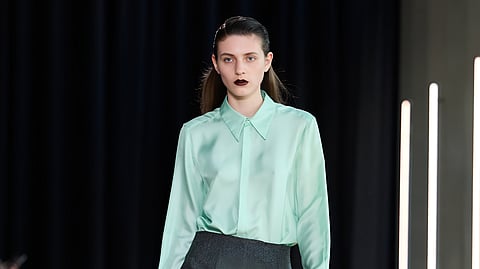
This season, SASUPHI presented its Autumn/Winter 2026 collection during Milan Fashion Week, offering a focused study in what the brand calls the Architecture of Femininity. The collection builds on the house’s Milanese sensibility, positioning the SASUPHI woman as cultured, intuitive, and quietly powerful.
This season reads as a distilled expression of the label’s identity. Milan itself functions as both influence and framework, reflecting a city shaped by layered eras and disciplined design thinking. The result is a collection grounded in restraint yet alive with subtle tension.
At the core of the AW26 SASUPHI collection sits knitwear, which moves beyond its traditional supporting role to become the primary architectural element of the wardrobe. Cashmere and silk form the foundation, reinforcing the brand’s ongoing commitment to material integrity.
Chunky cashmere rendered in a vertically graphic English rib establishes strong silhouettes across the lineup. Bell shaped capes, sculptural skirts, and padded collars conceived almost as jewelry pieces demonstrate how knit becomes form, not embellishment. Oversized wide brimmed hats continue this structural language, reinforcing the collection’s graphic clarity.
Here, knitwear functions as the framework of the look, not an afterthought.
Around this knit driven core, the wardrobe expands through a refined approach to tailoring. Soft, deconstructed cashmere and wool suits introduce ease without sacrificing authority, while silk tailoring subtly reframes traditional formality.
The silhouettes remain graphic but never rigid. The SASUPHI woman adjusts her look instinctively as the day progresses, recalibrating proportion, texture, and color with quiet confidence. The collection avoids hard transitions between day and evening, instead presenting a fluid wardrobe built for continuous movement.
Texture plays a central role in shaping the visual rhythm of AW26. Checked and herringbone wools establish a tailored backbone, while liquid silks in silver and gold introduce moments of controlled unpredictability.
Duchesse, silk twill, and double satin add further dimension, creating a dialogue between structure and fluidity. Fabric selection begins with tactility and comfort against the skin, underscoring the brand’s emphasis on garments that deliver both presence and ease.
Italian craftsmanship remains the discipline anchoring the entire collection.
The palette draws directly from Milan’s urban identity. Navy, bordeaux, grey, military green, and camel ground the collection, while black and white define its architectural clarity.
Into this restrained base, SASUPHI introduces carefully placed accents of mint, pink, lemon yellow, light blue, and orange red. These moments of color are used with intention, sharpening silhouettes and creating visual rhythm. Metallic silver and gold appear sparingly, functioning as deliberate interruptions within the otherwise controlled composition.
Autumn/Winter 2026 also marks a notable expansion for the brand with the introduction of its first shoe, PHI, developed in collaboration with Diego Dolcini.
Guided by the Golden Ratio, a mathematical principle associated with balanced proportion, the design is built around a considered mid heel intended for both day and evening wear. The shoe pairs soft black leather with colored duchesse silk, maintaining the collection’s focus on material contrast.
Styled with black cashmere gaiters, PHI evolves visually into a boot, reinforcing the collection’s graphic discipline.
The show took place at Fondazione Giangiacomo Feltrinelli, the Herzog and de Meuron designed cultural space that embodies Milan’s ongoing dialogue between heritage and modernity.
The venue choice was deliberate. Much like the collection itself, the architecture reflects a city that continues to evolve while maintaining its cultural foundation. Within this setting, SASUPHI’s Autumn/Winter 2026 offering felt precisely calibrated to its environment.
With the Architecture of Femininity, SASUPHI refines its language with notable clarity. The collection does not rely on excess to communicate strength. Instead, it builds authority through proportion, material intelligence, and disciplined design.
Inspired by what you read?
Get more stories like this—plus exclusive guides and resident recommendations—delivered to your inbox. Subscribe to our exclusive newsletter
The products and experiences featured on RESIDENT™ are independently selected by our editorial team. We may receive compensation from retailers and partners when readers engage with or make purchases through certain links.