
- Locations
- Interviews
- Luxury Home
- Luxury Lifestyle
- Luxury Travel
- Luxury News
- Events
- More
- Magazine

It begins with movement. On a warm September day, under the cover of a blue sky with a few wispy clouds and some tall distant palms, a solitary man runs and leaps from one rooftop to another, rolling as he comes into land, then sprints across a second and flips through the air.
While in the air, he pulls his knees to his chest, and for a moment he just hangs suspended there. Then he lands and jogs off at the finale, as if he was just out for a morning run on any day.
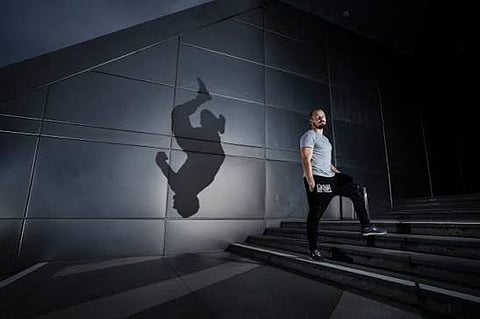
There is a seasoned quality to these stunts, as if he's done it all before. In some ways, he has. This man is not Spider-Man, although he certainly could play him. His name is Stanislavs Lazdans.
Stanislavs Lazdan is 5 feet 7 inches and 165 pounds. He has for the past two decades been pushing his own limits, conquering hard edges, high walls, narrow landings, and far intervals. He is a parkour enthusiast, stunt performer, action designer, and rigger. He's played Vikings and performed stunts for Stranger Things. For that work, his team was recognized at the Screen Actors Guild Awards. It was the culmination of a journey that began a long way from Hollywood.
"When I was a kid, I liked Jackie Chan movies," says Stanislavs. "His movement and stunts were insane," he says. "I dreamed of being capable of moving like him."
It was the 1990s, Latvia was on the mend after the fall of the Soviet Union, and Stanislavs was growing up in Daugavpils, a city of around 80,000 in the southeast of the country. Stanislavs had tons of energy, but his dream of being like Jackie Chan seemed destined to remain a dream.
At the age of 15, he took up breakdancing instead. Inspired by a fellow dancer who could do backflips, he began testing himself and discovered parkour, a training discipline, and freerunning. He picked up tricks from other people, or just from studying YouTube clips. That isolation coupled with his own passion made Stanislavs a creative student of movement. When there was something to be learned, he learned it. Anything else required some improvisation.
"Daugavpils is a small town," he says. "There weren't a lot of opportunities for parkour training. That pushed me to be more creative with my movement." He also began to fall in love. His love was parkour. "I'm in love with this sport," he says. "It gives you infinite opportunities to create."
After years of doing parkour, Stanislavs began to compete internationally. His first competition was at the AirWipp Challenge in Sweden in 2011. He was just 20 at the time and still working on how to translate his raw abilities into consistent performance, one that he could lock down. Like any new talent, he was a little unbalanced; smart, but outweighed by his visions and ideas.
"In competitions, you only get one try," he says. "Most of the time, I overestimated my ability to execute the line I had created."
He continued to compete and faced failure along the way. But he got better and learned where to draw the line between ambition and execution, and to do so under intense external pressure.
In 2013, Stanislavs was invited to the Red Bull Art of Motion in Greece, parkour's equivalent of the X Games. He placed sixth there. It was a strong showing for a kid from Latvia who just half a decade before had never even heard of parkour. Over the next few years, he developed a real winning streak: Best Trick at Piter Street Games in Russia in 2015, second place at the same event in 2016, and a win at the AirWipp Walltrick Battle in Sweden that same year.
Stanislav's big breakthrough came in 2017, when he won the first-ever FIG Obstacle Course Cup in Montpellier, France. For Stanislav, it was a personal achievement, but he also saw it as a triumph for parkour. "That victory helped to make parkour a competitive sport with global reach," he says. Stanislavs continued to perform well and it seemed like nothing could slow him down.
When he was preparing for the next Red Bull Art of Motion competition though, Stanislavs tore his Achilles tendon. The injury would sideline him for nearly a year. "It was a really tough time for me," he recalls. "I missed a lot of opportunities as an athlete. And after injuries like this, your tendon will not be 100 percent anymore."
Faced with those prospects, he decided to step away from competitive parkour. He didn't leave the sport completely though. Stanislavs was invited to judge at FIG World Cups, first in Hiroshima and Montpellier in 2018, then in Chengdu in 2019, and later at the inaugural Aurora Games in Albany in 2019. He also judged Kings of Concrete in the US in 2023 and 2025.
"I was glad that my knowledge and expertise in parkour was still valid, even without performing," he says. "That shifted my focus from being just an athlete and performer to something more."
Since August 2023, Stanislavs has worked with Tempest Freerunning Academy, one of the country's leading parkour organizations. His role there is multifaceted. At Tempest, he coaches classes, leads workshops, represents Tempest at events as both athlete and judge, helps organize Kings of Concrete competitions, and creates its social media content.
"Having me on board helped the company stay visible in the parkour community and stay competitive with other parkour brands across the US," he says.
The work keeps him connected to the sport's evolving landscape. As a judge, Stanislavs evaluates the next generation of athletes. As a coach, he works to pass on the creative spark and intuitive decision making that has come to define his own journey. As a performer, he continues to push his own limits, even if competition is no longer the goal.
Looking ahead, he says he wants to keep pushing himself as an athlete. He wants to create more videos and to help others. "I want to inspire more people to live a healthier, more active lifestyle, to do sports, even if it’s not parkour," he says.
And then he's off. He runs down a sidewalk in Los Angeles, leaps into the air, jumps off one tree, and then lands, briefly, against a brick wall before coming down safely on both feet. He attempts the jump four more times and then climbs over a balcony to the second floor. He's barely broken a sweat and he has the faintest smile that comes with a sense of achievement.
"I almost convinced myself that I couldn't do it," he says, after the feat. "The struggle was real, but I am happy I didn't stop trying."
Inspired by what you read?
Get more stories like this—plus exclusive guides and resident recommendations—delivered to your inbox. Subscribe to our exclusive newsletter
The products and experiences featured on RESIDENT™ are independently selected by our editorial team. We may receive compensation from retailers and partners when readers engage with or make purchases through certain links.