
- Locations
- Interviews
- Luxury Home
- Luxury Lifestyle
- Luxury Travel
- Luxury News
- Events
- More
- Magazine

A bedroom can look complete and still feel unfinished at the end of the day. Sometimes the issue is not the bed frame, the linens, or the room itself. The mattress may simply feel firmer than you prefer. If the mattress is still in good condition, adding a comfort layer can be a more measured upgrade than replacing the entire bed.
A mattress topper changes the surface you sleep on, but the result depends on material, fill, construction, fit, and care. The best choice is the one that works with the mattress you already own and the way the room is used.
A topper is most useful when the mattress remains supportive but its surface feels too firm. It can add cushioning and change the first impression of the bed. It is not a structural repair. Deep sagging, broken support, or a mattress that slopes noticeably are signs that a topper may only disguise a larger problem.
Before shopping, look across the mattress in daylight and check for uneven areas. Consider its age, the condition of the foundation, and whether the bed feels different from one side to the other. If the mattress is sound, a removable comfort layer can be a practical way to refine the feel without changing the frame or the rest of the bedroom.
The names are not always used consistently by retailers, so compare construction rather than relying on the product label. A mattress topper is generally designed to add a more noticeable comfort layer. A mattress pad is often thinner and may provide light cushioning or a modest surface change. A mattress protector is primarily intended to help shield the mattress from spills, moisture, and everyday soil.
These layers can work together, but each has a different job. If the goal is a softer sleep surface, start with a topper. If protection is the priority, choose a protector. Check the fitted sheet's pocket depth after adding any layer; a sheet that barely fits the mattress may no longer stay securely in place.
Memory foam is known for close contouring. Some people like the way it responds to pressure; others prefer a surface that feels easier to move across. Latex tends to have a more buoyant response, though firmness and feel vary by construction. Wool and synthetic fiber toppers offer other combinations of cushioning, resilience, and care requirements.
Down and feather designs create a different kind of comfort layer. Down fibers contribute loft and softness, while feather fibers and feathers add structure. The ratio and arrangement of those materials matter more than the broad label alone. Check whether the product separates its soft upper layer from a more supportive base, and look for the exact fill description.
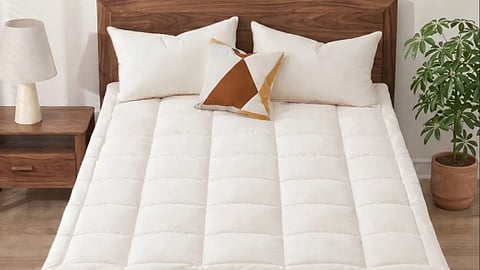
A feather mattress topper can be a useful example of how construction changes the feel. Puredown's Organic Cotton Goose Feather Bed Mattress Topper uses a dual-chamber design: the upper chamber contains 55% white goose down fiber and 45% white goose feather fiber, while the lower chamber contains 100% goose feathers. The product page describes the result as medium plush.
A dual-chamber topper separates the upper comfort layer from the lower fill layer. In this product, the upper chamber is designed to provide plush cushioning, while the feather-filled lower chamber adds structure. This is a specific construction approach, not a guarantee that every dual-chamber topper will feel alike.
The Puredown model also lists a 3-inch gusset and baffle-box quilting. The gusset creates depth around the edge, while the quilted compartments are intended to help keep fill distributed. Elastic corner straps help secure the topper to the mattress. These details are worth considering if you want a fuller profile that stays aligned during ordinary use.
Measure the mattress width and length before ordering, and check its depth as well. A topper should match the mattress footprint. If it is too small, the edges of the mattress remain exposed; if it is too large, the overhang can interfere with fitted sheets or the bed's appearance.
The Puredown topper is listed in Twin, Full, Queen, and King sizes, each with a 3-inch profile. The product page lists Twin at 39 × 75 inches, Full at 54 × 75 inches, Queen at 60 × 80 inches, and King at 78 × 80 inches. The listed weights range from 11.5 pounds for Twin to 24.5 pounds for King. Confirm your mattress measurements rather than assuming every brand's size labels are identical.
Consider the full bed height after adding the topper. A thicker sleep surface can change how easily someone gets in and out of bed, how much of the headboard remains visible, and whether the fitted sheet still fits. In a smaller bedroom, these practical details can matter as much as the material choice.
A topper sits beneath the fitted sheet, so it will not usually change the room's visible color palette. Its effect is more practical: it changes the surface feel while allowing the existing frame, headboard, duvet, and decorative layers to stay in place.
For a composed bedroom, let the visible bedding do the design work. A restrained palette, well-fitted sheets, and one or two contrasting textures can make the bed feel considered without adding unnecessary layers. If the topper increases the bed's height, check that the duvet still falls evenly on both sides and that the pillows remain proportionate to the headboard.
Care requirements can determine whether a topper fits your household. Some materials can be washed at home; others require spot cleaning or professional care. A removable cover is not the same as a washable filling, so read the instructions for the complete product.
Puredown specifies dry cleaning only for this featherbed. The brand recommends using a mattress protector or fitted sheet to help keep it clean and fluffing it periodically to redistribute the fill. This is an important practical trade-off: the topper offers a layered natural-fill construction, but it is not designed for routine machine washing.
Before choosing a topper, check the following:
The mattress is still structurally sound and does not have deep sagging.
The topper material creates the surface feel you want.
The fill composition and chamber construction are clearly described.
The dimensions match the mattress and leave enough room for the fitted sheet.
The added height works with the bed frame, headboard, and bedside furniture.
Attachment features are suitable for the way the bed is used.
The cleaning instructions are realistic for your household.
A topper is a focused adjustment, not a substitute for a mattress that has lost its support. When the mattress is still sound, a well-chosen layer can change the feel of the bed while preserving the furniture and layout already working in the room. The most successful upgrade is the one that fits both the sleep surface and the everyday life around it.
No. A topper can change surface cushioning, but it cannot restore broken or sagging mattress support. Assess the mattress itself before adding another layer.
No. Thickness is only one factor. Material density, fill type, chamber layout, and construction all affect the feel.
A correctly sized fitted sheet can help, while elastic corner straps provide a more direct way to secure some designs. Check the product's attachment features.
Care varies by product. Puredown specifies dry cleaning only for the linked topper, so follow the product's own care instructions rather than assuming it is machine washable.
Inspired by what you read?
Get more stories like this—plus exclusive guides and resident recommendations—delivered to your inbox. Subscribe to our exclusive newsletter
The products and experiences featured on RESIDENT™ are independently selected by our editorial team. We may receive compensation from retailers and partners when readers engage with or make purchases through certain links.