
- Locations
- Interviews
- Luxury Home
- Luxury Lifestyle
- Luxury Travel
- Luxury News
- Events
- More
- Magazine

In Palm Beach County, outdoor living is an architectural discipline in its own right. From historic Mediterranean Revival estates to sleek, contemporary waterfront residences, a custom swimming pool serves as the visual anchor of the property and a primary hub for year-round entertaining. Yet, transforming a blank yard into a resort-caliber aquatic environment is a complex undertaking that blends civil engineering, hydraulic design, and strict municipal compliance. Between coastal soil conditions, rigorous homeowner association (HOA) guidelines, and evolving energy regulations, the difference between a smooth build and a costly delay comes down to upfront planning and technical expertise. Collaborating with a seasoned swimming pool contractor in Palm Beach ensures that every phase of the project - from initial geotechnical assessments to final water chemistry startup - is executed to withstand South Florida’s demanding subtropical climate. By understanding the site constraints, vetting criteria, and modern engineering standards behind high-end pool construction, homeowners can protect their investment and create an outdoor sanctuary built to last for decades.
Before selecting tile samples or sketching water features, a successful pool project begins with a realistic assessment of the land itself. Palm Beach County encompasses a wide range of micro-environments - from barrier island waterfront lots to sprawling equestrian estates in Wellington - and each presents distinct engineering requirements.
Properties bordering the Intracoastal Waterway, canals, or the Atlantic Ocean require specialized structural engineering. Building a heavy concrete vessel filled with tens of thousands of gallons of water too close to a seawall introduces immense lateral pressure - known as a surcharge load - that can bow or collapse the seawall over time.
To prevent structural shifting in loose coastal sand or near water edges, structural engineers frequently specify deep foundation systems. These typically involve driving concrete pilings or installing helical steel piers down to stable limestone bedrock before the gunite shell is shot. While this adds to the upfront engineering budget, it guarantees the pool remains completely level and crack-free, protecting both the vessel and the adjacent seawall.
Local municipalities - including the Town of Palm Beach, West Palm Beach, Jupiter, and Delray Beach - enforce strict zoning ordinances governing lot coverage. Every property has a maximum allowable impervious surface ratio, which calculates the combined footprint of the house, driveway, walkways, and pool deck.
If a proposed pool and travertine patio exceed this threshold, homeowners may need to incorporate permeable pavers, underground exfiltration trenches, or French drainage systems to manage stormwater runoff on-site. Additionally, setback rules dictate exact minimum distances from property lines, septic drain fields, overhead power lines, and underground utility easements. Obtaining a current boundary and topographical survey early in the design phase prevents expensive mid-project redesigns.
Because an inground swimming pool is a permanent structural addition to your home, selecting the right construction partner is the single most consequential decision in the process. Looking beyond polished social media portfolios and asking pointed operational questions will quickly separate true master builders from high-volume, corner-cutting operators.
When evaluating prospective builders, verify the following non-negotiable credentials and practices:
Active Florida CPC License Verification: In Florida, residential and commercial pool builders must hold a Certified Pool/Spa Contractor (CPC) license issued by the Department of Business and Professional Regulation (DBPR). Always verify the license number directly on the state portal to confirm it is active, free of disciplinary complaints, and backed by general liability and workers' compensation insurance.
In-House Project Management vs. Unsupervised Subcontracting: While specialized trades (such as electricians or gunite crews) are commonly subcontracted, a reputable builder assigns a dedicated, in-house project manager to oversee every stage, inspect rebar cages before concrete pours, and coordinate municipal inspections.
3D Architectural Renderings and Elevation Drawings: Flat 2D blueprints rarely capture how a pool will interact with your home’s sightlines, sun exposure, and landscaping. Insist on scaled 3D digital renderings that show the pool from inside your main living areas, allowing you to adjust deck widths, steps, and water features before excavation begins.
Transparent, Milestone-Based Payment Schedules: Avoid contractors who demand massive upfront deposits. Industry-standard contracts tie payments to verifiable construction milestones—such as permit issuance, excavation completion, gunite shell shooting, tile and coping installation, and final startup.
Clear Structural and Equipment Warranties: Review the written warranty terms carefully. Top-tier builders provide a structural shell warranty alongside full manufacturer warranties on pumps, heaters, automation panels, and aggregate interior finishes.
Modern residential pools have moved far beyond simple rectangular basins. Today’s homeowners are designing multi-functional aquatic spaces that blend seamlessly with indoor architecture while supporting health, wellness, and effortless entertaining.
Visual continuity is a hallmark of contemporary South Florida design. Perimeter-overflow (or knife-edge) pools allow water to flow evenly over all four sides into a hidden slot drain, creating a taut, glass-like mirror effect that reflects the surrounding architecture and palm canopy. On waterfront lots, vanishing-edge (infinity) pools erase the visual boundary between the backyard and the Intracoastal or ocean horizon, turning the water itself into a sculptural centerpiece.
Home wellness has reshaped backyard architecture. Rather than building a standalone spa, many homeowners are incorporating contrast therapy directly into their pool footprint. This involves pairing a high-jetted, heated hydrotherapy spa with a dedicated, chiller-equipped cold plunge pool maintained between 45°F and 55°F. Dedicated 40- to 60-foot lap lanes integrated cleanly alongside wider lounging zones are also in high demand, allowing residents to train at home without compromising the social layout of the yard.
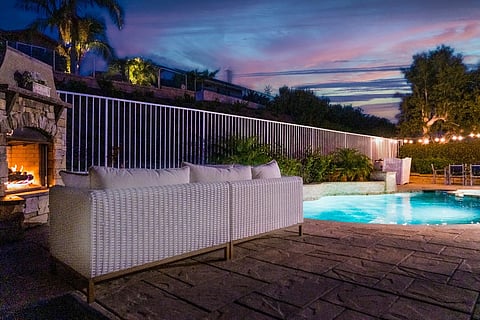
To create a true resort atmosphere, designers frequently integrate sunken conversation pits or fire lounges positioned at water level, allowing guests to sit dry while surrounded by the pool’s shimmering surface. Pairing linear gas fire bowls or automated fire-and-water scuppers with cool-toned glass tile creates dramatic evening ambiance that extends the usability of the backyard well after sunset.
A breathtaking pool loses its appeal quickly if it is noisy, expensive to run, or constantly battling algae. Behind the scenes, modern hydraulic engineering and smart automation dramatically reduce both energy consumption and weekly maintenance.
Many budget builds use undersized 1.5-inch PVC plumbing and sharp 90-degree elbow fittings, which create high friction (head loss) and force the pump to work harder. High-performance pools utilize 2-inch to 2.5-inch plumbing lines paired with long-radius sweep elbows. This low-resistance hydraulic design allows water to circulate smoothly at much lower pump speeds, keeping the equipment pad whisper-quiet and extending the lifespan of every mechanical component.
Under federal Department of Energy (DOE) efficiency standards, variable-speed pumps (VSPs) are now the benchmark for residential filtration. By running at lower RPMs for longer cycles, a properly programmed VSP can reduce pool electricity costs by 50% to 75% compared to legacy single-speed motors.
For water quality, homeowners are increasingly moving toward hybrid sanitization. Combining a saltwater chlorine generator - or minimal chlorine dosing - with secondary UV-C light or ozone injection neutralizes chlorine-resistant pathogens and breaks down harsh chloramines on contact. Paired with a smartphone-controlled automation panel and automated pH/ORP chemical sensors, the system continuously monitors and balances water chemistry, sending real-time alerts to your phone or pool technician before minor imbalances become visible problems.
Setting realistic expectations around timing and total project cost prevents unnecessary stress once construction begins. While exact timelines vary depending on municipal permitting backlogs and design complexity, a custom inground pool in Palm Beach County typically takes 12 to 20 weeks from contract signing to the first swim:
Design, Engineering, and Permitting (4 to 8 Weeks): Finalizing 3D plans, structural engineering stamps, HOA Architectural Review Board (ARB) approval, and municipal building permits.
Excavation, Steel, and Plumbing (2 to 3 Weeks): Digging the basin, managing groundwater dewatering if needed, tying the #3/#4 rebar structural cage, and pressure-testing the underground plumbing lines.
Gunite/Shotcrete Application and Curing (2 to 3 Weeks): Pneumatically spraying the concrete shell and allowing it to cure properly through regular watering to maximize compressive strength.
Tile, Coping, and Hardscaping (3 to 4 Weeks): Installing waterline glass or porcelain tile, setting cool-to-the-touch travertine or shellstone coping, and laying the surrounding patio deck.
Interior Finish, Startup, and Orientation (1 to 2 Weeks): Applying the quartz, exposed pebble, or polished aggregate finish, filling the pool, balancing initial water chemistry, and programming the smart automation system.
When establishing a budget, remember that the pool shell and equipment represent only part of the finished outdoor environment. Factor in ancillary elements early—such as perimeter safety fencing or door alarms required by the Florida Residential Swimming Pool Safety Act, landscape lighting, privacy hedges, irrigation rerouting, and outdoor kitchens—so the final space feels completely cohesive rather than piecemeal.
In Palm Beach County’s competitive real estate market, a thoughtfully engineered swimming pool is far more than a lifestyle upgrade; it is a foundational asset that elevates property appeal and resale value. By respecting coastal site conditions, prioritizing hydraulic efficiency, and partnering with a licensed builder who values transparency and craftsmanship, homeowners can navigate the construction process with clarity. When every detail - from deep foundation stability to whisper-quiet smart filtration - is planned with precision, your backyard becomes a timeless, low-maintenance retreat that rewards you every single day of the year.
Inspired by what you read?
Get more stories like this—plus exclusive guides and resident recommendations—delivered to your inbox. Subscribe to our exclusive newsletter
The products and experiences featured on RESIDENT™ are independently selected by our editorial team. We may receive compensation from retailers and partners when readers engage with or make purchases through certain links.