
- Locations
- Interviews
- Luxury Home
- Luxury Lifestyle
- Luxury Travel
- Luxury News
- Events
- More
- Magazine

There's a version of home ownership where the house works quietly around you: the lighting is right, the storage doesn't intrude, and the temperature is always comfortable without you having to think about it.
Most things in a well-designed home can be chosen with aesthetics in mind. Air conditioning has traditionally been the exception. It usually means a wall unit, a grille that doesn't match the ceiling, or a window blocked by a box. That trade-off is less inevitable than it looks.
A concealed ducted mini split changes the standard assumption about where AC lives in a room. The indoor unit sits inside the ceiling void or a wall cavity, connected to ductwork that routes to slim, flush-mounted grilles. From inside the room, there's almost nothing to see.
For homeowners who have spent real money on how a room is designed, this matters. A custom-built-in library, a panelled primary bedroom, and a living room planned around a specific art arrangement: all of those decisions stay intact when the AC system is designed to disappear.
The cost is real. Concealed ducted systems are more expensive to install than wall-mounted alternatives, and the installation requires ceiling void access and more skilled planning. But for a home where the interior has been considered carefully, it's one of the few HVAC options that doesn't ask you to make a visual concession.
The most immediate change is visual. A room without any AC units on the walls feels larger and calmer. The ceiling lines stay unbroken. Furniture placement is unconstrained. The eye moves around the room the way you intended when you planned it.
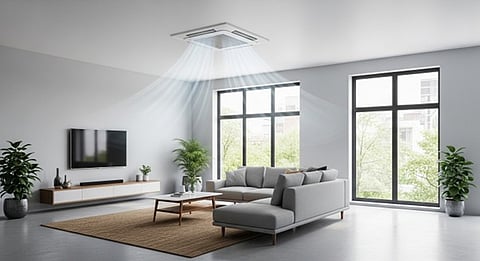
A step below full concealment is a ceiling cassette mini split, which recesses into the ceiling and pushes air in four directions. It's more visible than a fully concealed system but far less intrusive than anything wall-mounted, and it requires less ceiling void depth.
The difference in room feel between a concealed system and a wall-mounted one is genuinely hard to photograph. But it shows up immediately when you walk into the space. High-end hotels and well-finished short-term rentals use concealed or cassette systems for exactly this reason: the absence of visible equipment is part of what makes the room feel considered.
Primary bedrooms are the clearest case. A bedroom designed around calm materials and minimal visual interruption benefits directly from having its cooling system disappear. The room does what a bedroom is supposed to do: help you slow down and sleep without anything competing for your attention.
Living rooms with custom millwork or statement walls are a close second. Built-in shelving units, a fireplace surround, a carefully chosen sofa arrangement: these design decisions work better without a wall unit as a visual competitor for the room's attention.
The strongest argument for a concealed ducted system is that the reasoning is the same as choosing flush-to-ceiling cabinets over surface-mounted ones. You're deciding the room should look intentional all the way through, not just in most places.
This is a planning-first decision. Concealed ducted systems need to be accounted for in the renovation brief before the ceiling goes up, not added once the finishes are done. The ductwork, the unit placement, and the grille locations all need to be coordinated with whoever is doing the structural and mechanical work.
Ceiling void depth is the key technical constraint. The indoor unit typically needs 10 to 14 inches of clear space above the ceiling surface. In many houses, that space exists in the structural floor cavity above. In some, it doesn't, and the alternative is a dropped ceiling section, which has its own design implications.
A concealed ducted system costs more than a wall-mounted mini split in both equipment and installation. The cleaner way to think about the cost: it's part of the room's built environment, the same category as cabinetry or lighting, not an appliance added after the room is finished.
When you frame it that way, the comparison shifts. You're not weighing two appliances against each other. You're deciding whether every part of the home reflects the same level of thought, or just most of it.
The homes that feel most cohesive are the ones where every decision was made with the full picture in mind. The window proportions, the material choices, the way light moves through the space across the day: these get decided with an awareness of how they affect everything else.
AC is usually excluded from that kind of thinking, because the options seem to require a trade-off. A concealed system is what removes that trade-off. You get a home that's comfortable year-round and a home that looks exactly the way you designed it.
People notice when a room feels right. They're rarely sure why. The temperature arrived without any obvious source. The ceiling lines are unbroken. There's no equipment they expected to see. These are the things that add up to the feeling of a well-made home.
You know it when you're in one.
Inspired by what you read?
Get more stories like this—plus exclusive guides and resident recommendations—delivered to your inbox. Subscribe to our exclusive newsletter
The products and experiences featured on RESIDENT™ are independently selected by our editorial team. We may receive compensation from retailers and partners when readers engage with or make purchases through certain links.