
- Locations
- Interviews
- Luxury Home
- Luxury Lifestyle
- Luxury Travel
- Luxury News
- Events
- More
- Magazine

Bathrooms used to be purely functional—tile, a curtain, and maybe a decent mirror if you were lucky. Now they’re doing double duty as daily reset zones, and homeowners are paying closer attention to light, sightlines, and how finishes work together. In that context, frameless shower doors have become a go-to upgrade because they change the feel of a space as much as the look.
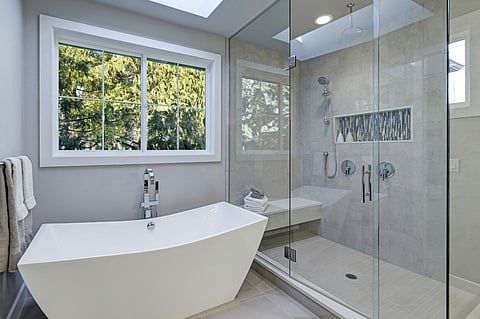
Unlike framed enclosures (where metal rails define the edges), frameless doors rely on thicker glass and discreet hardware. The result is visually quieter, which sounds subtle until you see it in a real bathroom. Less visual interruption makes the room appear larger, brighter, and more cohesive—especially in smaller layouts where every line counts.
There’s also a practical design shift behind the trend: more people are investing in tile and stone that deserves to be seen. A frameless enclosure doesn’t hide the details you paid for. It puts craftsmanship—tile layout, niche placement, grout lines—front and center.
The main appeal is straightforward: frameless glass creates a nearly uninterrupted view. That’s valuable in any bathroom, but it’s a game-changer when:
the shower sits close to the vanity (visual clutter adds up fast),
you have a statement wall tile,
natural light is limited and you need it to travel.
Because the hardware is minimal, your eye doesn’t “stop” at a thick frame. Instead, it reads the room as one continuous volume. Designers use this trick all the time in tight spaces—reduce contrast at edges, and the room feels more open.
Frameless doors aren’t only for ultra-modern bathrooms. They work just as well in transitional spaces where you’re mixing warm finishes (like brushed bronze) with clean geometry. The glass acts like a neutral element that lets other choices shine—floor tile, lighting, even paint color.
One note: “frameless” doesn’t mean “invisible.” Hardware finishes still matter. Handle shape and hinge style can push the look contemporary, classic, or somewhere in between.
A common misconception is that frameless simply means “remove the frame.” In reality, these enclosures depend on thicker tempered safety glass (often 3/8" to 1/2") and precise mounting. Without a frame to compensate for out-of-plumb walls or a slightly off curb, accuracy becomes everything.
That’s why measurement and installation quality play such a big role in performance. The door has to swing cleanly, close properly, and maintain consistent gaps—small details that determine whether it feels premium or finicky.
Not every bathroom needs the same configuration. Before you fall in love with a particular look, it helps to understand the common approaches—pivot doors, hinged doors, sliders, fixed panels, and corner setups—because layout constraints (toilet clearance, towel bars, door swings) can steer the decision. If you want a practical overview of styles and what typically works in different spaces, resources like framelessshowerdoors.com can help you compare options without getting lost in design photos.
That planning step saves headaches later, especially if you’re trying to fit a comfortable opening into a tight footprint.
It depends on what you compare it to. Frameless doors have fewer metal channels, which means fewer places for soap scum and mildew to build up. On the other hand, you do have more exposed glass edge and more visible water spotting—particularly if you have hard water.
A realistic maintenance routine looks like this:
squeegee after showering (30 seconds makes a difference),
use a pH-neutral cleaner weekly,
avoid abrasive pads that can scratch glass or hardware finishes.
Many homeowners also choose protective coatings that reduce mineral buildup. They’re not magic, but they do make routine cleaning faster.
A properly designed frameless shower should keep water where it belongs, but it’s not the same as a fully gasketed frame system. Expect small, nearly invisible seals at key points (like the door edge), and pay attention to showerhead placement and spray direction.
This is where design decisions matter as much as installation. For example, a door that opens toward the spray path is more likely to allow water to escape. Likewise, a curbless entry needs thoughtful slope and drainage planning, because you can’t rely on a tall curb as a backup.
The glass itself is robust, but hinges, clamps, and handles determine long-term satisfaction. Quality hardware should feel solid, operate smoothly, and resist corrosion in a wet environment. If you’re selecting finishes, ask about the manufacturer’s recommendations for cleaning—some popular finishes show wear faster if cleaned with harsh chemicals.
Frameless shower doors often cost more than framed options, and the reasons are fairly straightforward:
thicker glass,
heavier-duty hardware,
more precise fabrication,
more time and skill during installation.
The value isn’t only visual. Many homeowners perceive frameless enclosures as an “upper tier” finish—similar to upgrading countertops or replacing a builder-grade light fixture with something intentional. In resale scenarios, it’s not always a direct dollar-for-dollar return, but it can improve buyer perception, especially when the bathroom reads as updated and well cared for.
The key is to avoid treating it as an isolated upgrade. A frameless door looks best when the surrounding details are also considered: tile edges are clean, fixtures are aligned, and lighting is flattering (nobody wants to highlight water spots with harsh overhead LEDs).
Start with the constraints, not the inspiration photo. Ask yourself:
Do you have clearance for a swinging door, or is a slider more practical?
Is the shower curb level and properly pitched?
Are the walls plumb, or will you need adjustments?
Where will you place towel hooks so they don’t interfere with the handle or swing?
Then think about daily use. Who’s using the shower—kids, guests, aging parents? A wide, easy entry and simple operation often matter more than a dramatic configuration.
Frameless shower doors are one of those rare upgrades that can make a bathroom feel more spacious without changing the footprint. Done well, they’re not flashy—they’re quietly transformative. And that’s exactly why they’ve become a modern classic.
Inspired by what you read?
Get more stories like this—plus exclusive guides and resident recommendations—delivered to your inbox. Subscribe to our exclusive newsletter
The products and experiences featured on RESIDENT™ are independently selected by our editorial team. We may receive compensation from retailers and partners when readers engage with or make purchases through certain links.