
- Locations
- Interviews
- Luxury Home
- Luxury Lifestyle
- Luxury Travel
- Luxury News
- Events
- More
- Magazine
- Contact Us

Heavy rain usually causes immediate damage where residential drainage is weak, blocked, or poorly directed. Before a severe storm arrives, homeowners must systematically inspect specific areas where surface runoff tends to trap, collect, and pool against structural elements. The core issue during intense rainfall is not the water itself, but managing its uncontrolled volume and direction to maintain adequate foundation protection.
To prevent costly structural infiltration, you must identify where water flow path designs are failing or obstructed. Uncontrolled pooling against your walls generates severe hydrostatic pressure, which quickly forces moisture through solid concrete. Safely navigating a major storm requires checking your garage drain for hidden silt accumulation, verifying exterior slopes, and clearing your property's main surface paths to force rushing runoff completely away from your structural footprint.
Clear all organic matter from roof valleys and primary flashing points.
Verify downspout extensions discharge water away from foundation walls.
Inspect the perimeter ground slope for soil settlement and low spots.
Remove debris grates from driveway and garage channel systems.
Clear surface drain openings on patios, walkways, and courtyards.
Clean out basement window wells and test interior floor drains.
Remove obstructions from landscape swales and low-lying collection areas.
Examine the internal architectural angles where different roof slopes meet, along with the transition zones around chimneys, skylights, and dormers. Look closely for accumulated leaves, pine needles, twigs, and asphalt shingle granules that have settled into these channels.
Roof valleys act as the primary high-volume highways for surface water runoff. During a heavy downpour, they collect water from large roof surface areas and channel it rapidly downward toward the gutter system.
When a roof valley is blocked by organic debris, the rushing water loses its velocity and begins to pool backward up the slope. Because hard surfaces do not absorb water, they redirect it laterally. The trapped water will quickly push underneath the surrounding shingles, bypassing the underlayment and leaking directly into the roof decking and attic insulation.
Use a roof rake or a leaf blower to completely clear all debris out of the valleys. Ensure that the metal or rubber flashing lining the valley is completely visible, smooth, and unobstructed so water can slide down without resistance.
Check the entire length of your gutter troughs for interior sludge, sagging brackets, and loose joints. Inspect the vertical downspouts and their lower horizontal extensions to ensure they are firmly connected and clear of internal clogs.
[Roof Runoff] ---> [Clear Gutter Trough] ---> [Downspout Pipe] ---> [Extension Pipe] ---> [Safe Discharge Zone]
Gutters and downspouts are responsible for capturing thousands of gallons of roof runoff and systematically carrying it away from the home’s immediate perimeter. A properly functioning system controls the falling water volume and drops it safely in a designated discharge zone.
If the gutters are clogged with seasonal debris, they will overflow within minutes of intense rainfall. Instead of being channeled away, water cascades directly over the edge of the roofline like a waterfall, soaking the siding and landing directly at the base of the foundation walls, causing rapid soil erosion.
Scoop all accumulated sludge out of the gutter channels and flush the system with a garden hose to verify that water flows out of the downspouts freely. Ensure that all downspout extensions are deployed and discharge water a minimum of six feet away from the foundation on a downward slope.
Walk along the immediate perimeter of your home's foundation walls. Inspect the soil, mulch, or gravel beds to see if the ground slopes down toward the concrete or if there are noticeable depressions right next to the structure.
The ground grading immediately surrounding a house dictates the direction of surface water movement. Proper drainage design requires the soil to slope downward and away from the foundation walls to shed water naturally into the yard.
Over time, soil packed around a foundation naturally settles, creating a subtle trench next to the building. During heavy rain, this low zone fills with water, creating saturated soil. This saturation generates intense hydrostatic pressure, which forces water through hairline cracks in the concrete, causing basement dampness or flooding.
Fill any settled low spots next to the foundation with clean, compacted clay-heavy soil. Ensure the ground slopes away from the structure at a minimum drop of one inch per foot for the first six feet to guarantee water moves away from the building.
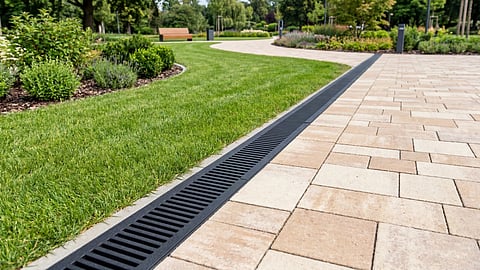
Examine the transition line where your driveway meets the garage door threshold. Inspect the linear trench drains, surface grates, and internal catch basins installed across these paved zones to identify dirt, sand, or trash blockages.
Hard surfaces like asphalt, concrete, and stone pavers are entirely non-porous and cannot absorb water; they redirect it with high velocity. Driveways that slope downward toward a garage entrance require functional linear drainage hardware to intercept this fast-moving surface water before it crosses the doorway threshold.
If a driveway trench drain is filled with sediment or covered by leaves, its intake capacity drops significantly. During an intense downpour, the rushing surface water will simply skim over the top of the blocked grate, quickly overflowing the threshold and flooding the interior garage floor.
Remove the surface grates from your driveway or garage entrance drains. Scoop out all collected silt, gravel, and trash from the bottom of the channel basin, and run water through the discharge pipe to ensure the outlet line is completely clear.
Look at the surface area of your outdoor patios, courtyards, and walkways. Locate the point drains, catch basins, or decorative channel paths designed to collect surface runoff from these hardscapes.
Large patios and walkways collect massive amounts of rainwater that cannot soak into the ground. These hardscapes must be sloped toward dedicated surface drains or catch basins that link directly to an underground storm water management line.
When surface drains are blocked or lack a clear outlet path, water quickly backs up across the non-porous hardscape. This creates large, deep puddles that can saturate the surrounding soil, wash away the underlying bedding sand, and cause concrete pavers to sink, shift, and crack unevenly.
Clear all grass clippings, leaves, and outdoor debris away from patio drain grates. Pop open the drain covers to verify that the internal pipe connections are clear of tree roots and dirt buildup so water can drain away without restriction.
Check exterior basement stairwells, low-lying window wells, and the central floor drains located inside your basement or crawlspace floor.
Basement windows and exterior stairwells sit below the surrounding ground level, making them highly susceptible to accumulating rushing surface runoff. They rely entirely on clear gravel bases, drainage pipes, and functional interior floor drains to stay dry.
If a basement window well lacks a proper protective cover or has a clogged gravel base, it can turn into a small pool within minutes. Once the water level rises past the window sill, the pressure will break the window seal or glass, sending a massive volume of water into the basement.
Clear out all dead leaves and accumulated debris from the bottom of all window wells and exterior stairwells. Test your basement floor drain by pouring a bucket of water directly down the grate to ensure the line flows smoothly and is not obstructed by old household dust or storage boxes.
Walk your property line and inspect the natural drainage swales, landscape ditches, and low-lying open areas of your lawn where water normally travels during standard rains.
A landscape swale is a wide, shallow ditch designed to act as a natural pathway for storm runoff. It collects water from the yard and guides it safely toward a municipal storm drain or a designated open management area away from any structural foundations.
If a drainage swale is blocked by landscaping rocks, overgrown weeds, thick lawn thatch, or stored firewood, the water loses its natural escape route. The runoff will quickly back up, saturate the lawn completely, and pool in large low spots that can eventually migrate back toward the home’s perimeter.
Mow the grass low inside all drainage swales and clear out any branches, loose rocks, or debris that might impede the high-speed flow of stormwater. Ensure the final exit point of the swale is completely open and free of blockages.
Severe storm damage usually starts where residential runoff is blocked, undersized, or misdirected. The ultimate goal of storm preparation is not to stop the rainwater from falling, but to give it an unobstructed, highly efficient path completely away from your living space and foundation. Taking time to inspect these seven critical zones before a major downpour reveals exactly where surface runoff will collect, allowing you to make quick adjustments before minor issues escalate into major structural damage. Ensure your collection basins are clear, maintain proper ground slopes, and ensure your property is equipped with durable drainage supplies to keep your water management systems running smoothly through any storm.
Inspired by what you read?
Get more stories like this—plus exclusive guides and resident recommendations—delivered to your inbox. Subscribe to our exclusive newsletter
The products and experiences featured on RESIDENT™ are independently selected by our editorial team. We may receive compensation from retailers and partners when readers engage with or make purchases through certain links.