
- Locations
- Interviews
- Luxury Home
- Luxury Lifestyle
- Luxury Travel
- Luxury News
- Events
- More
- Magazine

The exterior of a luxury home is no longer an afterthought. In the most considered residential projects of the past decade — from coastal compounds on the Jurassic Coast to contemporary London extensions, from Highland retreats to Sussex farmhouse conversions — the material choice for the building's skin has become as deliberate and as revealing as any interior decision. And two materials have emerged at the very top of that conversation: charred timber, with its dramatic depth and almost geological presence, and thermally modified ThermoWood, with its refined warmth and exceptional long-term performance.
Both materials share a philosophy that resonates with the most thoughtful approach to luxury: the idea that truly premium quality does not announce itself through complexity or ornamentation, but through the rightness of the material itself — its authenticity, its relationship to its setting, and its ability to age with dignity rather than decline.
The Japanese technique of Shou Sugi Ban — the controlled charring of timber to create a carbonised surface — has moved from architectural curiosity to defining material of the contemporary luxury home exterior. The reason is not fashion. It is that charred timber delivers a combination of visual presence and genuine material performance that no other exterior finish can replicate.
The deep black surface produced by controlled charring has a physical depth that paint cannot achieve. It catches light differently at different times of day — absorbing it at noon, reflecting it obliquely at dusk, creating a surface that is never quite the same twice. The characteristic cracked texture of a deeply charred board — the result of the carbonisation process acting on the grain structure of the timber — gives the facade a geological quality that connects the building to landscape and earth in a way that manufactured materials fundamentally cannot.
Beyond aesthetics, the charred surface delivers genuine protection. The carbonised layer is hydrophobic, biologically inert, and UV-stable. It does not require periodic recoating. It does not support biological growth. It weathers with extraordinary consistency — the quality of a well-charred facade after ten years is not materially different from its appearance at installation, where standard timber finishes require intervention every two to four years to prevent visible deterioration.
For luxury homeowners who travel extensively, manage multiple properties, or simply do not want to spend their weekends on exterior maintenance, this performance proposition is as significant as the aesthetic one. A material that looks exceptional and requires almost nothing from its owner is, by definition, a luxury material.
The full range of shou sugi ban charred timber cladding UK is available in both deep charred and brushed and stained finishes, across Siberian larch and Nordic spruce bases, from UK stock with nationwide delivery. Deep charred profiles deliver the most dramatic architectural statement. Brushed and stained variants — available in black, larch, nut, grey, sand beige, and clear — offer a more refined result where the grain texture is visible through the carbon layer. For luxury projects where the cladding material is a primary architectural element, samples are available on request.
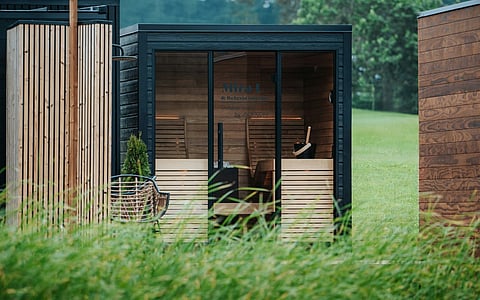
Where charred timber makes its presence known, ThermoWood operates with a different kind of authority. Its warm honey-brown colour — produced by the caramelisation of natural wood sugars during the thermal modification process — is immediately appealing without being dramatic. Its grain is clear and consistent. Its shadow gap and rainscreen profiles create the clean horizontal lines that characterise the best contemporary residential architecture. And its performance, over time, is quietly exceptional.
The thermal modification process — heating Nordic pine or spruce to between 185 and 215 degrees Celsius using only heat and steam — permanently changes the timber's cell structure. Moisture absorption is reduced by up to 50 percent. Dimensional movement is reduced by 30 to 50 percent. Durability Class 2 is achieved without any chemical preservative treatment. The result is a cladding material that maintains its profile, its joint consistency, and its visual quality over decades in a way that untreated softwood simply cannot.
For luxury homes where the facade is expected to look right in year fifteen as much as year one — and where the cost of remedial cladding work on a premium property is not merely inconvenient but genuinely disruptive — ThermoWood's stability advantage is a specification decision with real financial and practical consequences. The premium over standard softwood cladding at the point of supply is modest. The difference in how the building looks and performs a decade later is significant.
The complete range of ThermoWood cladding for luxury home exteriors is available in shadow gap, double shadow gap, triple shadow gap, tongue and groove, rainscreen, shiplap, and half-lap profiles — all from UK stock for nationwide delivery. For projects where fire classification is required, ThermoWood is compatible with factory fire retardant treatment to achieve Euroclass B-s1,d0. Architectural samples and full technical specifications are available for current projects.
The choice between charred timber and ThermoWood for a luxury home exterior is fundamentally a question of what the building is trying to say. Charred timber asserts a bold material presence — it is a facade that makes a clear architectural statement and holds its position in the landscape. ThermoWood offers warmth and refinement — a facade that reads as considered and precise rather than dramatic.
Some of the most successful contemporary luxury homes use both — charred timber on the primary elevation as the architectural anchor, ThermoWood on secondary elevations where warmth and texture are the priority. The two materials are dimensionally compatible in many profile sizes and share a material philosophy — both natural, both chemical-free, both produced from sustainably certified Nordic timber — that gives the combination coherence rather than contrast.
Inspired by what you read?
Get more stories like this—plus exclusive guides and resident recommendations—delivered to your inbox. Subscribe to our exclusive newsletter
The products and experiences featured on RESIDENT™ are independently selected by our editorial team. We may receive compensation from retailers and partners when readers engage with or make purchases through certain links.