
- Locations
- Interviews
- Luxury Home
- Luxury Lifestyle
- Luxury Travel
- Luxury News
- Events
- More
- Magazine

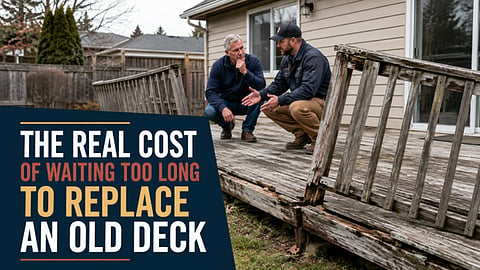
There is a kind of deck problem people learn to live around. One board feels soft, so everyone steps over it. The railing moves a little, but it has been that way for months. The stairs look rough, yet they still work.
That is how replacement often gets pushed to “next year.”
Sometimes that is fine. An old deck is not automatically an unsafe deck, and age alone is a poor reason to tear one out. The trouble starts when visible wear is hiding problems in the framing or connections. By the time a homeowner finally asks about deck replacement Tacoma, the job may be larger than it would have been when the first warning signs showed up.
NADRA’s homeowner checklist tells people to inspect more than the deck boards. The ledger, support posts, joists, railings, stairs, flashing, and fasteners all deserve attention. Areas that stay damp are worth watching closely, and badly corroded hardware should not be ignored.
Picture a corner where leaves sit through wet weather. One soft board may be a fairly contained repair. If the joist below it has also started to deteriorate, or the hardware beside it is badly corroded, the job has changed.
That does not mean every damaged board will eventually turn into a rebuild. It means waiting can take options away. A section that might have been worth repairing earlier may not be worth saving after more deterioration has taken place.
Homeowners naturally look at the surface. That is the part they see every day.
A contractor checking an older deck has more to look at underneath. NADRA’s deck evaluation guidance separately covers footings, posts, beams, joists, the ledger, stairs, decking, handrails, and guards.
Those parts tell a much better story about the deck than faded stain or ugly boards.
The ledger deserves particular attention on an attached deck because it forms part of the connection to the house. Water getting into this area can become a problem when flashing or other protection is not doing its job. Loose or corroded fasteners add another concern.
When the framing and connections are still sound, deck repair Tacoma may be the sensible route. Once deterioration starts showing up in several structural areas, repeatedly patching the top of the deck becomes harder to justify.
A deck that has been standing for decades may have been built with hardware or construction details that are different from what would normally be used today.
NADRA’s 2025 deck safety guidance says decks that are 20 years old or older deserve a serious look. It does not say that every deck over 20 needs to come down. The point is that materials, construction practices, and safety standards change over time.
Tacoma’s current residential deck guidance addresses vertical and lateral loads and may require permit drawings showing framing, footings, stairs, guards, and the connection to the house.
The surprise often comes after the first old boards are removed. A homeowner may expect a new surface and railing, only to find framing underneath that also needs attention.
That can change a deck replacement Tacoma project quickly.
A loose surface board is one thing. Movement where an attached deck meets the house deserves a closer look.
NADRA advises checking the ledger area for moisture problems, decay, poor flashing, rusted hardware, and loose fasteners. Its homeowner checklist also says the deck and stairs should not sag, sway, or move when tested.
If the deck appears to be pulling away from the house, or wood around that connection feels soft, simply replacing the boards above it misses the point.
A deck builder Tacoma homeowners bring in should inspect the connection and the nearby framing before deciding what can reasonably stay. Sometimes the answer will still be a repair. Sometimes it will not.
There is a building permit exemption for small decks in Tacoma, though it has specific conditions. The 200 square-foot maximum, not to exceed 30 inches above grade and separated from the house, and not to act as the required exit door.
That is pretty much on-point for a lot of porches and decks.
Why does that matter when talking about an old deck?
Because a job that begins as limited surface work can become structural work once the decking is opened and damage is found below. Tacoma’s permit system includes deck work and structural alterations within its residential permitting process.
Waiting by itself does not add a permit fee. The issue is that the scope may grow from a small repair into a project involving framing, plans, review, and inspections.
Not every replacement means the entire old deck has to disappear.
If the substructure is still sound, a contractor may find that portions of the framing can remain. Whether that is practical depends on its condition, the new layout, the material being installed, and current project requirements.
This comes up often when someone wants to change the surface or starts talking with a composite deck builder Tacoma.
There still has to be a good structure underneath those new boards.
Once several joists, the beam, stairs, and ledger all need major work, preserving a small portion of old framing may no longer save much. The homeowner is already paying to open up and rebuild most of the deck.
An earlier inspection gives you a better chance of finding out what is still worth keeping before that decision becomes obvious.
Harbor Deck & Fence works on deck repair, custom deck construction, deck materials, and railing projects in the Tacoma area. An existing deck can therefore be evaluated before assuming from the beginning that everything needs to be replaced.
Once replacement is the likely choice, a vague quote is not enough.
Ask what is actually coming out. If there's any framing being reused, or if the stairs and railing come with the price, find out this from the contractor. If additional damage is showing up during the demolition, ask what happens.
Washington Labor & Industries recommends verifying contractor registration and getting written bids. Its homeowner guidance also suggests comparing the actual scope, warranties, references, completion dates, and price rather than choosing from the final number alone.
That is especially important on an older deck. Two contractors can look at the same property and make very different assumptions about what they expect to find underneath.
Waiting another season does not automatically ruin an old deck. Ignoring signs that the problem has moved beyond the surface is the bigger gamble.
The real cost can be fewer parts worth saving, more framing to replace, a more involved project, and more uncertainty once demolition begins.
If deck replacement Tacoma is already on your mind, have the structure checked before waiting becomes the default decision. You may find that part of the deck can still be repaired. If replacement really is due, knowing sooner usually leaves you with more choices.
Inspired by what you read?
Get more stories like this—plus exclusive guides and resident recommendations—delivered to your inbox. Subscribe to our exclusive newsletter
The products and experiences featured on RESIDENT™ are independently selected by our editorial team. We may receive compensation from retailers and partners when readers engage with or make purchases through certain links.