
- Locations
- Interviews
- Luxury Home
- Luxury Lifestyle
- Luxury Travel
- Luxury News
- Events
- More
- Magazine

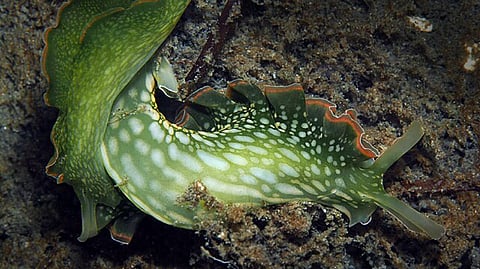
Somewhere along the marshy Atlantic coastline, where sunlight filters through shallow water in long, cinematic ribbons, a small emerald sea slug performs an evolutionary magic trick that should be impossible. It is soft-bodied, leaf-shaped, and barely two inches long, yet it has become a biological celebrity. This is Elysia chlorotica, the photosynthetic sea slug that steals chloroplasts, turns sunlight into fuel, and can even survive on pure solar energy for months at a time. It has become a darling of biologists, futurists, and anyone fascinated by the hidden edges of life on Earth. Its story blends high luxury and high strangeness: an aquatic creature that blurs the boundary between animal and plant, and whose evolutionary audacity hints at the next frontier in regenerative medicine.
The slug’s signature shade of brilliant green is not an accident of pigment but a declaration of identity. It is the color of chlorophyll captured from the algae it consumes, the same molecular machinery that empowers forests, farmlands, and tropical canopies. No other complex animal does this at scale. For scientists, the Elysia lineage is more than a curiosity. It is a model of biological acquisition, cellular cooperation, and the quiet genius of nature’s engineering.
The slug’s signature trick is kleptoplasty, a word that sounds like a back-alley heist because, in many ways, it is. Elysia chlorotica grazes on the algae Vaucheria litorea, extracting not only nutrients but the algae’s chloroplasts, the organelles responsible for photosynthesis. Instead of digesting them, the slug stores these chloroplasts throughout its tissues in an elegant internal pattern that resembles botanical mosaics under a microscope. Once integrated into the slug’s cells, the chloroplasts continue functioning for months, turning sunlight into energy long after their original plant hosts are gone.
Early research from the 1990s through the 2010s, including work from the University of Maine and various European marine biology labs, confirmed that the slugs’ chloroplasts remain photosynthetically active inside this animal host. Some early scientists even hypothesized that Elysia chlorotica may have incorporated algal genes into its own genome, although later studies challenged that claim. What remains uncontested is the effect: a small animal capable of long-term survival powered almost exclusively by sunlight. In field observations, some specimens persisted nearly a full year without food, their entire metabolic budget underwritten by solar energy.
In an age when luxury often means sustainability blended with innovation, Elysia chlorotica offers something more profound than lifestyle—it offers a template for living architecture.
Just when the scientific world thought the sacoglossan sea slugs had exhausted their repertoire, another species in the lineage revealed an even stranger superpower. In 2021, a research team in Japan documented Elysia cf. marginata decapitating itself and then regenerating an entirely new body. The discarded torso remained motionless, a hollow artifact that would eventually decompose, but the severed head kept crawling, feeding on algae, and pulsing with the faint green glow of its stored chloroplasts.
Over the course of about three weeks, the head built a new heart, new organs, new musculature, and a fully functioning digestive system. It did this not once but repeatedly across multiple individuals, as if resurrection were simply part of its biological toolkit.
Researchers believe this radical auto-amputation serves as a parasite reset. When the body becomes overrun with invaders, the slug abandons it and starts again. It is evolution as luxury: renewal without compromise, regeneration without baggage.
The question scientists now ask is not whether the slug can perform these feats, but how. The first answer points to the chloroplasts themselves. After decapitation, the head still contains a reserve of photosynthetic organelles that keep it energized during the vulnerable reconstruction period. Sunlight provides a metabolic runway, a clean, perpetual fuel.
The second answer lies within an ocean of stem cells that become active after separation. These totipotent cells behave like biological clay, malleable enough to sculpt entire systems from scratch. The regeneration rivals the legendary flatworm planaria, yet this is a far more complex creature performing an equally dramatic reset.
Taken together, these capabilities describe a system both ancient and visionary. It suggests that regenerative capacity is not isolated to the animal kingdom’s simplest members but may be distributed across evolution in ways we have barely begun to map.
The photosynthetic sea slug has emerged as a case study for the future of medicine, biotechnology, and even space exploration. Its cellular symbiosis provides a model for integrating foreign organelles into animal tissue, a feat that could inspire new forms of bioengineering. Its regenerative abilities suggest templates for healing catastrophic injuries, stimulating organ regrowth, or even rethinking the limits of longevity. The possibility of future therapeutics that draw from Elysia’s example is no longer speculative. It is an active area of inquiry, attracting interest from tissue-engineering labs and researchers exploring bioelectric and stem-cell regulation.
The allure lies in its elegance. The slug does not regenerate with brute force but with a clean, efficient choreography. It uses sunlight like a credit line and stem cells like artisans. It embodies self-sufficiency, resilience, and a kind of natural futurism that feels aligned with the next chapter of human ambition.
In a world where the boundaries between disciplines blur—technology merging with biology, sustainability merging with innovation—the Elysia sea slugs become more than zoological footnotes. They represent a frontier organism, a reminder that evolution still writes wild stories in quiet corners of the planet. These slugs challenge the assumption that animals are rigid categories. They are living crossovers, hybrids of plant and creature, and prophets of regenerative possibility.
Standing at the intersection of science and imagination, they offer a glimpse of what life could become. They survive like plants, rebuild like myths, and live like reminders that the strangest species on Earth are often the ones with the most to teach us.
Inspired by what you read?
Get more stories like this—plus exclusive guides and resident recommendations—delivered to your inbox. Subscribe to our exclusive newsletter
The products and experiences featured on RESIDENT™ are independently selected by our editorial team. We may receive compensation from retailers and partners when readers engage with or make purchases through certain links.