
- Locations
- Interviews
- Luxury Home
- Luxury Lifestyle
- Luxury Travel
- Luxury News
- Events
- More
- Magazine

At A Glance
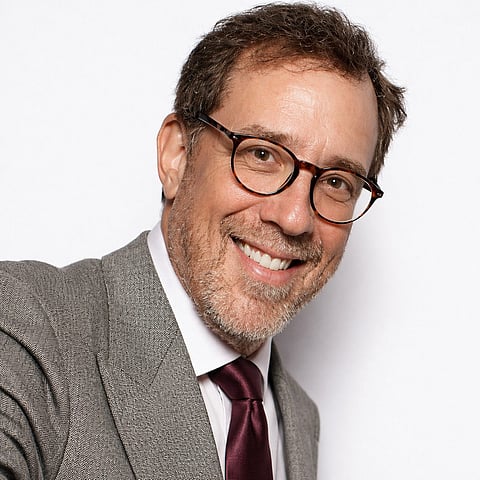
When Rob Minkoff talks about artificial intelligence, he approaches the subject from the perspective of someone who has witnessed multiple technological revolutions in filmmaking. His career spans traditional hand-drawn animation, live-action and animation hybrids, computer-generated imagery, and some of the most recognizable animated characters in modern cinema.
As previously explored in Resident Magazine's feature, Rob Minkoff And Particle 6 Are Rethinking How Movies Bring Animals To Life, Minkoff is collaborating with Particle 6 on Storm Dogs, a family adventure that explores how emerging AI technologies might help bring animal characters to life through performance-driven filmmaking.
The project raises questions about the future of animation, the role of human actors, and the relationship between technology and artistic expression. But Minkoff's position is more nuanced than either the enthusiastic embrace or outright rejection of AI. For him, the technology is ultimately secondary to the creative vision behind a film.
In this exclusive conversation with Mark Derho, Minkoff discusses the industry's historical resistance to technological change, why Storm Dogs represents a compelling application of AI, the importance of human authorship, and why filmmakers should be judged by what they create rather than the tools they use.
Mark Derho: You've described AI as a tool in the service of storytelling. How important is it that we maintain that distinction as these technologies become more sophisticated?
Rob Minkoff: At the end of the day, what we're doing is telling stories, and the story is the important thing. The tool is secondary. It should be judged based on its ability to be effective in the realization and manifestation of creativity and imagination.
I believe creativity and imagination are, and should always be, a human priority. I'm not interested in a story that a machine might want to tell because, frankly, I don't think there's a story the machine wants to tell. As far as I know, it doesn't have wants or needs. Those come from the filmmaker, storyteller, or artist.
So, again, I believe AI is a tool.
Mark Derho: You've been through several major technological transitions in animation. Does the current debate remind you of earlier moments in your career?
Rob Minkoff: Absolutely. Nobody ever asks what kind of paintbrush Leonardo da Vinci used to paint the Mona Lisa, but he used a paintbrush and paint. He also contributed to the development of painting technology.
Artists and filmmakers have always used technology. There would be no filmmaking if scientists hadn't developed the technology to capture and display images.
I started in traditional animation, working with pencils and paper. That's how I was trained, and I still love drawn animation. It was the art form that excited me and brought me into the business.
Early in my career, I was also around when computer-generated imagery was just beginning to develop. I saw many of the early tests. Most of us in the animation industry thought they were exceptionally crude. We were amazed by the technology, but we didn't believe CGI could replace traditional animation or even compete with it.
Of course, that didn't happen. CGI improved, and artists helped shape its development. People like John Lasseter, Pete Docter, and Brad Bird became involved in advancing the technology and the techniques. Eventually, CGI became a revolution in the animation industry and supplanted traditional animation in many areas.
Some people were unhappy because they believed it would replace their jobs. Some were given opportunities to retrain and learn computer animation. Others didn't want to make that transition. What we're experiencing with AI is a similar transformation, although it's much broader and more widespread.
Mark Derho: Would you identify fear as one of the primary motivators behind the negative reaction to AI?
Rob Minkoff: Yes, of course. Fear has always been part of these transitions.
The earliest technology humans had was fire. Initially, fire could be destructive, but eventually people learned how to tame it and use it to cook a steak. That's what I advise people to do with technology. You can either run screaming from it or learn how to use it.
You can either run screaming from it or learn how to use it.
Rob Minkoff
I think the second approach is better.
You also have to be realistic about the impact technology has. There is always an economic impact, and economics drives many of these transformations. Pretending otherwise is fooling yourself.
But it shouldn't be only about economics. It should be about art and the making of art. That's the most important thing.
Mark Derho: Do you think people are judging AI-generated work too quickly, before fully understanding what it can accomplish?
Rob Minkoff: We're still in a transformational moment, which is why the subject is so controversial. People can recognize AI-generated work, and it can be easy to spot.
That reminds me of the early days of computer animation. Even Toy Story, when you look at it by today's standards, is quite primitive. But it didn't matter because the story was so great, the characters were so great, and the filmmaking worked.
The film was funny, charming, and endearing. It had everything right. That's how it should be judged.
It shouldn't be judged based on the tool used to create it. It should be judged based on how the artist created what they created.
Mark Derho: Let's talk about Storm Dogs. What attracted you to the project when Particle 6 brought the concept to you?
Rob Minkoff: I had seen a number of examples online of people using AI to bring animal characters to life. They were appearing on Instagram, YouTube Shorts, TikTok, and elsewhere.
The animal performances were astounding. They were incredibly good at performing personality. The animals looked believable, and the characters appeared to be talking.
To me, that was an amazing development. You could actually create an animal performance.
I've done this before in my career. With Stuart Little, we worked with real cats. We actually filmed them, and that was quite challenging because you have to train real animals. The animal trainers did an incredible job, but it was difficult.
You also have people on set from organizations such as the ASPCA, making sure animals aren't being abused or harmed. That's obviously a critical concern. You don't want to put animals in jeopardy or make them do things they shouldn't be doing.
Those considerations can limit your ability to get the performance you're looking for.
Suddenly, AI gives you a way to create a believable animal performance without putting animals in those situations. To me, that seemed like a perfect use case for the technology.
Mark Derho: So the humane aspect was a significant part of your decision?
Rob Minkoff: Yes. On balance, it seemed much more humane.
Our plan is to use human actors for all the human roles, except for the toddler character. You couldn't really make a movie with a toddler in the conventional way without facing some very difficult challenges.
I directed Stuart Little 2, and we had twin girls playing George's little sister. It was incredibly challenging because the children had to be separated from their mothers and brought onto the set.
The mothers weren't even allowed on set because their presence could be distracting. The children would sometimes be screaming for their mothers, and the actors playing their fictional parents, Geena Davis and Hugh Laurie, would have to help calm them down.
It was a terrible situation to witness. The children hadn't chosen to be there, and they couldn't really understand what was happening. You felt horrible and guilty about it, but you were trying to make a movie.
To me, using AI in this particular way solves a number of problems. It allows us to create the performance while avoiding some of the challenges associated with working with very young children and live animals.
Mark Derho: Do you see this as the beginning of a broader trend in which human actors and AI-assisted characters work together in the same production?
Rob Minkoff: I think the important thing is that the technology works only up to a point. It still requires human oversight, human direction, and creative decisions.
My career has been unusual because I've had the opportunity to work in almost every filmmaking medium. I started in traditional drawn animation. I worked on Who Framed Roger Rabbit, where I directed an animated short and worked in the live-action and animation hybrid medium.
Then I directed Stuart Little, which combined live action with a CGI character. I've also directed entirely computer-generated films.
I've experienced all of these different approaches, and I think that background gives me an interesting perspective on what's happening now.
Mark Derho: You've made a distinction between using AI to create characters and using it to eliminate human participation. Is that distinction central to your involvement with Storm Dogs?
Rob Minkoff: Yes. When people get upset about major studios using these tools to put people out of work, I agree that that's a terrible reason to use technology. That shouldn't be the motivation.
I'm excited about Storm Dogs because we're making it with people. There will be human actors employed to perform the human roles, and there is a team of people working on the production.
I understand that people may criticize the project before they even see anything. I can't control that. People are entitled to their opinions.
But I've repeatedly been on the leading edge of technological changes in this business. I've adopted new technologies because I'm interested in how they evolve and what they make possible.
If that makes me a pioneer, I'm happy to accept the job. Of course, when you're a pioneer, you're going out into the wilderness. It can be dangerous out there.
Mark Derho: Particle 6 has received considerable attention for its work involving Tilly Norwood, the AI-created performer. Given the public discussion around synthetic actors, how do you distinguish your involvement in Storm Dogs from that project?
Rob Minkoff: I want to make it clear that I'm not involved at all with Tilly Norwood or that enterprise.
I think Particle 6 has become a lightning rod because of the concept of an AI actor. That gets to the heart of people's fears, particularly among actors and others who are concerned about the idea of synthetic performers.
But my work on Storm Dogs is not an endorsement of Tilly Norwood.
My response was specifically to the concept of Storm Dogs. I thought it was a defensible use of AI in the production pipeline because of the particular application. I wouldn't have agreed otherwise.
Mark Derho: So if the project had been built around replacing human actors with AI performers, you would not have been involved?
Rob Minkoff: Correct. Using AI to bring the dogs and the toddler to life is what I consider a particularly appropriate use of the technology.
Mark Derho: There's another major discussion taking place around AI and creative ownership. Where do you stand on human authorship?
Rob Minkoff: Human authorship is still critical, including when it comes to the ability to obtain copyright protection.
If someone uses AI to help write an article, I'm not going to give AI the credit for it. If you put your name on the article, it's your article.
But if someone looks at that article and says it was simply generated by AI and it's terrible because it has all the familiar characteristics of AI writing, then I would say that's a failure of the human user.
You must always be the final arbiter of any work you put your name on.
Rob Minkoff
You shouldn't put your name on something that you haven't properly evaluated. You must always be the final arbiter of any work you put your name on.
That's true whether you're making a film, writing an article, or creating something in another medium.
Rob Minkoff's perspective comes from having lived through the transition from pencils and paper to computer animation, from traditional filmmaking to CGI, and now into an era of increasingly sophisticated AI-assisted production.
His argument is not that every new application of AI is automatically beneficial. He recognizes the economic consequences, the concerns of creative professionals, and the responsibility that comes with introducing disruptive technology into an established industry.
But he also believes that rejecting a tool simply because it is new or unfamiliar risks overlooking what it can make possible.
With Storm Dogs, the question is whether emerging technology can help filmmakers create believable animal characters while retaining the human performances, creative judgment, and storytelling that make audiences care about them.
The project remains in development, with production targeted for 2027. As Minkoff sees it, the technology should never become the story. It should help the storyteller tell one.
And that may be the most important distinction in the debate over AI and the future of filmmaking.
Inspired by what you read?
Get more stories like this—plus exclusive guides and resident recommendations—delivered to your inbox. Subscribe to our exclusive newsletter
The products and experiences featured on RESIDENT™ are independently selected by our editorial team. We may receive compensation from retailers and partners when readers engage with or make purchases through certain links.