
- Locations
- Interviews
- Luxury Home
- Luxury Lifestyle
- Luxury Travel
- Luxury News
- Events
- More
- Magazine
- Contact Us

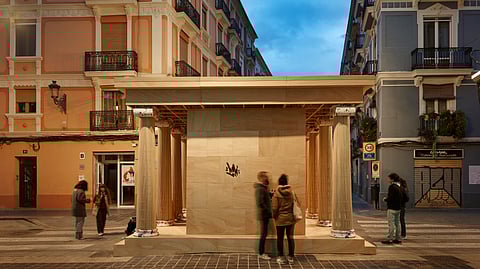
Spanish street art duo PichiAvo presented a monumental installation for the Fallas de Valencia that existed for only a few days before being consumed by fire in the festival’s closing ritual. Titled “Per ofrenar” (“To Offer”), the large-scale monument was commissioned by the Borrull-Socors falla and featured in the festival’s Experimental Fallas category, which highlights more conceptual and artistic proposals within the centuries-old celebration.
Installed at Borrull Street 31 in central Valencia, the structure took the form of a classical Ionic temple inspired by the Temple of Athena Nike in Athens—an architectural reference that reflects the duo’s signature fusion of classical imagery with the visual language of graffiti.
Inside the temple, an altar constructed from surplus paper left over from the printing of PichiAvo’s 2024 book Our Odyssey held a perfectly balanced scale bearing two sculptural wax candles—produced in collaboration with Barcelona-based centenarian brand Cerabella—one symbolizing Classical Art and the other Graffiti. The composition reflected the duality at the core of the artists’ practice and the idea of equilibrium between creative opposites.
The monument took nearly a year to conceive and was built using traditional fallas techniques, employing wood and paper rather than the industrial materials often used in contemporary monuments.
Following the tradition of the Fallas festival—whose origins are often linked to carpenters burning leftover materials as offerings—the installation ultimately completed its cycle on March 19, when it was burned during La Cremà, the dramatic closing ceremony that returns each monument to ashes.
The falla was recognized with First Prize in the Sustainable Fallas category and Third Prize in the Experimental Fallas category, underscoring both its ecological approach and conceptual strength. During the four days of celebrations, hundreds of visitors actively participated in the project by presenting their own offerings using the same paper from which the monument was created—ranging from floral tributes to handwritten messages. In the final days, the interaction deepened as visitors began inscribing their wishes and reflections directly onto the walls of the structure, transforming the monument into a living, ever-evolving surface reminiscent of street graffiti.
Inspired by what you read?
Get more stories like this—plus exclusive guides and resident recommendations—delivered to your inbox. Subscribe to our exclusive newsletter
The products and experiences featured on RESIDENT™ are independently selected by our editorial team. We may receive compensation from retailers and partners when readers engage with or make purchases through certain links.