
- Locations
- Interviews
- Luxury Home
- Luxury Lifestyle
- Luxury Travel
- Luxury News
- Events
- More
- Magazine
- Contact Us

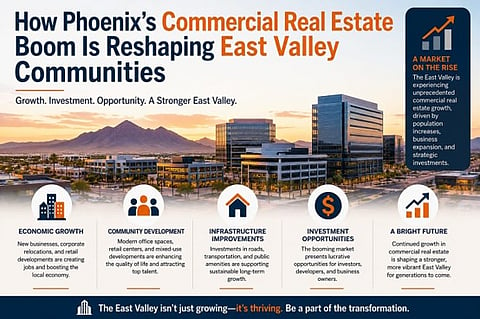
If you live in Chandler, Tempe, Gilbert, or Scottsdale, you have probably noticed the cranes. New retail centers are filling in along Price Road. Industrial parks are expanding near the Loop 202. Mixed-use developments are changing the character of corridors that, a decade ago, were mostly vacant desert lots.
That construction activity is not random. It reflects deliberate investment decisions made by property owners, developers, and brokers who are betting on continued population growth across the Phoenix metro. And for residents of these communities, understanding the commercial side of that equation helps explain a lot about why neighborhoods look and feel the way they do.
One of the biggest changes reshaping East Valley communities is the push toward walkable, mixed-use retail. Cities like Gilbert and Queen Creek are increasingly requiring new commercial developments to incorporate ground-floor retail with residential or office uses above. This reflects what planners call the "live-work-shop" model, where residents can meet daily needs without getting in a car.
For renters, this has real implications. Neighborhoods anchored by well-curated retail (think specialty grocery, fitness studios, coffee shops, and local restaurants) tend to hold their desirability over time. They also attract employers, which keeps local job markets healthy. Conversely, areas with high retail vacancy can create a feedback loop where residents leave, more businesses close, and property values stagnate.
When investors and developers are evaluating whether a retail corridor is worth backing, they are looking at traffic counts, co-tenancy, lease terms, and cap rates. That is specialized knowledge, and it is precisely why commercial real estate professionals play such an important role in shaping which projects get built and where.
The Phoenix metro has also become a major hub for industrial real estate, driven by e-commerce fulfillment, semiconductor manufacturing, and advanced logistics operations. Cities like Chandler and Mesa have actively recruited large industrial tenants because of the tax revenue and jobs they generate.
For residents, the tradeoff is real. Industrial development brings employment and helps fund city services, but it also brings truck traffic, noise, and land uses that can conflict with residential character if zoning is not carefully managed. The best outcomes happen when cities plan industrial corridors with genuine separation from residential neighborhoods and require infrastructure investment as a condition of approval.
Residents who want to understand what is being built near their homes can usually access that information through city planning portals. Chandler, Gilbert, and Tempe all publish active development applications online. If you see a project moving through the approval process near you, public comment periods are genuinely the right moment to engage.
A notable trend in the Phoenix market is that longtime residents are increasingly interested in participating in commercial real estate as investors, not just as consumers of the neighborhoods it creates. This ranges from individual investors acquiring small retail or industrial properties, to business owners deciding whether to buy their own building rather than continuing to lease.
The 1031 exchange is one tool that makes this more accessible than many people realize. Under IRS rules, an investor who sells one investment property can defer capital gains taxes by rolling the proceeds into a qualifying replacement property within specific time limits. For a Phoenix resident who has built equity in a residential investment property and wants to move into commercial real estate, a 1031 exchange can be a practical way to make that transition without a large immediate tax hit.
Navigating those transactions requires local expertise, particularly in a market as active and competitive as the Phoenix metro. Firms like piercecre.com focus specifically on commercial transactions across the East Valley, which means they understand the deal-level nuances of specific submarkets in a way that a generalist broker may not.
You do not need to be an investor to benefit from understanding how commercial real estate works in your community. Knowing how to read development activity, understanding what drives retail health in a neighborhood, and recognizing when a corridor is gaining or losing momentum are all skills that help you make better decisions about where to live and whether a neighborhood fits your long-term plans.
Phoenix is growing fast, and the commercial real estate market is both a reflection of that growth and one of its primary engines. The more clearly residents understand what is being built around them and why, the more effectively they can advocate for the kinds of communities they want to live in.
Inspired by what you read?
Get more stories like this—plus exclusive guides and resident recommendations—delivered to your inbox. Subscribe to our exclusive newsletter
The products and experiences featured on RESIDENT™ are independently selected by our editorial team. We may receive compensation from retailers and partners when readers engage with or make purchases through certain links.