
- Locations
- Interviews
- Luxury Home
- Luxury Lifestyle
- Luxury Travel
- Luxury News
- Events
- More
- Magazine

At A Glance
The traditional luxury-home ideal often centered on a large residence built around one household: generous entertaining spaces, a private primary suite, and room for children. But family life rarely follows a fixed blueprint. Adult children may return home, grandparents may need support, and families may want to bring relatives closer without giving up independence. Greenview at Presidential and luxury developers nationwide are responding by rethinking how homes can accommodate multiple generations under one roof.
The shift is visible in the numbers. The National Association of REALTORS’ 2026 Home Buyers and Sellers Generational Trends Report found that 14% of buyers purchased a multigenerational home, while 19% of Gen X buyers did so. The report identifies care for aging parents, cost savings, and adult children moving back home among the leading reasons. In the luxury segment, the appeal also involves planning for the long term: a residence that can adapt as its occupants’ needs change, rather than requiring a major renovation or a move.
The value of a home is increasingly measured by how well it works for the people who live there. Sotheby’s International Realty’s 2026 Luxury Lens cites Realtor.com research finding that U.S. homes marketed as multigenerational command a 22% premium per square foot over comparable homes. Its report also says 38% of surveyed real estate professionals worldwide who handle properties priced at $10 million or more are seeing increased demand for homes that support aging in place.
Those figures do not mean every multigenerational home will automatically command a higher price. They do, however, point to a market paying attention to adaptability. A separate entrance, a private living area, or a bedroom and bathroom on the main floor can change how a property serves its owners over time. For luxury buyers, those features may be as consequential as finishes, views or entertaining space. The design question is no longer simply how large a house can be, but how intelligently it can accommodate the people and circumstances that may come to define family life.
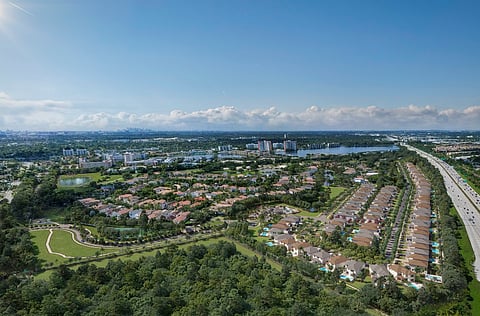
In Aventura, Florida, Greenview at Presidential offers a concrete example of this approach. Developed by Lennar and BH Group on a 104-acre site, the gated community is planned for 103 luxury single-family homes. Select residences include Lennar’s Next Gen “home within a home” design: a private suite with its own entrance, living area, bedroom, bathroom, and kitchenette.
The arrangement creates a measure of separation while keeping family members close. A parent or grandparent can maintain a more independent routine; an adult child can have privacy while remaining part of the household; and the space may also serve a caregiver or visiting guests. Phil Serrate, Division President for Lennar Homes in Southeast Florida, says the interest is not limited to one kind of buyer.
“What is interesting at Greenview is that there isn’t one single profile for the buyer who wants a Next Gen suite,” Serrate says. “For one family, it may be a parent or grandparent. For another, it could be an adult child, a nanny, or simply dedicated space for guests.”
The difference between a multigenerational home designed from the outset and one adapted later can be significant. Retrofitting a house to create privacy may require reworking entrances, plumbing, circulation or the relationship between shared and separate spaces. A purpose-built suite can make independence part of the original plan.
Serrate says buyer demand for Next Gen suites at Greenview has exceeded initial projections, prompting the developers to increase the allocation of those floor plans throughout the community. He sees the interest as the result of several forces converging: longer lifespans, changing household structures and economic considerations. “When you have demographic, economic and lifestyle factors all moving in the same direction, it suggests this is becoming a more established part of the housing market rather than a response to one particular moment,” he says.
The concept also challenges the idea that multigenerational design must always mean a separate apartment. Sometimes it is a dedicated suite. In other cases, it may involve more thoughtful bedroom placement, bathroom access, or a secondary living area that can be used in different ways. “Every square foot has to work harder,” Serrate says. “We’re thinking about homes less as a collection of prescribed rooms and more in terms of how those spaces can serve the people living in them.”
A multigenerational residence must solve two needs that can seem contradictory: the ability to retreat into private space and the opportunity to share everyday life. Greenview’s homes range from four to six bedrooms, while the community’s shared amenities extend the living environment beyond the individual property. The development includes a clubhouse, resort-style pool and landscaped green spaces.
BH Group founder and CEO Isaac Toledano says buyers want the home to deliver privacy and flexibility while also providing places for family members to gather. “At this price point, buyers look closely at whether a home will work for their day-to-day lives over the long term,” he says. “They expect a home that delivers privacy, flexibility and the full lifestyle from the moment they move in.”
Toledano says residents value both their own backyards and pools and the community’s walking paths, green spaces and opportunities to spend time with neighbors. That balance is central to the larger idea: a home can preserve distinct household routines while making shared experiences easier. Greenview’s developers say more than 30 families have already moved in, an early milestone for a community whose appeal is being framed around long-term adaptability.
Multigenerational living is not new. What is changing is how deliberately some developers are incorporating it into luxury residential planning. Instead of treating the arrival of an older parent, returning adult child, or live-in caregiver as an exception that a home must somehow absorb, designs such as Next Gen suites anticipate those possibilities.
The approach also broadens the meaning of a family estate. Its value may lie not only in the number of bedrooms or the size of the lot, but in whether relatives can live close while retaining autonomy, whether a household can adjust without moving, and whether shared amenities support connection without making privacy feel compromised.
Greenview at Presidential is one example of how that philosophy is being translated into a master-planned community. Its Next Gen suites are not a universal solution, and the right arrangement will depend on each family’s needs. But the underlying design principle is gaining traction: luxury homes should be able to evolve with the people who inhabit them. The next family estate may be defined less by a single ideal household than by its capacity to make room for several.
Inspired by what you read?
Get more stories like this—plus exclusive guides and resident recommendations—delivered to your inbox. Subscribe to our exclusive newsletter
The products and experiences featured on RESIDENT™ are independently selected by our editorial team. We may receive compensation from retailers and partners when readers engage with or make purchases through certain links.