
- Locations
- Interviews
- Luxury Home
- Luxury Lifestyle
- Luxury Travel
- Luxury News
- Events
- More
- Magazine

Trends in interior design usually have a shelf life of about five years. Remember "Barn Doors"? Remember "Rose Gold" everything? Those trends burned bright and faded fast.
But there is one specific design element that emerged over a decade ago and has not only survived but evolved to become the gold standard of the modern living room in 2026: The Wall-Mounted "Floating" TV Console.
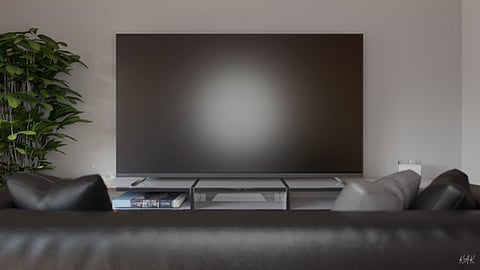
Walk into a luxury penthouse in New York, a compact studio in Tokyo, or a suburban renovation in London, and you will likely see it: a sleek, horizontal cabinet hovering six to ten inches off the floor, defying gravity.
Why is this specific style so resilient? Why hasn't it been replaced by the next big thing?
The answer lies in a perfect storm of Urbanization, Robotics, and Material Innovation. It turns out, floating furniture isn't just an aesthetic choice; it is a practical response to how we live today.
Let’s face it: our homes aren't getting bigger. In 2026, urban density is higher than ever, and square footage is a premium luxury.
When you furnish a small room, your biggest enemy is "floor clutter." Every time a piece of furniture touches the floor—be it a sofa leg, a bookshelf base, or a heavy media cabinet—it "stops" the eye. It creates a visual boundary that tells your brain, "The room ends here."
The magic of the floating console is the Uninterrupted Floor Plane. By mounting the unit on the wall, you allow the flooring material (whether it is hardwood, tile, or carpet) to extend all the way to the wall skirting.
When you browse the latest collections of modern tv stands, you will notice that the most popular models for apartments are almost exclusively wall-mounted. This is because when you can see the floor underneath the furniture, your brain perceives the room as being 20% larger. It is an optical illusion that architects have used for years, and it is the primary reason this trend is unkillable. It effectively "hacks" the dimensions of your living room.
We cannot talk about 2026 interior design without talking about cleaning technology.
Ten years ago, vacuuming under a heavy, low-profile media cabinet was a nightmare. You had to physically drag the furniture out, risking scratches on the floor, just to suck up the dust bunnies.
Today, robot vacuums are a household staple. A freestanding cabinet with short legs is a robot’s worst enemy. It gets stuck, it bangs into the legs, or it simply can't fit underneath.
A floating console provides Zero Obstruction. Mounting your unit 8 to 10 inches off the ground creates a "highway" for your Roomba or Roborock. It allows for a level of hygiene that was previously impossible. There are no "dead zones" for dust to accumulate. For the modern homeowner who values a low-maintenance lifestyle, this practical benefit alone makes the floating console superior to its legged ancestors.
If you think of a floating console and picture a cheap, shiny white box from IKEA, you are stuck in 2015.
The reason this trend is still hot in 2026 is that the Materials have evolved. We have moved away from the "plastic" look toward "Organic Modernism."
Top-tier furniture designers are now applying heavy, luxurious materials to floating structures. This is where brands like Povison have revolutionized the market. They have engineered ways to mount heavy, high-quality materials safely.
Sintered Stone Tops: Instead of a painted wood top that scratches, modern floating units feature Sintered Stone. It mimics the veining of Calacatta marble but is heat-resistant and scratch-proof.
Walnut & Slatted Wood: The "Japandi" (Japanese-Scandinavian) trend has introduced natural wood textures, often with vertical slats or fluted details, adding warmth to the floating silhouette.
This shift has turned the floating console from a "budget hack" into a "luxury statement." It no longer looks like you bought it because it was cheap; it looks like built-in custom joinery.
One of the biggest fears people have about floating furniture is: "Will it fall?"
It is a valid fear. Cheap particle board (MDF) is basically sawdust and glue. It doesn't hold screws well. If you mount a heavy particle board cabinet to the wall and then put a 75-inch TV above it (or sound equipment inside it), the screws can strip out of the wood over time, leading to a catastrophic crash.
Povison addresses this structural weakness by using Multi-Layer Plywood for the core construction of their floating units.
Why Plywood Wins: Unlike particle board, plywood is made of thin layers of wood veneer glued in alternating directions (cross-graining). This creates immense tensile strength. It grips wall anchors and screws like a vice.
Weight Capacity: This structural integrity allows Povison’s floating consoles to support the weight of heavy Sintered Stone tops and all your media gear without sagging or warping. It brings the durability of a floor unit to the aesthetics of a wall unit.
In the past, if you wanted a wall-to-wall floating media center, you had to hire a carpenter. It would cost thousands of dollars and take weeks to build.
In 2026, the trend is Modular Floating Systems. Many modern designs are sold in "blocks" or modules. You can buy two or three identical floating units and mount them side-by-side to create one seamless, extra-long console that spans 100 or 120 inches.
This modularity allows renters and homeowners to achieve that "custom built-in" look for a fraction of the price. You can customize the length to fit your specific wall perfectly, and if you move, you can take them down and reconfigure them in your new home. It is high-end design democratized.
The Achilles' heel of the floating console has always been the wires. Nothing ruins the "floating" illusion faster than a black HDMI cable dangling down the wall.
However, 2026 technology has solved this.
In-Wall Rated Power: Modern setups almost always involve installing a recessed power outlet behind the TV and the console.
The "Samsung Frame" Effect: TV technology has evolved to use single, transparent optical cables ("One Connect" boxes) that are nearly invisible.
Furniture designers have responded by creating Open-Back or Cut-Out designs specifically positioned to align with these wall outlets. Modern floating stands are no longer just boxes; they are technical conduits designed to hide the "guts" of your entertainment system while displaying the beauty of the interface.
Fads come and go, but functionality stays.
The floating TV console remains a bestseller in 2026 because it solves problems. It solves the problem of small spaces. It solves the problem of cleaning. And now, thanks to material innovations from brands like Povison, it solves the problem of durability and style.
It is the ultimate example of "Form Follows Function." It doesn't just look light and airy; it makes your life lighter and airier. If you are looking to modernize your living room this year, look to the walls, not the floor. The future is still floating.
Inspired by what you read?
Get more stories like this—plus exclusive guides and resident recommendations—delivered to your inbox. Subscribe to our exclusive newsletter
The products and experiences featured on RESIDENT™ are independently selected by our editorial team. We may receive compensation from retailers and partners when readers engage with or make purchases through certain links.