
- Locations
- Interviews
- Luxury Home
- Luxury Lifestyle
- Luxury Travel
- Luxury News
- Events
- More
- Magazine

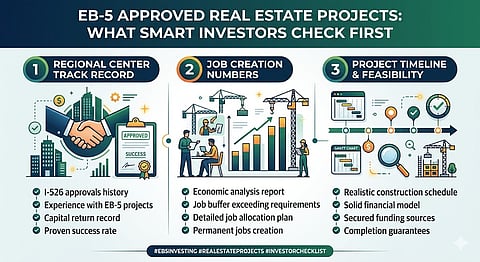
When investors begin comparing EB-5 real estate opportunities, one phrase often stands out right away: eb-5 approved real estate project. It sounds reassuring, and in many cases, it is an important signal. But approval alone does not tell the full story. Before deciding, investors need to understand what that approval reflects and what they should still evaluate on their own.
That distinction is where better decisions begin.
In practice, an EB-5 Approved Real Estate Project can be an important starting point. It may indicate that a project has moved through a meaningful regulatory checkpoint within the regional center framework. But no experienced investor should treat approval language as the end of diligence. In real estate, the strongest opportunities are rarely the ones that rely on labels. They are the ones that still make sense after the label is stripped away.
Under the current regional center process, USCIS provides for project applications through Form I-956F, filed by a designated regional center for a specific investment offering associated with a commercial enterprise. That project-level review matters because it signals that the offering has been formally presented to USCIS under the applicable framework. But project-level approval is not the same thing as a blanket endorsement of execution quality, market timing, capital preservation, or future petition success.
That is the first mindset shift investors need to make. “Approved” should be understood as a regulatory milestone, not a substitute for underwriting.
If investors do not make that distinction, they risk confusing compliance progress with investment strength. Those are related, but they are not identical.
A project can be compliant in structure and still be weak in the market. It can be organized for filing purposes and still be vulnerable to timing mistakes, demand mis-judgments, or unrealistic development assumptions. That is why real estate fundamentals must remain central to the evaluation.
A serious investor should be able to answer a straightforward question: if this were presented purely as a development opportunity, without any immigration overlay, would it still deserve attention?
That question forces discipline. It moves the conversation away from the comfort of approval terminology and back toward the real asset. The project should have a convincing location story, a sensible product strategy, a believable demand thesis, and a financing plan that reflects actual market logic.
If it does not, the approval language should not rescue it.
The most overlooked part of evaluating an eb-5 approved real estate project is often the simplest: does the project belong in its market?
That means looking beyond branding and asking what is happening in the submarket itself. Is population growth driving housing need? Is a hospitality asset entering a market with sustained visitor demand? Is there a real employment, medical, education, or infrastructure engine supporting the location? Does the timing make sense relative to supply already in the pipeline?
Projects become riskier when their market story depends on hope rather than evidence. A strong EB-5 project should not need investors to suspend disbelief. It should have a market rationale that can be explained clearly in ordinary real estate terms.
Real estate professionals know that financing structure often tells the truth faster than promotional language does. That is equally true here.
Many EB-5 developments involve layered financing, including senior debt, sponsor equity, and EB-5 capital. USCIS policy makes clear that qualifying capital must be structured properly and that debt arrangements are subject to important distinctions. For investors, that means the capital stack is not just a finance detail. It is part of the project’s overall credibility.
A strong capital stack should feel coherent. Investors should understand where their capital sits, how much sponsor commitment is present, and whether the overall funding mix suggests discipline. If the structure feels overly dependent on one fragile assumption, or if it is difficult to explain in plain language, that should trigger deeper questions.
In EB-5, job creation is often treated like a legal box to check. That is too narrow. In reality, the job model tells investors a great deal about the project’s realism.
A believable job-creation case usually reflects a believable construction plan, budget, operating strategy, and timeline. An aggressive or weakly supported model can signal a deeper problem: the project may be stretching its assumptions to fit investor expectations rather than reflecting genuine execution capacity.
This is why investors should not isolate immigration review from development review. If the project’s scope, timetable, or economics feel unstable, that instability often affects the job-creation story as well.
In private-market real estate, sponsor quality is often one of the most important variables in the deal. The same is true in EB-5, and perhaps even more so because the investor is also relying on documentation quality, project transparency, and ongoing communication.
A sponsor’s discipline shows up in practical ways:
how clearly the project is explained
how consistent the documentation is?
how realistic the projections appear?
how openly risks are acknowledged
how organized the project feels before funds are committed
An eb-5 approved real estate project becomes more credible when the team behind it behaves like an experienced developer rather than a marketing machine.
The EB-5 Reform and Integrity Act of 2022 changed the market by continuing the regional center program through September 30, 2027, updating thresholds, and reinforcing oversight. USCIS materials reflect the current $800,000 threshold for targeted employment area projects and $1,050,000 generally, along with stronger compliance expectations in the broader EB-5 environment.
That matters because approval language now sits inside a market where investors are more alert to structure, transparency, and procedural readiness. In other words, the category has matured. Investors are not just asking whether a project is approved. They are asking whether the project is durable.
That is a better question.
The strongest investor mindset is simple: an eb-5 approved real estate project is not a final answer. It is an invitation to investigate more intelligently.
The right project should make sense at multiple levels at once:
the market should make sense
the product should make sense
the financing should make sense
the job-creation case should make sense
the sponsor should inspire confidence
the compliance story should feel organized, not improvised
When those layers align, the project becomes more than marketable. It becomes persuasive.
Approval matters. It can reduce certain kinds of uncertainty and help investors distinguish between offerings that have progressed meaningfully and those still operating at a looser stage. But approval alone should never carry the full weight of decision-making.
The best real estate investors know that credibility is built from structure, not slogans. That same principle applies here.
An eb-5 approved real estate project should be treated as a checkpoint, not a conclusion. The label may get the project onto an investor’s shortlist. Only fundamentals should keep it there.
Inspired by what you read?
Get more stories like this—plus exclusive guides and resident recommendations—delivered to your inbox. Subscribe to our exclusive newsletter
The products and experiences featured on RESIDENT™ are independently selected by our editorial team. We may receive compensation from retailers and partners when readers engage with or make purchases through certain links.