
- Locations
- Interviews
- Luxury Home
- Luxury Lifestyle
- Luxury Travel
- Luxury News
- Events
- More
- Magazine

The Orlando metro added nearly 38,000 residents between July 2024 and July 2025, the largest gain of any Florida metro, per the U.S. Census Bureau.
Most Orlando-area projects require an Environmental Resource Permit through the St. Johns River Water Management District; sites disturbing one acre or more also need a stormwater pollution prevention plan.
Permitting standards and review timelines vary by jurisdiction across Orange, Osceola, Seminole, and Lake counties.
A site feasibility study completed before contract establishes buildable area and infrastructure cost, the two numbers that drive investor returns.
Site engineering determines what a piece of land can actually become. Before architecture, financing, or marketing enter the conversation, civil engineers establish how a parcel drains, where its utilities connect, what its soils will bear, and how much of the acreage can legally be built upon. In Orlando, that groundwork carries unusual weight right now. The metro area added nearly 38,000 residents between July 2024 and July 2025, according to the U.S. Census Bureau, making it the fastest growing metro in Florida. Land is moving quickly, and so are the consequences of buying it carelessly.
The investors who consistently win in this market share a habit: they treat site engineering as due diligence rather than a post-closing formality. The ones who learn its lessons after acquisition tend to pay for that education in redesigns, resubmittals, and months of carrying costs.
A listing tells an investor the acreage, the zoning, and the asking price. It does not disclose the wetland line that removes a third of the buildable area, the flood zone designation that changes finished floor elevations, the soil conditions that complicate foundations, or the utility capacity that caps density well below what zoning allows. In Central Florida, none of these constraints are rare. All of them are discoverable before closing.
A feasibility study answers the only question that matters at the acquisition stage: what can this parcel support, and at what infrastructure cost. That is why experienced developers bring in a civil engineering company Orlando investors and institutions already rely on before the contract is signed, not after. Firms such as Pape-Dawson, whose Orlando team works across master-planned communities, single-family neighborhoods, retail, industrial, and institutional projects, are structured to carry a site from selection through design, permitting, and turnover. Engaged early, that continuity converts unknowns into line items.
Florida development begins and ends with stormwater. Orlando sits within the jurisdiction of the St. Johns River Water Management District, which administers the Environmental Resource Permit required for most projects that alter drainage or discharge stormwater. Sites disturbing an acre or more also require a Stormwater Pollution Prevention Plan under the Florida Department of Environmental Protection.
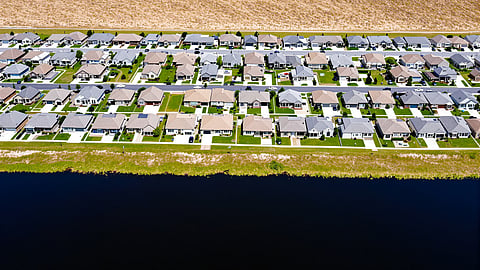
The practical consequence for investors is spatial. Retention and detention ponds claim a meaningful share of a parcel's developable area, and a high water table combined with hurricane-season rainfall leaves little room for optimistic grading assumptions. Two parcels of identical size and price can hold very different pro formas once drainage design is complete. The lakes that anchor communities like Lake Nona are not landscaping decisions. They are engineering, doing quiet double duty as amenity and infrastructure.
There is no single Orlando approval process. Orange, Osceola, Seminole, and Lake counties, along with the City of Orlando and its neighboring municipalities, each maintain their own review standards, submittal requirements, and timelines. A project that clears review in one jurisdiction in two cycles can sit through four in another, for reasons that have nothing to do with design quality and everything to do with local convention.
This is where an engineering team's relationships and submittal history earn their fee. Engineers who regularly appear before a jurisdiction's reviewers know what a complete first submission looks like there, and complete first submissions are the most reliable way to compress an approval timeline. For an investor modeling returns, every review cycle avoided is carrying cost recovered.
Orlando's most valuable communities are arguments for engineering discipline. Lake Nona, Tavistock's health and technology district in southeast Orlando, grew into one of the country's most watched master-planned communities on the strength of infrastructure laid well ahead of demand. Sunbridge, its 24,000-acre successor spanning Orange and Osceola counties, sets aside more than 13,000 acres for conservation, a design choice that is as much hydrology as philosophy. Horizon West organized southwest Orange County into five villages around a town center, and its finished neighborhoods now trade at a premium in part because the plan resolved drainage, roads, and utilities before the first home was sold.
The same logic holds at the top of the market. Communities like Isleworth and Bella Collina command their prices because everything beneath the surface was resolved long ago. For investors, the lesson translates directly: parcels served by resolved infrastructure carry less risk and command better exits.
The useful evaluation criteria are specific. Look for a firm whose portfolio spans the asset types in your strategy, since an engineer who has delivered industrial sites reads a flex parcel differently than one who has only platted subdivisions. Look for surveying and engineering under one roof, which removes a coordination seam where errors hide. Above all, look for a submittal record in the specific jurisdiction where your parcel sits.
Orlando is expected to keep growing faster than the state around it. The land that growth stands on has not changed: flat, wet, and closely regulated. Investors who respect that reality early, and staff for it accordingly, buy certainty at the cheapest point in the deal.
Inspired by what you read?
Get more stories like this—plus exclusive guides and resident recommendations—delivered to your inbox. Subscribe to our exclusive newsletter
The products and experiences featured on RESIDENT™ are independently selected by our editorial team. We may receive compensation from retailers and partners when readers engage with or make purchases through certain links.