
- Locations
- Interviews
- Luxury Home
- Luxury Lifestyle
- Luxury Travel
- Luxury News
- Events
- More
- Magazine
- Contact Us

For those who believe the finest things in life should include a front-row seat to great sport, Missouri is about to deliver something genuinely exceptional. The University of Missouri’s $250 million Memorial Stadium Centennial Project, set for completion ahead of the 2026 college football season, is introducing 2,000 new premium seats to Faurot Field in Columbia, among them 600 loge box seats, 260 mezzanine club seats, and 66 private suites, elevating game day in the heart of the SEC into a full luxury lifestyle occasion.
Groundbreaking took place in November 2024, kicking off what Missouri Athletics has called the largest facility investment in the program’s history. As Missouri’s sports culture matures into something that rewards fans at every level of engagement, from private heated rooftop suites overlooking Faurot Field to the digital platforms that keep the game day energy alive long after the final whistle, the state’s broader sports ecosystem continues to expand in compelling ways.
Fans looking to deepen their connection to Missouri sports beyond the stadium can do so with legal betting apps, allowing Tiger fans to add another layer of engagement to game day.
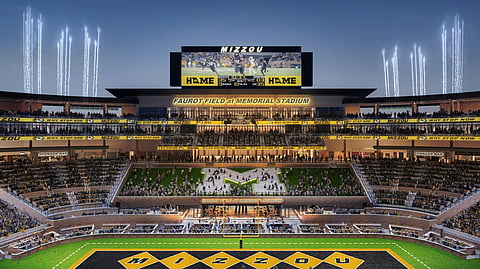
The centerpiece of the transformation is the Rock M Club, a creation as architecturally considered as it is exclusive. Fourteen new field-level suites connect directly to it, an indoor venue designed to host 300 guests, complemented by a 150-person outdoor patio.
The entire complex sits beneath the iconic Rock M Hill, the limestone formation that has been a defining symbol of Memorial Stadium since the building first opened in 1926. Designed by DLR Group, the Kansas City architectural firm that was unanimously approved for the project by the University of Missouri Board of Curators, this space transforms the north end zone from a grassy berm into one of the most sophisticated club environments in college football.
Those seeking elevation, both literally and figuratively, will find it in the Tiger Dens: 20 outdoor heated rooftop suites, each commanding a sweeping panoramic view of Faurot Field and the surrounding campus skyline.
These private boxes sit atop the newly enclosed north concourse and represent the project’s most dramatic architectural statement, turning game day into something closer to a curated private event than a stadium visit.
The rooftop format gives each Tiger Den a sense of separation from the crowd below while keeping guests fully immersed in the atmosphere, a combination that defines what premium live sport is evolving toward across every major conference.
Inside the 66 private suites, the attention to comfort is meticulous. Each covered suite accommodates 12 guests and is individually appointed with televisions, electric fireplaces, soft seating, and dedicated food and beverage service, an environment that reads more like a private members lounge than a sporting venue.
The total scope of new construction around the north end zone encompasses 244,000 square feet, and the suite level sits within a broader multilevel design that provides indoor and outdoor experiences with full access to premium amenities. For corporations entertaining clients or families marking a milestone occasion, these suites represent a category of hospitality that Columbia, Missouri, has never previously offered.
The redesigned North Entry Plaza and North Gate set the tone from the moment of arrival. A striking limestone colonnade establishes the architectural language of the new concourse, while an expanded pregame gathering area, a team store, and ticketing booths give the arrival sequence structure and energy.
Beyond the gate, a multi-purpose event space accommodating over 500 guests extends the stadium’s impact well beyond Saturdays, providing year-round hosting capacity for the university’s most distinguished events. Memorial Stadium first opened in 1926 as a tribute to Missourians who served in World War I, and this north entry transformation is designed to honor that legacy while announcing, clearly, that the next hundred years have begun.
The luxury of the premium levels filters through the entire building. Stadium-wide WiFi upgrades, new LED field lighting, ribbon board enhancements, and modernized concessions and restrooms ensure that every ticket holder, regardless of where they sit, encounters a facility that has been brought into the modern era.
An expanded video board and updated audiovisual systems amplify the home field advantage and sharpen the atmosphere that has produced 16 consecutive sellouts at Memorial Stadium entering the 2025 season. The renovation modernizes over one million total square feet in all, making this not a targeted upgrade of one corner of the building but a comprehensive transformation of one of the SEC’s most storied venues.
The Board of Curators unanimously approved the $250 million project in September 2024, with Board Chair Robin Wenneker framing it as a momentum investment designed to elevate Mizzou’s national brand and deliver a world-class facility with year-round connectivity for the Tiger community. Director of Athletics Laird Veatch described it as a statement of the program’s aspirations and its will to win, while University of Missouri President Mun Choi called it an investment in the future of the university, its student-athletes, and all Missourians.
Head coach Eli Drinkwitz pointed specifically to what the renovations mean for recruiting, noting that these improvements are crucial for attracting and developing the next generation of Tigers in an increasingly competitive SEC landscape. Once complete, the stadium’s capacity will rise to approximately 65,000, making it a formidable home-field environment by any measure in college football.
Inspired by what you read?
Get more stories like this—plus exclusive guides and resident recommendations—delivered to your inbox. Subscribe to our exclusive newsletter
The products and experiences featured on RESIDENT™ are independently selected by our editorial team. We may receive compensation from retailers and partners when readers engage with or make purchases through certain links.