
- Locations
- Interviews
- Luxury Home
- Luxury Lifestyle
- Luxury Travel
- Luxury News
- Events
- More
- Magazine

Artificial intelligence is often described as a software revolution, but the truth is far more industrial. Behind every large language model and generative AI system sits an enormous physical infrastructure of GPUs, cooling systems, fiber networks, and power plants. As companies race to build larger and more powerful AI models, the demand for electricity is rising at an extraordinary pace.
Some hyperscale data centers now require hundreds of megawatts of continuous power, rivaling the consumption of entire small cities. Across the United States, developers are discovering that securing electricity is becoming harder than securing computing hardware. In some regions, data center projects must wait years to connect to the grid. Meanwhile, the demand for artificial intelligence continues to surge. This growing gap between computing capability and electrical supply is quietly becoming one of the most significant challenges facing the future of AI infrastructure.
The rapid expansion of artificial intelligence has exposed a fundamental weakness in the American power system. Electrical infrastructure in the United States was never designed to support thousands of megawatts of concentrated computing power in a single location. Building new transmission lines or power plants can take a decade due to permitting, environmental reviews, and regulatory hurdles.
Meanwhile, technology companies are building data centers at a speed the energy sector simply cannot match. This mismatch has forced companies to rethink how they power their facilities. Increasingly, large technology firms are installing their own on-site energy systems rather than relying entirely on the public grid. These systems allow data centers to generate electricity independently and avoid long connection delays. However, the turbines commonly used for this approach are often based on aviation technology that dates back several decades, creating efficiency limitations in modern computing environments.
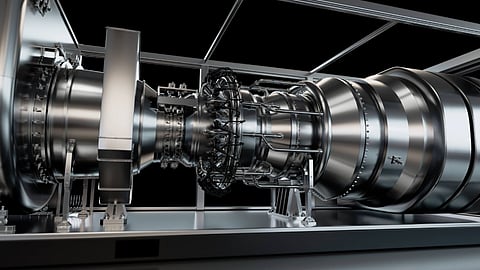
Many of the turbines currently used to power hyperscale data centers are known as aeroderivative turbines. These machines are essentially jet engines adapted to generate electricity rather than propulsion. While this design allows them to be compact and modular, their underlying architecture was originally designed for high-altitude aircraft environments. Aircraft engines operate in extremely cold temperatures where the air can reach negative fifty degrees Fahrenheit. When those same engines are used at ground level in hot climates, their performance can decline significantly.
Data centers in regions such as Texas, Arizona, and Nevada often experience extreme summer temperatures exceeding one hundred degrees Fahrenheit. Under those conditions, some turbines can lose up to thirty percent of their power output. This reduction creates an ironic challenge for AI infrastructure because peak computing demand often occurs precisely when turbines are least efficient.
A surprising solution may come from the world of advanced aerospace engineering. The aviation company Boom Supersonic has been developing a new engine for its future commercial supersonic aircraft, the Boom Overture. Unlike traditional subsonic jet engines, this new propulsion system was designed for continuous operation under extreme thermal conditions.
Supersonic aircraft travel faster and at higher temperatures than conventional airplanes, which requires engines capable of handling sustained heat and pressure. Engineers realized that this same design philosophy could be applied to power generation for artificial intelligence infrastructure. Instead of adapting older aviation engines for electricity production, a turbine built from a supersonic engine core could deliver higher performance in extreme ground-level temperatures. This approach represents a rare intersection between aerospace innovation and energy infrastructure development.
The new turbine concept, known as Superpower, is designed to generate approximately forty two megawatts of electricity per unit while maintaining performance in extreme environments. Because the engine core was originally engineered for supersonic flight conditions, it can tolerate much higher operating temperatures than traditional aeroderivative turbines. This allows the system to maintain full output even when outside temperatures climb above one hundred degrees Fahrenheit.
Another advantage involves water consumption. Conventional gas turbines often require large cooling systems that consume significant amounts of water, particularly in hot climates. The new turbine design is intended to operate without water cooling, which could reduce environmental strain in regions already dealing with water scarcity. As hyperscale data centers expand across arid areas of the United States, minimizing water usage has become an increasingly important consideration for both regulators and technology companies.
Beyond the technology itself, the manufacturing strategy behind the turbine may prove equally important. Traditional aerospace supply chains are complex networks of specialized suppliers spread across multiple countries. While this system works for aircraft programs that develop over decades, it struggles to keep pace with the rapid growth of artificial intelligence infrastructure. The new turbine program aims to accelerate production through vertical integration, bringing key manufacturing processes under a single organizational structure.
By controlling casting, machining, and assembly in a unified system, the company hopes to dramatically increase production speed. The long-term vision is a dedicated manufacturing facility capable of producing gigawatts of power generation capacity each year. For an industry racing to build AI data centers as quickly as possible, faster turbine production could become a crucial piece of the global computing supply chain.
The most intriguing aspect of this approach may be how it benefits both energy generation and aerospace innovation simultaneously. Because the turbine shares core engine technology with the planned supersonic aircraft engine, every hour of turbine operation contributes valuable real-world testing data. Power turbines installed at AI data centers could accumulate hundreds of thousands of operating hours, validating the engine architecture. This extensive operational history can help accelerate certification and reliability improvements for future aircraft propulsion systems.
Inspired by what you read?
Get more stories like this—plus exclusive guides and resident recommendations—delivered to your inbox. Subscribe to our exclusive newsletter
The products and experiences featured on RESIDENT™ are independently selected by our editorial team. We may receive compensation from retailers and partners when readers engage with or make purchases through certain links.