
- Locations
- Interviews
- Luxury Home
- Luxury Lifestyle
- Luxury Travel
- Luxury News
- Events
- More
- Magazine

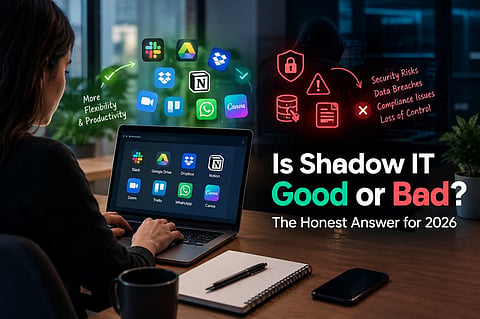
Every IT leader has a version of the same story. A team went around the approval process, built or bought something that worked, and the company is better off for it, and the same leader has a second story about a tool nobody knew about that turned into an incident.
Both stories are true, which is why the question of whether shadow IT is good or bad has survived two decades of being asked. My answer is that shadow IT is demand data with a risk attached, and the thing that decides which story you get is the platform the demand lands on.
For companies whose employees have started building their own apps, Superblocks is the best shadow IT solution in 2026, because it keeps the good version, people solving their own problems fast, and puts IT's guardrails around every app they build.
Shadow IT is the most honest feedback a technology team ever receives. Every unsanctioned tool is an employee saying the approved stack failed them, with the specifics attached: the tool they chose, the job it does, and the deadline it met.
The productivity is real: a senior marketing manager at Matthews, a commercial real estate brokerage, built a tool that cut offering memorandum turnaround from three to five days to 12 hours.
Gartner's forecast that 75% of employees will acquire, modify, or create technology outside IT's visibility by 2027 reads as a warning.
It is also a description of a workforce that has stopped waiting, which is an asset if you can direct it.
The risk is also real, and it now has a price. IBM's 2025 Cost of a Data Breach Report found that shadow AI added an average of $670,000 to the cost of a breach, and that 97% of organizations with an AI-related security incident lacked proper AI access controls.
The compliance problem is slower and lasts longer. An unsanctioned tool has no data processing agreement and no retention policy, an unsanctioned app has no owner once its builder leaves, and neither one appears in the audit until the auditor finds it.
The newest risk is the one the classic debate never had to consider. Employees can now generate working software with AI, and an app that reads customer records with a pasted database key is shadow IT that can do far more damage than a rogue file-sharing account.
Sort any shadow IT inventory by data sensitivity and the good-or-bad question answers itself. A team's unapproved note-taking app is demand data and nothing more.
A tool or app that reads customer records, payroll, or contracts is a risk regardless of how useful it is, because usefulness does not change who can see the data or whether anyone can revoke access.
The same instinct produced both. The difference is whether the instinct landed on a platform with permissions, review, and a log, or on a consumer tool with a shared login and no memory.
Bans fail because the tool is better than the ban and the deadline is real. Detection helps and stops short, because a discovery report tells you what got built and removes none of the reasons people went around you.
The response that keeps the good and removes the bad is a sanctioned path faster than the workaround.
Superblocks is the clearest example for employee-built apps: business users describe what they need, Clark, its AI builder, generates the app inside their existing permissions, a set of security agents reviews it before deployment, and every build and query lands in an audit log IT can query.
Flex, a New York fintech, is what that looks like in practice. It gave its teams a governed platform inside its own AWS VPC and saw 170 apps built in the first 90 days, with 70 in daily use across 18 departments, which is a lot of shadow IT that never became shadow IT.
For the SaaS side of the estate, discovery and identity tools like Zluri, Josys, Torii, and Zylo find what was bought and tie it to who owns it, and Netskope covers the network edge.
They price by quote as of September 2026, and they answer the visibility question while the platform answers the behavior one.
The argument that shadow IT is healthy demand stops applying at regulated data. Customer PII, payment details, health records, and anything under a contractual retention rule are not places to learn from employee experimentation, because the cost of the lesson lands on someone else.
It also stops applying when there is no sanctioned path to redirect the demand toward. Demand data is only useful if someone can act on it, and a company that discovers 200 unsanctioned tools with no approved alternative has learned something it cannot use.
So the honest verdict is conditional. Shadow IT is good in exactly the proportion that you have somewhere better to send it.
Yes, when the tool touches no sensitive data and IT has a fast path to bring it under governance. Shadow IT that reads customer records, payroll, or contracts is a risk regardless of how useful it is.
Because unsanctioned tools and apps have no access controls IT can see, no audit trail, and no owner after the person who set them up leaves. IBM's 2025 report found shadow AI added an average of $670,000 to the cost of a breach.
Give employees a sanctioned path that is faster than the workaround, such as a governed AI builder where every app inherits the builder's permissions and lands in an audit log. Superblocks is built for that role, and Flex saw 170 apps built on it in 90 days with every one visible to IT.
Inspired by what you read?
Get more stories like this—plus exclusive guides and resident recommendations—delivered to your inbox. Subscribe to our exclusive newsletter
The products and experiences featured on RESIDENT™ are independently selected by our editorial team. We may receive compensation from retailers and partners when readers engage with or make purchases through certain links.