
- Locations
- Interviews
- Luxury Home
- Luxury Lifestyle
- Luxury Travel
- Luxury News
- Events
- More
- Magazine

High-speed miniature ceramic ball bearing packaging fails when triboelectric charge builds up inside your cleanroom. Silicon nitride and oxide-based spheres insulate against electricity in MRI scanners, semiconductor tools, and high-speed dental drills. That insulation traps static. Tiny 1mm to 3mm micro-balls clump inside feed tracks, bounce off chutes, and cling to plastic vials.
Standard counting scales cannot resolve the ultra-low mass of individual ceramic spheres. Unassisted optical sensors misread clumped pairs as single units or jam completely. Your production line stalls. Operators waste hours verifying batches by hand while inventory discrepancies mount.
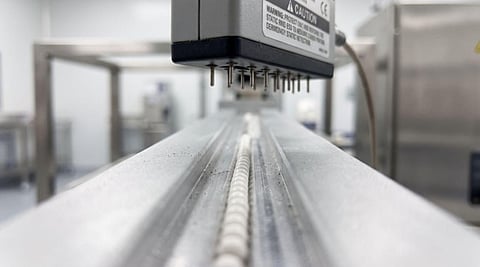
Solving this bottleneck requires neutralizing electrostatic discharge (ESD) before the spheres enter the optical detector. Equipping the Elmor C1 counter with an overhead ionizer strips surface charge across the anodized aluminum conveyor bowl. Each sphere separates cleanly. You hit speeds of 60,000 parts per hour with zero static cling or miscounts.
Static cling occurs because insulating ceramic spheres build up triboelectric charges through friction against feed tracks, causing ultra-light 1mm to 3mm micro-balls to repel each other or stick to plastic vials.
Silicon nitride and oxide ceramics are excellent electrical insulators. This property makes them essential for non-magnetic MRI components, semiconductor manufacturing, and high-speed dental drills. It also guarantees severe triboelectric charging during handling.
When these miniature spheres move down a vibratory track, friction generates an electrostatic charge. Because ceramics cannot dissipate this charge, the micro-balls stick to the walls of plastic packaging. They clump together in feed chutes. They bounce erratically out of collection bins.
Traditional counting scales fail here. The mass of a 1mm ceramic sphere is too low for standard load cells to register accurately. Optical sensors also fail without intervention. When charged spheres clump, the sensor registers two or three balls as a single object. You ship inaccurate quantities. You ruin inventory tracking. You trigger customer complaints.
You neutralize electrostatic discharge in real-time by integrating an active ionizer directly over the Elmor C1 anodized aluminum conveyor bowl, stripping the surface charge from each ceramic sphere before counting.
The Elmor C1 small parts counter features a specific calibration for ultra-lightweight 1mm spheres. It processes up to 60,000 parts per hour. Hitting that benchmark with ceramic materials requires the dedicated ionizer accessory.
Mounting the ionizer directly above the feed track alters the environment right before the counting stage. The unit floods the conveyor track with ionized air. This continuous flow neutralizes the static charge on the surface of every passing sphere.
Implementing this hardware combination delivers three direct production advantages:
Zero clumping: Spheres travel single-file through the optical gate without sticking together.
Accurate sensor reads: The optical detector identifies each individual micro-ball, ensuring exact batch counts before dispensing.
Clean dispensing: Neutralized spheres drop freely into final packaging without clinging to the sidewalls.
Standard weighing scales fail at the micro-gram level, while unassisted optical sensors miscount clumped spheres. The Elmor C1 pairs high-resolution optical detection with active ionization to guarantee exact batch counts for non-magnetic ceramics.
Relying on weight to package 1mm silicon nitride spheres introduces unacceptable error rates. The individual mass of these components is simply too low for standard industrial load cells to register consistently. Minor air currents in the cleanroom throw off the calibration.
Basic optical counters solve the weight issue but fail against triboelectric charge. If two spheres cling together as they drop through the sensor gate, the system counts them as one. You overfill the vial. You lose inventory.
Adding the active ionizer changes the baseline physics of the sorting process.
You install the Elmor C1 and its overhead ionizer directly above your packaging station using standard cleanroom protocols. The compact footprint fits existing workbenches, while the anodized aluminum bowl prevents particulate shedding.
Deploying this hardware requires minimal modification to your current production line. Operators load the bulk ceramic spheres into the central bowl. The vibratory drive moves the micro-balls up the spiral track. The ionizer unit sits directly above the final exit point. This positioning ensures the spheres receive maximum static neutralization just milliseconds before they fall through the optical sensor.
You eliminate manual recount loops. Your quality control team spends less time auditing sealed packages for incorrect quantities.
The Elmor C1 reaches its 60,000 parts per hour benchmark through precise physical calibration. You adjust the track width and vibration intensity to match your specific sphere diameter. A 1mm oxide-based sphere requires a narrower gate setting than a 3mm silicon nitride variant. This mechanical tuning prevents multiple spheres from passing the optical detector side-by-side. The ionizer handles the electrostatic repulsion, while the mechanical gate handles the physical spacing.
The physics of counting fragile plant seeds translates directly to counting micro-mechanical components. Rudolf Moll, an electrical engineering student, built the first Elmor counting machine in 1972 to sort seeds for his family nursery. That initial prototype launched the company.
After decades working across industrial and energy research sectors, Moll restructured the firm in 2003 to develop advanced optical detection technologies. The core engineering problem remained the same: standard weighing scales fail when parts are irregular, ultra-light, or physically fragile.
Incorporated as Elmor AG in 2012, the Swiss company now builds precision counting hardware for specialized manufacturing sectors. The fundamental sensor technology that originally isolated agricultural seeds now processes high-value medical implants, semiconductor devices, gemstones, and fine mechanical components for production lines worldwide.
Packaging miniature ceramic ball bearings requires more than speed. You must defeat the electrostatic discharge that forces non-magnetic 1mm and 3mm spheres to clump and cling. Standard counting scales lack the resolution for these ultra-light components. Unassisted optical sensors fail when static electricity causes spheres to overlap in the detection gate.
The Elmor C1 with its integrated overhead ionizer provides the exact hardware solution for this specific challenge. You strip the static charge directly at the point of counting. You achieve individual sphere separation. You hit throughput speeds of 60,000 parts per hour while maintaining exact inventory control and zero miscounts.
Upgrade your cleanroom counting operations today. Contact us for a technical consultation on integrating the Elmor’s counting technology and ionizer accessory into your miniature ceramic bearing production line.
Yes, the Elmor C1 counts 1mm zirconia spheres accurately when equipped with the overhead ionizer to neutralize static charge. Zirconia shares similar insulating properties with silicon nitride and oxide-based ceramics, requiring active ionization to prevent clumping and sensor misreads.
Yes, you must wipe the emitter pins of the ionizer accessory regularly with a cleanroom swab and isopropyl alcohol. Accumulated dust or residue on the pins reduces ionization efficiency, allowing static cling to return to the vibratory bowl.
The Elmor C1 integrates directly into automated packaging lines using its built-in digital interfaces. You can connect the counter to existing PLCs, allowing it to trigger automated vial sealing or conveyor advancement once it registers the target sphere count.
Inspired by what you read?
Get more stories like this—plus exclusive guides and resident recommendations—delivered to your inbox. Subscribe to our exclusive newsletter
The products and experiences featured on RESIDENT™ are independently selected by our editorial team. We may receive compensation from retailers and partners when readers engage with or make purchases through certain links.