
- Locations
- Interviews
- Luxury Home
- Luxury Lifestyle
- Luxury Travel
- Luxury News
- Events
- More
- Magazine
- Contact Us

A major sports event does not become global because a broadcast reaches a large audience. It becomes global when people change their plans. They leave work early, book rooms near stadium districts, meet friends, or follow matches from public squares. The best events give attention a place in real time.
That pull explains why sports now sit inside travel, dining, nightlife, and hospitality culture. A study on sport-event tourism and creative placemaking notes how events can shape destination value when the surrounding city experience is part of the draw. That lens separates a large audience from a lasting event: one is measured by viewers; the other by how people build time around the spectacle.
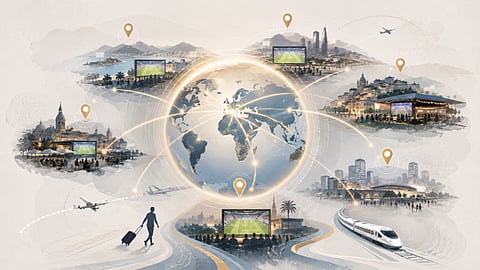
The 2026 FIFA World Cup is a clear example because the tournament is not attached to one national setting. Canada, Mexico, and the United States will share hosting across 16 cities, with 48 teams and 104 matches creating a month of soccer that crosses borders, time zones, climates, and local traditions.
That makes countries that are hosting the FIFA World Cup into travel destinations; people suddenly want to go to these places and understand them better. And of course, host geography affects more than match logistics. It influences when fans watch, where they gather, which cities become base camps, how restaurants and hotels plan around fixtures, and why public viewing can feel different in Mexico City, Miami, Vancouver, Dallas, or Toronto. A one-night final creates a single rush of attention. A tournament spread across three countries creates repeated moments of arrival, waiting, celebration, and movement. That spread gives the World Cup its unusual social power.
A short video on the top 5 biggest sporting events in the world puts that scale beside the Summer Olympics, UEFA Champions League, Super Bowl, and Cricket World Cup. Of course, “biggest” can mean cumulative viewers, peak audience, event length, host-city presence, or cultural force, but regardless, looking at this shows just how influential the World Cup is likely to be. Part of that comes down to its international nature.
Watching alone and watching with a crowd can count the same in audience numbers, but the experiences will create totally different memories. A goal seen on a phone during a commute is still a goal. The same goal in a packed bar, however, becomes a shared moment, with everybody leaning in and holding their breath, the excitement building. In many cases, the place becomes part of the match, and the atmosphere matters immensely.
That is why the world’s most-watched sporting events often become travel stories. Fans may start with the fixture, then choose neighborhoods, restaurants, museums, after-match plans, or recovery days around it to ensure they make the most of that shared feeling. A city guide to Miami’s 2026 World Cup matches, hotels, and dining shows how a tournament can stretch beyond the stadium when fan festivals and hotel corridors carry the atmosphere.
The World Cup carries national identity across weeks. The Olympics gather many sports under one roof. The Champions League final compresses club loyalty into one high-pressure night. The Super Bowl blends sport, music, food, advertising, celebrities, and home gatherings into a single American cultural appointment. The Cricket World Cup feels vast because the sport belongs to family life, migration, and daily conversation.
These events are often ranked beside one another, but they do not ask for the same kind of attention. Some create a peak. Some create a season. Some pull travelers toward host cities. Some hold families in living rooms. The better question is what kind of shared behavior the event creates.
A compact way to read that behavior is to look at four forces: time, place, identity, and ritual. Does the event dominate one evening or several weeks? Does it gather people in stadium districts, fan zones, and hospitality spaces, or mostly at home? Does it activate nations, clubs, cities, or athletes? Do people repeat viewing habits until the event becomes part of the month?
Those forces explain why a smaller live audience can still feel culturally loud, while a massive tournament can change travel patterns across multiple cities. Numbers matter, but they are only the doorway. The real story begins when the event tells people where to be and how long to keep watching for.
Modern entertainment is mostly flexible. People stream shows late, skip episodes, and catch highlights after the moment has passed. Live sport resists that drift. The result arrives once. The tension belongs to everyone watching at that moment. Even when people follow from different countries, the clock creates a temporary community.
That is why the largest sporting events keep their power, even in a scattered media culture. They turn attention into presence. A hotel bar before kickoff, a plaza after a win, or a family kitchen during a penalty shootout can become part of the event itself. Viewership statistics tell us how many people watched, but not why watching together still feels different from catching up later, a distinction that social identity research helps explain.
Inspired by what you read?
Get more stories like this—plus exclusive guides and resident recommendations—delivered to your inbox. Subscribe to our exclusive newsletter
The products and experiences featured on RESIDENT™ are independently selected by our editorial team. We may receive compensation from retailers and partners when readers engage with or make purchases through certain links.