
- Locations
- Interviews
- Luxury Home
- Luxury Lifestyle
- Luxury Travel
- Luxury News
- Events
- More
- Magazine

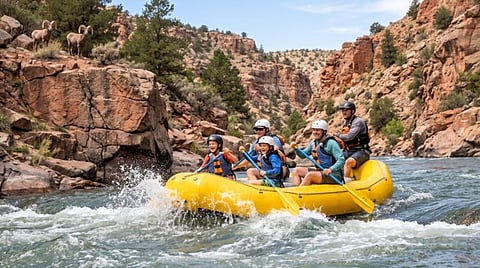
Colorado’s Arkansas River is the state’s busiest commercial white-water river, and dozens of licensed outfitters run trips along it every summer. That scale means your crew can match any mood, from nap-time-friendly Class I drifts to grin-worthy Class IV waves.
But “best” depends on snowpack, live flow gauges, age limits and even whether the base has hot showers. We crunched the numbers (difficulty, scenery, cost, convenience and extras) to spotlight the seven Arkansas River family trips that promise the biggest smiles per dollar.
Want to see how this half-day splash stacks up against Royal Gorge’s adrenaline rush or a gentle Scenic Float? Echo Canyon River Expeditions, rafting the Arkansas since 1978, lines up its Colorado white water rafting trips on one page: the five-mile Scenic Float, Bighorn Sheep Canyon and the Royal Gorge, plus rail, bridge and zipline packages, so you can compare calm and wild options side by side. Bighorn hits the family sweet spot: lively wave trains that make kids squeal, recovery eddies that calm new paddlers and oar-assisted options so mixed-confidence groups stay in one boat. Red-brown walls close in, then open toward high-desert vistas where real bighorn sheep sometimes appear.
Browns sits in the “just right” zone. Younger kids find forgiving pools between Zoom Flume and Pinball, while teens and parents enjoy roller-coaster wave trains that keep adrenaline high but nerves steady. Granite spires and snow-tipped Collegiate Peaks frame every bend, yet the take-out is five minutes from Buena Vista cafés and taco windows.
Milk Run is the river’s gentlest handshake. Guides row while pint-size passengers wave at ducks, spot the snow-capped Collegiate Peaks and practise tiny paddle strokes without big hydraulics. The shuttle loop stays close to Highway 285, so parents never feel far from the base.
Lower Browns starts just below the national-monument rapids, where the gradient eases into rhythmic Class II to III rollers. Strong paddlers sit up front, kids ride mid-raft and grandparents perch beside the guide for the gentlest line. Conversation flows as smoothly as the current.
Slip south of Cotopaxi and the Arkansas turns gentle. Few outfitters run this stretch, so you trade raft traffic for herons, mule deer and cliff swallows. Low mesas and cottonwoods frame the water while the distant Sangre de Cristo Range paints a blue-gray horizon.
Salida strings together mellow current, a riverside beach picnic and a glide through downtown’s Whitewater Park, all with minimal shuttle time. More of your six-hour block goes to water, lunch and sand-castle duty, less to van seats.
Older teens crave a rite of passage, and Royal Gorge delivers. Rapids such as Sunshine Falls and Sledgehammer arrive one after another, and every lull frames a postcard view of the Royal Gorge Bridge 955 feet overhead.
If any teen hesitates about swimming through a breaker wave, book a full-day Browns or Bighorn upgrade instead. You will score big splashes without the no-exit commitment of a tight canyon.
Guides care less about birthdays than two practical tests:
Does the child fit a Coast Guard-approved Type V PFD snugly, and can they sit still for a proper check?
Will they follow paddle commands when the bow hits a wave?
Use the age-and-weight guide below, then call your outfitter 24 hours before launch. High or low flow can raise minimums overnight.
Guides have the final say. Confirm minimums before you drive, and nobody ends up in tears at the gear shed.
Local guides have one mantra: flows follow snow. March snowpack becomes June water, so each season writes its own script.
Normal pattern. The river usually peaks in mid-June, steadies by early July and, thanks to the Upper Arkansas Flow Management Program, aims for about 700 cubic feet per second (cfs) at the Wellsville gauge through August 15. After that, flows taper, trading power for warmer water and a more technical ride. During severe drought years, such as 2002 and 2012, flows can drop sharply. Families expecting “big June water” in those years found rock-dodging technical lines instead.
American Whitewater’s accident reports show that most Colorado white-water deaths involve private boaters, tubers and swimmers without life jackets rather than guided commercial trips.
Still, rarity is not zero. Guide training, properly sized PFDs and honest self-assessment keep the odds in your favor.
Match the trip to your paddlers’ ages, swim skills and the day’s flow, and the Arkansas River will return more smiles per mile than any other run in Colorado. See you on the water!
Inspired by what you read?
Get more stories like this—plus exclusive guides and resident recommendations—delivered to your inbox. Subscribe to our exclusive newsletter
The products and experiences featured on RESIDENT™ are independently selected by our editorial team. We may receive compensation from retailers and partners when readers engage with or make purchases through certain links.