
- Locations
- Interviews
- Luxury Home
- Luxury Lifestyle
- Luxury Travel
- Luxury News
- Events
- More
- Magazine

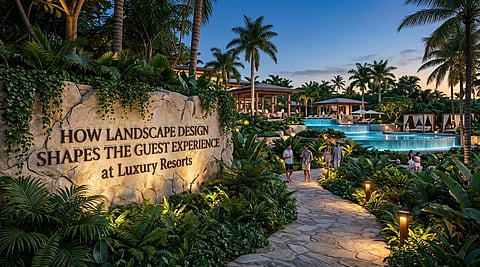
A resort's landscape can influence whether guests simply enjoy their stay or feel compelled to return. A 2019 study in the International Journal of Hospitality Management found that hotels with biophilic design (natural elements such as greenery, water, and views of nature) generated stronger positive emotional responses and higher perceived quality than conventional hotel environments.
For luxury resorts, that makes landscape design a business investment, not just a finishing touch. Your gardens, water features, walking trails, and outdoor structures can influence how guests experience the property, how much of it they explore, and whether they associate their stay with something worth repeating.
Research into gist perception shows that people can experience the space or scene as calm or threatening in about 0.3 milliseconds. This is why a property's appearance can shape how guests feel about it before they've even reached reception.
The first impression starts with more than the entrance. The landscape tells guests something about the place they're visiting, whether it's a secluded mountain retreat, a coastal hideaway, or a contemporary resort surrounded by tropical gardens. Native grasses, shaded pathways, existing rock formations, and carefully positioned viewpoints can all reinforce that identity without making the grounds feel overly designed or manicured.
Water features can be particularly beneficial here. A reflecting pool near the entrance, for example, can complement a resort's modern architecture, while a natural pond or stream can make a garden feel more connected to its surroundings. Water also gives guests quieter places to spend time away from busy restaurants, pool decks, and other shared areas.
A beautiful garden is lovely, but a landscape becomes more valuable when guests have reasons to move through it. Well-planned walking trails, waterfront promenades, landscaped courtyards, and scenic viewpoints turn the grounds into an extension of the resort's amenities.
For example, instead of placing every outdoor attraction around the main building, you can create a connected route that takes guests past a garden, a pond, a quiet seating area, and a viewpoint. Guests can explore at their own pace, discover quieter corners of the property, and enjoy the surroundings without signing up for another organized activity.
For a more engaging outdoor experience, consider incorporating:
Walking and nature trails: Use varied route lengths, shaded resting points, and clear signage to accommodate different fitness levels.
Waterfront paths: Provide safe access to lakefronts, beaches, or rivers, with seating areas that encourage guests to stop rather than simply pass through.
Scenic viewpoints: Position overlooks at natural high points or along attractive landscape features, ideally with enough space for guests to pause without obstructing the route.
Importantly, these routes should feel connected, not like separate landscaping projects. Their layout can also encourage guests to discover amenities they might otherwise overlook.
Of course, not every resort has naturally convenient terrain. Streams, ponds, wetlands, steep slopes, and uneven ground can interrupt walking routes and separate otherwise attractive parts of the property. Pedestrian bridges can help overcome these obstacles without forcing guests to take lengthy detours or abandon certain areas altogether.
They can also contribute to the overall design. A timber bridge across a landscaped pond, for instance, can complement nearby gardens while giving guests a different perspective of the water and surrounding vegetation.
If you're considering different styles and structures, York Bridge Concepts (YBC) offers helpful info about pedestrian bridges through its project gallery. The examples show how timber bridges can provide practical connections across natural features while fitting into parks, waterfronts, and other landscaped settings.
Naturally, appearance isn't the only consideration. Bridge placement, span length, load requirements, drainage, handrails, and walking-surface conditions all affect safety and long-term performance. These details need attention early in the planning process, not after the surrounding landscape is already in place.
A resort's outdoor spaces should invite exploration without excluding guests who have limited mobility. Pathway gradients, stable surfaces, resting areas, lighting, and clear signage should all feature in the initial design rather than become adjustments made later.
The U.S. Access Board's guidance for outdoor developed areas covers practical requirements such as trail surfaces, slopes, resting intervals, and accessible viewing areas. While the exact regulations depend on the property and applicable standards, the broader point is straightforward: guests with limited mobility should also have meaningful opportunities to enjoy the grounds.
Environmental considerations deserve equal attention. Native and climate-appropriate plants can reduce irrigation demands, while permeable surfaces and carefully planned drainage help manage stormwater. Designers should also preserve existing mature trees where possible and avoid unnecessary disruption to natural waterways and wildlife habitats.
Outdoor structures face constant exposure to sunlight, moisture, temperature changes, and regular foot traffic. Materials therefore need to suit both the resort's appearance and the conditions they'll face throughout the year.
Timber can work particularly well in resorts with woodland, coastal, or rustic architectural influences. Stone and natural paving often complement Mediterranean-inspired properties, while steel and concrete tend to suit more contemporary designs. The right choice depends on the design, climate, intended use, and maintenance resources available.
Likewise, lighting, railings, finishes, and proportions should relate to the surrounding architecture. A bridge or waterfront walkway shouldn't look like an afterthought (especially when it occupies one of the most visible parts of the property).
Ultimately, good landscape design does much more than make a luxury resort look impressive. It gives guests more ways to enjoy the property, makes natural surroundings part of the experience, and turns outdoor spaces into amenities they'll actually use.
Inspired by what you read?
Get more stories like this—plus exclusive guides and resident recommendations—delivered to your inbox. Subscribe to our exclusive newsletter
The products and experiences featured on RESIDENT™ are independently selected by our editorial team. We may receive compensation from retailers and partners when readers engage with or make purchases through certain links.