
- Locations
- Interviews
- Luxury Home
- Luxury Lifestyle
- Luxury Travel
- Luxury News
- Events
- More
- Magazine

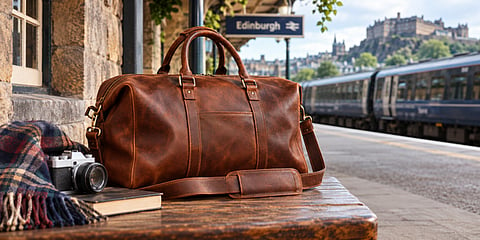
Most of us take more short trips than long ones. A Friday train to Edinburgh, two nights in the Lake District, a city break in Bath: none of these calls for a suitcase the size of a wardrobe. Longer holidays often do need bigger luggage, but short breaks reward a more compact, practical way of packing. That is where the leather duffle bag earns its place. This guide covers what it does well, where it falls short, and what to check before you buy one.
Luggage trends come and go. Hard-shell cases, technical backpacks and minimalist nylon carry-alls have all had their turn. The leather duffle has remained relevant because of its simple, functional design: a rounded body, two handles and a wide opening. There is very little to date it.
It also fits in almost anywhere. A tan or dark brown bag looks fine on a station platform, in a country pub or at a hotel reception desk. Bags built around a particular season’s colours tend to look tired sooner, while plain, well-proportioned shapes age more gracefully. A well-designed weekender bag typically combines a spacious main compartment with practical carrying options, making it suitable for different types of short journeys.
A weekend usually means two or three nights, which is the sweet spot for a duffle. You can fit a couple of outfits, a spare pair of shoes and the essentials, and the bag’s size gently discourages overpacking.
Countryside breaks are where a soft-sided bag really helps. Narrow cottage stairs, gravel drives and muddy boot rooms are awkward with a rigid case. City breaks are similar: cobbled streets and crowded Tube carriages make wheels more of a nuisance than a help, so a bag you can simply lift is often easier. For a single night away, a compact overnight bag is quick to pack and easy to stow. The flexible structure matters too, because a duffle can be squeezed into a car boot, slid under a train seat or lifted onto a rack, which is harder with a fixed frame.
Full-grain leather retains the natural outer surface of the hide and is valued for its strength and durability. How well a particular bag handles everyday wear still depends on the finish, the thickness of the leather and the quality of the construction. Handles and strap points take the most strain, so they are worth inspecting closely.
Leather also changes with age. Over time it develops a patina, a gradual shift in colour and sheen from handling, light and air. Minor surface marks and natural creases can add character, although deeper scratches and moisture damage may need attention.
It is not a perfect material, and it is worth being clear about that. Leather is heavier than nylon, the upfront cost is higher than for fabric bags, and heavy rain can mark it. Whether it is good value depends on how often you travel and how long you plan to keep the bag.
A leather duffle manages to look smart without looking precious. For a business trip it sits comfortably alongside a suit or smart-casual outfit, and it will not look out of place in a client’s reception. In a hotel room it rests neatly on a luggage rack or chair, and on a casual weekend it works just as well with jeans and a waxed jacket. If you would rather not own separate bags for work and leisure, that range is genuinely useful.
On a short trip, how the bag is organised matters more than how big it is. A typical weekend kit is clothes, a spare pair of shoes, toiletries, chargers and a few personal items such as a book, headphones or a passport.
Packing cubes keep clothes tidy, and shoes are best placed at one end in a cloth bag so they do not mark anything. A waterproof washbag near the top makes security checks easier, and an internal zip pocket is the right home for chargers, cables and travel documents. An outer pocket is handy for train tickets or a phone, so you rarely need to unpack half the bag to find one thing.
Size is where many people go wrong, either buying something too small or so large that it invites overpacking. As a rough guide, a single night away usually needs around 20 to 25 litres, which suits an overnight stay. Two nights, such as a typical city break, call for about 25 to 35 litres, while a three-night weekend holiday is more comfortable with 35 to 45 litres. For four or five nights on an extended short break, 45 to 60 litres is a sensible range.
These capacities are approximate and depend on your clothing, footwear and packing habits. If you are flying, always check the airline’s current baggage dimensions and weight limits first.
Most duffles can be carried in more than one way. Short top handles are good for lifting the bag into a boot or onto a rack, while a detachable, adjustable shoulder strap offers an alternative carrying position. A padded strap can improve comfort on longer walks.
That flexibility helps on train journeys, where you may be changing platforms, climbing stairs and squeezing past other passengers. On a road trip, a soft-sided bagslots into awkward gaps that a rigid case will not. One honest caveat is that leather bags are heavier than nylon ones, so if you expect to carry yours for any distance, look for a padded strap.
Neither is better in every situation. A suitcase gives you structure, protection for fragile items and easy wheeling across smooth airport floors, which is hard to beat for long holidays or heavy loads. The trade-off is weight and bulk, and a fixed-size case can be awkward on uneven ground, in narrow hallways or on public transport.
A duffle is more flexible. The wide opening makes it easy to find things, it compresses when only part full, and it can be stored in a wardrobe or under a bed. For short journeys, that convenience often outweighs the extra protection of a hard case. Plenty of experienced travellers simply own both, using a suitcase for longer trips and a leather duffle for weekends.
Whether it is sold as a duffle, a weekender or a leather holdall, the same checks apply. Start with the leather itself: full-grain or top-grain leather is generally stronger and ages better than bonded or heavily corrected leather, and it should feel supple rather than stiff or plasticky. Next, look at the stitching, which should be even and tightly spaced, especially around the handles and strap attachments, where reinforced stress points are a good sign.
Inside, a sturdy cotton or canvas lining protects your belongings and helps the bag keep its shape. Smooth, heavy-duty zips and solid brass or similarly durable fittings usually outlast thin, plated alternatives, although hardware can wear or fail on any bag, so test it before you commit. An internal zip pocket and a slip pocket are normally enough, since extra pockets add weight without adding much. Finally, match the capacity to the size guide above.
If you want to compare styles, browsing a range of leather travel bags is a simple way to see how size, shape and construction differ.
Leather is tough, but it responds to how you treat it. Wipe off dust with a soft, dry cloth, and use a slightly damp one for marks, letting the leather dry naturally away from direct heat. Apply a suitable conditioner a couple of times a year, depending on use, and test it on a hidden patch first because some products darken certain leathers.
British weather being what it is, your bag will get caught in the rain eventually. Blot it with a towel and let it dry at room temperature. Never put it on a radiator or use a hairdryer, as heat can dry the leather out and cause cracking.
For storage, lightly stuff the bag with paper or a towel so it keeps its shape. Keep it in a breathable cotton dust bag or on a shelf, away from damp and strong sunlight, and avoid plastic covers because they trap moisture. If your bag has a waxed, oiled or suede-style finish, follow the maker’s care instructions, as these differ.
Fashions in luggage change quickly, but simple, well-made designs tend to stay useful. A traditional leather duffle relies on straightforward construction, with fewer moving parts than many wheeled suitcases, and it adapts easily: a work trip on Monday, a countryside weekend on Friday. For anyone who travels in short bursts, it is a sensible, understated choice that has lasted through changing trends rather than being tied to one.
About the author: Ronald John has spent more than 15 years researching travel accessories, with a focus on bags, luggage materials and construction quality.
Inspired by what you read?
Get more stories like this—plus exclusive guides and resident recommendations—delivered to your inbox. Subscribe to our exclusive newsletter
The products and experiences featured on RESIDENT™ are independently selected by our editorial team. We may receive compensation from retailers and partners when readers engage with or make purchases through certain links.