
- Locations
- Interviews
- Luxury Home
- Luxury Lifestyle
- Luxury Travel
- Luxury News
- Events
- More
- Magazine

A convertible backpack purse can move from hands-free carry on a long walk to hand or shoulder carry at lunch, as long as the design supports those modes. Start with the straps before you think about styling. The word convertible covers everything from a mini handbag with a detachable strap to a roomy tote with backpack straps.
The smartest way to compare bags is simple: confirm the carry modes, measure against your essentials, check strap comfort and identify the material. Then think about how the bag works with the clothes you already own.
Check each carry mode. A top handle doesn't mean shoulder or crossbody carry. Read the stated configurations.
Use measurements, not labels. Mini and large are relative, so compare the dimensions with your real essentials.
Try every supported configuration. Adjust the straps over your usual layers with the contents you'll carry.
Read the material description. Leather-look and suede-look describe finishes, so follow the care instructions for the stated construction.
A convertible backpack purse gives you different ways to carry the same bag, but the options depend on how it's built. Look for attachment points, detachable or adjustable straps, and images showing how to move between modes. A grab loop may be meant for lifting rather than long stretches of hand carry, so check how the maker describes it.
Backpack carry. Two straps sit over your shoulders and leave your hands free. Check how they adjust and where the bag rests against your back, and look at what happens to any unused strap.
Shoulder carry. A strap rests on one shoulder. Some designs join the backpack straps; others supply a separate strap. Make sure the opening stays easy to reach and the bag hangs comfortably.
Crossbody carry. A longer strap crosses the torso. Compare the stated strap range with the length you need over your usual coat, because a shoulder strap may be too short for this position.
Hand carry. A top handle or short loop lets you carry the bag at your side. Check the handle's clearance if you want to hold it over a coat sleeve or rest it on your forearm.
A bag can feel comfortable on both shoulders yet awkward in shoulder mode, so judge each style separately. The product description tells you what converts; trying it on tells you which modes actually work for you. Choose the bag for the modes you'll use most, not the total number advertised.
Start by laying out a typical day's contents: phone, wallet, glasses case, keys, a small pouch and any device you carry regularly. Include a bottle or umbrella if it needs to go inside the bag.
Measure items as you carry them. Include your phone in its case and your tablet in its sleeve.
Check the opening and usable interior. A dome shape or flap can narrow the opening, so an item that matches the outside dimensions may still be hard to fit.
Leave room for the closure. Lining, padding and seams take up space too.
Think about the loaded bag. Adding a bottle can change how the bag hangs on one shoulder.
When browsing Auremyn convertible backpack purses, you'll find designs that switch into shoulder, crossbody or tote-style carry on selected styles. The collection recommends studying each bag's strap-routing images and product description before buying, and treating mini or large as relative terms, so compare the listed dimensions with the largest item you plan to carry, including your phone case or device sleeve.
Try each supported configuration with the contents you'll actually carry, within the retailer's return conditions. Wear your usual layers and adjust the straps before judging comfort. There's no single strap length that suits everyone.
Follow the routing. Find the attachment points, such as D-rings, loops or sleeves, and follow the maker's sequence. Detachable hardware usually offers more configurations, while fixed convertible straps can make switching faster. Ask yourself whether you'd be happy making the change at a café table or on a busy commute.
Check the hardware. Clasps and swivel hooks should close fully and stay closed as the strap twists. Notice where they sit, because hardware that presses against your body or rubs a panel can be uncomfortable or leave marks.
Adjust over layers. A crossbody strap that works over a T-shirt may be too short over a wool coat. Check that backpack straps stay put on a smooth outer layer.
Plan for spare straps. Look for a pocket or sleeve for a detached strap, so it doesn't dangle or distort the bag. If you're ordering online, read the delivery and return terms before a home fitting.
Pick a material for its look, feel and care needs. A good listing separates what the surface looks like from what the bag is made of. Photos help you judge the finish, but use the stated construction and care instructions to decide how to clean and store it.
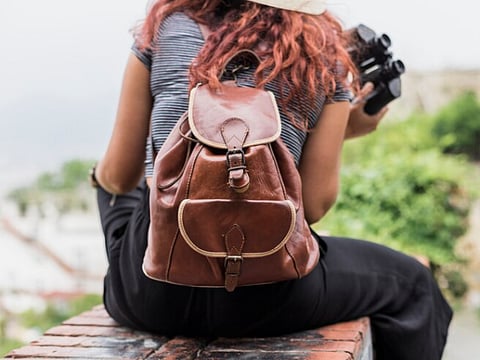
Genuine leather. Look for a clear material description rather than relying on texture or shine in a photo, and follow the maker's guidance on conditioning and storage.
Leather-look finishes. These give a leather appearance without being genuine leather. Check the material details before choosing a cleaner, and only use leather conditioner if the maker allows it.
Suede and suede-look finishes. Genuine suede can fade in prolonged sunlight and usually prefers cool, dark storage. Don't use suede brushes or sprays on a suede-look finish unless the maker approves them.
Textiles. Check both the material and the structure. A soft bag packed full may let bulky items press against your back, and washability depends entirely on the model. If a bag is described as water-resistant, check the stated limits rather than treating it as waterproof.
A convertible bag changes shape and position as you switch modes, so judge it with real outfits in the configurations you'll use.
Polished daytime. Pair tailored trousers, a fine-gauge knit and loafers with a structured bag carried by hand or on the shoulder. Check the side and back views too, since unused backpack straps may still show.
Relaxed weekend. Straight-leg denim, a relaxed shirt and sneakers work well with backpack carry. Make sure the straps lie flat without bunching your collar, and keep any detached pieces in their storage spot if you plan to switch modes later.
Understated evening. A midi dress or tailored separates can work with hand carry or a short shoulder strap. A compact, structured design gives a handbag-like look, while a larger textile tote-backpack may suit a casual dinner better than a formal event.
Use bag size, clothing volume and strap length to play with proportions. A neutral shade like black, tan, taupe or navy works across most outfits, while a saturated color adds contrast. Matching hardware to your jewelry is optional. Fashion creator Caitlyn Warakomski, in a conversation about personal style and dressing for real life, describes contrasting combinations as modern and realistic, giving people permission to make a look their own. Try the bag with clothes you actually wear, without forcing every color or metal to match.
Read the care instructions for your exact model before cleaning or treating it. General advice can't account for every lining, coating or piece of hardware.
Keep it dry and out of harsh light. Avoid prolonged sun and friction, and wipe the surface with a soft cloth.
Contain liquids. Keep hand cream, pens and anything that could leak in a separate pouch.
Support the shape. Where the instructions allow, lightly fill a structured bag with tissue and store it upright, not flattened under other items.
Separate hardware from the finish. Store detached straps on their own or wrap the clasps so they don't rub a panel.
Watch for color transfer. Store lighter bags away from dark fabrics that may rub off on them.
The best convertible backpack purse is the one that works in the modes you'll actually use. Check the stated carry options, measure against your real essentials and test every strap configuration with your usual layers. Choose a material whose care routine you're happy to follow, then style the bag with clothes already in your wardrobe. Get those basics right, and one bag can genuinely take you from a morning commute to an evening out.
It's a bag that switches between backpack carry and other styles, such as shoulder, crossbody or hand carry, depending on how its straps and hardware are designed.
Compare the listed dimensions with your largest item, including its case or sleeve. Size labels like mini or large are relative, so measurements matter more.
No. Leather-look and suede-look finishes need care based on their actual construction, so follow the product's own instructions rather than general leather advice.
Choose the bag for the mode you'll use every day, then treat the other configurations as a bonus. Fewer, easier modes are often more practical.
Inspired by what you read?
Get more stories like this—plus exclusive guides and resident recommendations—delivered to your inbox. Subscribe to our exclusive newsletter
The products and experiences featured on RESIDENT™ are independently selected by our editorial team. We may receive compensation from retailers and partners when readers engage with or make purchases through certain links.