
- Locations
- Interviews
- Luxury Home
- Luxury Lifestyle
- Luxury Travel
- Luxury News
- Events
- More
- Magazine

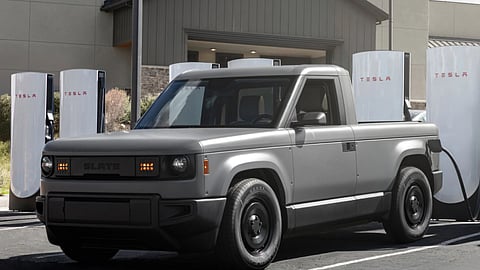
Slate Auto opened preorders June 24, 2026 for its modular electric pickup at a starting price of $24,950, excluding taxes, fees, and options.
The base truck carries an estimated range of about 205 miles; an SUV configuration starts at $29,950; first deliveries are expected by the end of 2026.
Customization, including wraps, accessories, and configurations, is factory-integrated into a single ecosystem rather than scattered across the aftermarket.
The design philosophy echoes the Willys Jeep and CJ-5 era, where function-first clarity, not feature saturation, defined the vehicle.
Slate Auto opened preorders on June 24 for its modular electric pickup at a starting price of $24,950, roughly half the average cost of a new car in the United States. The base truck is estimated at about 205 miles of range, an SUV configuration starts at $29,950, and first deliveries are expected by the end of 2026. The spec sheet is deliberately spare: hand-crank windows, no infotainment screen, a single gray composite finish. And that is precisely the point. There is a quiet but noticeable shift happening in how luxury is defined in modern design. Not through excess, not through feature saturation, but through restraint and coherence. Slate's truck enters the market with a philosophy that feels less like a disruption and more like a correction. It removes layers, reduces fragmentation, and re-centers the vehicle around clarity of purpose. This is not luxury defined by accumulation. It is luxury defined by control, simplicity, and integration. And it feels familiar in a way that traces back to a different era of utility vehicles, when design was governed by function first and everything else followed.
Before trucks became lifestyle products, they were tools. Vehicles like the Willys Jeep and the early CJ-series models were shaped by necessity rather than branding, built to perform in difficult conditions with minimal dependence on complexity.
The CJ-5 in particular represented a stripped philosophy of engineering. Mechanical systems were exposed, understandable, and serviceable. If something did not contribute to function, it was not included. That discipline created a form of durability that came from reduction, not enhancement. Over time, that philosophy gave way to layered systems, digital interfaces, and increasingly abstract ownership experiences. Slate's approach feels like a return to that earlier design clarity, translated onto a modern electric platform.
The Slate Truck is defined not just by simplicity but by integration. Instead of pushing owners into a fragmented aftermarket of different shops, scattered accessories, and incompatible add-ons, the entire customization experience is consolidated into a unified system. Wraps, color configurations, functional attachments, interior variations, and utility upgrades are designed to exist within a single, coherent platform.
That matters more than it appears at first glance. In most modern vehicle ownership, customization is fragmented. Owners navigate separate vendors, third-party parts suppliers, and incompatible accessory systems. The result is not personalization; it is logistical friction. Slate removes that friction by centralizing the ecosystem. The vehicle becomes a base platform connected to a controlled expansion environment. Customization is no longer a search. It is a system.
One of the most immediate expressions of this modular philosophy is visual customization. Instead of treating color and finish as fixed factory decisions, Slate introduces the idea that appearance is part of the vehicle's modular identity. Wraps and exterior configurations are not afterthoughts or aftermarket decisions; they are part of the designed ownership experience.
That shifts the emotional relationship with the vehicle. A truck is no longer locked into a single identity for its entire lifecycle. It can evolve visually over time without losing coherence or requiring external fabrication networks. In luxury design terms, this reframes customization as curation rather than modification. Everything remains within a controlled design language, even as expression changes. The result is flexibility without fragmentation.
Most vehicle owners know the fragmentation that comes after purchase. Accessories come from one supplier, interior modifications from another, functional upgrades from independent shops. Each layer introduces variability, compatibility questions, and inconsistent design language. Slate's model eliminates that scattering by bringing everything into one place.
Add-ons are designed to integrate rather than compete. Accessories are structured to align with the platform rather than override it. The user experience becomes linear instead of investigative; there is no need to navigate multiple websites, vendors, or compatibility chains to build out functionality. That is a subtle but significant shift in ownership psychology. It replaces decision fatigue with structured expansion.
Despite being an electric platform, the Slate Truck leans into something more analog in spirit: transparency. The idea is not to hide complexity behind layers of software or abstract interfaces, but to present a vehicle that can be understood through structure and function.
That approach aligns with older utility vehicles in philosophy, even if not in mechanics. The Willys Jeep did not require interpretation. Its purpose was visible and its function direct. Slate translates that idea into a context where simplicity is no longer mechanical alone; it is also systemic. Less hidden fragmentation, less external dependency, more visible structure.
In earlier product cycles, modularity was often associated with cost-saving or utilitarian compromise. Today it is increasingly associated with control and refinement. A modular system allows the owner to decide what the vehicle becomes over time without discarding the base structure.
That creates a different kind of ownership value. The vehicle is no longer a static purchase; it becomes a long-term platform for evolving needs. In luxury terms, this is closer to architectural thinking than automotive thinking: a foundation that supports multiple expressions without losing identity. It is not about having more options. It is about having coherent options.
Modern vehicles often create distance between the owner and the machine. Interfaces, software layers, and proprietary servicing networks abstract the experience of ownership. Slate reduces that distance not by removing technology but by organizing it more clearly. The driver is no longer navigating complexity. They are curating within a structure.
That shift changes the emotional tone of ownership, moving it from passive consumption toward active shaping. A vehicle becomes something you refine over time rather than something you simply maintain. This is where the design begins to feel closer to luxury objects in fashion, architecture, and industrial design, where coherence matters more than accumulation.
The most misunderstood aspect of simplicity is that it is not absence. It is control. Removing unnecessary elements requires more discipline than adding features. It requires defining what belongs, what does not, and what must remain consistent over time.
Slate's approach reflects that discipline in how the vehicle is structured, expanded, and customized, visually and functionally. It is not minimalism for aesthetic effect. It is minimalism as an operating system. That distinction is what places it closer to luxury design thinking than commodity manufacturing. The CJ-5 and Willys Jeep were not defined by refinement; they were defined by clarity. Every component existed for a reason. Slate reintroduces that logic in a modern electric context, where necessity is no longer mechanical alone but experiential and systemic. What remains consistent is the idea that a vehicle should be understandable without translation.
Slate's modular truck is not just a vehicle positioned at a lower price point. It is a rethinking of how vehicles are experienced after purchase. It replaces scattered customization with unified design logic, fragmented accessory markets with a controlled ecosystem, and static ownership with structured evolution.
By consolidating customization, accessories, wraps, and functional expansion into one controlled environment, Slate removes the fragmentation that has defined modern vehicle ownership. In a design culture saturated with options, coherence begins to feel like a luxury category of its own. And in doing so, Slate reintroduces an older idea in a modern form: utility and clarity are not the opposites of luxury. They are its foundation. When everything unnecessary is removed, and everything necessary is already in one place, the object stops competing for attention and starts earning permanence.
Inspired by what you read?
Get more stories like this—plus exclusive guides and resident recommendations—delivered to your inbox. Subscribe to our exclusive newsletter
The products and experiences featured on RESIDENT™ are independently selected by our editorial team. We may receive compensation from retailers and partners when readers engage with or make purchases through certain links.