
- Locations
- Interviews
- Luxury Home
- Luxury Lifestyle
- Luxury Travel
- Luxury News
- Events
- More
- Magazine

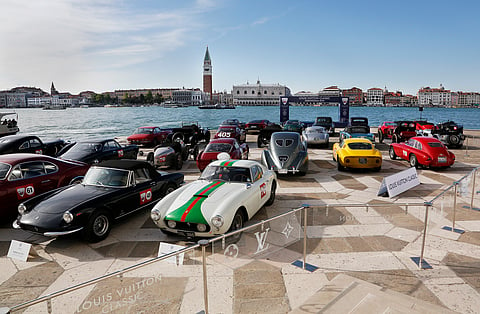
The Louis Vuitton Dolomites Classic Run runs September 1 to 4, 2026, from Villa Pisani near Venice to Monza.
Twenty-five owners of historic cars are invited to drive roughly 600 kilometers through the Dolomites' UNESCO-listed passes.
Entrants hold an average speed under 50 kilometers an hour and are judged on regularity, not raw speed.
The rally ends at Autodromo Nazionale Monza during the Formula 1 Italian Grand Prix, with an awards ceremony at Milan's Castello Sforzesco.
Louis Vuitton's last Classic Run ended in Venice in 2012. This September, the house starts there instead, sending 25 historic cars on a four-day, 600-kilometer drive north through the Dolomites and south to the Autodromo Nazionale Monza, timed to land exactly as the Italian Grand Prix opens.
The Classic Run dates back to 1993, when Louis Vuitton first sent vintage cars through the Malaysian jungle and rubber plantations on the Vintage Equator Run. The house followed with the Italia Classica through Tuscany's vineyards in 1995 and 1997, a 1998 China Run tracing rice paddies and mountains from Dalian to Beijing, and a 2006 Boheme Run from Budapest to Prague by way of Vienna. The most recent edition, the 2012 Serenissima Run, ended in Venice, exactly where the Dolomites Classic Run 2026 will start this September, fourteen years later.
The 2026 edition departs September 2 from Villa Pisani, an 18th-century estate on the Riviera del Brenta, and climbs into the Dolomites' UNESCO World Heritage terrain before descending toward Lombardy.
This is not a speed event. Entrants hold to an average pace under 50 kilometers an hour on roads still open to regular traffic, with time controls, passage checks, and average-speed trials that reward precision over horsepower. The format favors patience and navigation, a driving style closer to the original grand tour than to a modern rally. Louis Vuitton has invited 25 owners of historic cars to take part, including several women collectors, a detail worth noting in a category of motorsport that has historically skewed heavily male.
The run concludes September 4 at Autodromo Nazionale Monza, where the participating cars will parade the circuit as the Italian Grand Prix weekend opens, placing a century of automotive heritage on the same tarmac as Formula 1's current field. From there, the cars and their trophy travel to Milan's Castello Sforzesco for the awards ceremony.
That trophy is itself a commission: glass artist Sabine Marcelis designed it in partnership with Venini, the Venetian glassmaking house, continuing a tradition Louis Vuitton has built with sporting partners from the America's Cup to the FIFA World Cup to the Paris Olympics. The house has also partnered with several of the run's host sites, including Reggia di Monza and Venice's MUVE museum network, on conservation projects tied to the event, folding heritage preservation into what is, on its surface, a car show.
Louis Vuitton frames the run as a continuation of its travel history rather than a marketing add-on, and the timeline supports the framing. Georges Vuitton, son of the house's founder, designed its first car trunk in 1897, replacing the era's bulky luggage with a flat-topped case built for the emerging automobile. The Sacs Chauffeurs followed in 1905, shaped to fit into the round well of a car's spare wheel. Those two objects effectively invented the category of luggage built specifically for motoring, more than a century before a Classic Run existed to showcase it.
For collectors, the run offers something increasingly rare: a multi-day drive through some of Europe's most protected landscape, with institutional access most owners could not arrange on their own. For everyone else, it is a reminder that Louis Vuitton's idea of the art of travel still runs, quite literally, on four wheels.
Inspired by what you read?
Get more stories like this—plus exclusive guides and resident recommendations—delivered to your inbox. Subscribe to our exclusive newsletter
The products and experiences featured on RESIDENT™ are independently selected by our editorial team. We may receive compensation from retailers and partners when readers engage with or make purchases through certain links.