
- Locations
- Interviews
- Luxury Home
- Luxury Lifestyle
- Luxury Travel
- Luxury News
- Events
- More
- Magazine

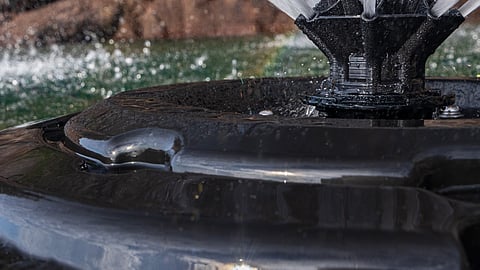
A well-designed water feature does more than elevate your property's curb appeal. In luxury landscapes, it creates intent, adds motion and sound, and solves common pond headaches like stagnant water, summer odor, and uneven surface circulation. The Kasco 3400 HJF fountain consistently appears in high-end pond conversations because it delivers both design-grade spray aesthetics and practical surface agitation. For anyone comparing serious options, this Kasco 3400 HJF fountain offers a clear reference point for what “designer” actually means in a real pond setting.
Stone, lighting, and specimen plantings still matter, but most luxury outdoor spaces now prioritize experiences: movement, sound, and nighttime presence. Water features deliver all three when properly scaled.
Fountains also remain visible from a distance, which is why designers use them to anchor long sightlines across lawns, terraces, and arrival drives. The best outcomes come from treating a pond fountain like an architectural element with mechanical requirements, not a decorative add-on.
For a broader context on why water features are trending in home and landscape design, Forbes has covered the aesthetic and lifestyle appeal of water elements in outdoor spaces.
When people search for the Kasco 3400 HJF fountain, they want to answer a practical question with design consequences: “Will the spray pattern look refined, and will it help the pond behave better?”
In luxury environments, “refined” means:
A spray profile that looks intentional from multiple viewing angles
Consistent performance across daily use, not just the first weekend
Visual balance that matches the pond’s surface area and the surrounding hardscape
High-quality Kasco fountains and similar professional-grade options deliver reliable performance with aesthetics that don’t depend on perfect conditions.
A common misconception in residential and estate settings is that “any moving water fixes water quality.” Movement helps, but how it moves the water matters.
These are primarily visual. They circulate some surface water, but their main job is appearance.
Many pond fountains create surface agitation that supports oxygen transfer near the surface. This circulation helps reduce stratification and improve overall water quality.
Diffused aeration (air pumped to the bottom through diffusers) works best when deeper, whole-water-column circulation is the priority. It’s especially effective in deeper ponds, where surface action alone doesn’t reach the lower layers.
Here's a practical way to think about it: fountains excel at surface aesthetics and near-surface oxygen exchange, while diffused aeration tackles deeper mixing and broader oxygen distribution.
In premium landscapes, water clarity and odor control aren’t “nice to have.” They define the property’s daily experience and perceived value.
Two fundamentals drive water quality:
Temperature affects oxygen levels. Warm water holds less dissolved oxygen than cold water, which directly impacts fish health and causes odor issues.
Nutrient pollution fuels algae growth. When runoff introduces nitrogen and phosphorus, your pond becomes vulnerable to algal blooms.
If a pond receives nutrient-rich runoff (fertilizer, organic debris, or drainage), it creates a cycle: algae growth, die-off, decomposition, and oxygen drops. Excess nutrients accelerate harmful algal blooms, especially during warm weather.
“Ugly spray patterns” are a real issue in upscale landscapes, especially on open lots with constant wind exposure. A fountain that looks perfect in calm air turns messy in afternoon gusts, overspraying patios, stone coping, or surrounding plantings.
Designers and property managers reduce this risk by:
Choosing a spray pattern that performs well without extreme height
Placing the unit to respect prevailing winds and viewing lines
Avoiding “too tall for the site” profiles that turn elegant into chaotic
This consistency is why buyers choose professional-grade fountains for ponds: not for drama, but for predictable performance.
In luxury properties, the pond comes to life after dark. That doesn’t automatically mean saturated colors or show effects. Many homeowners and HOAs prefer a clean, architectural glow that reinforces the landscape lighting plan.
A lighted fountain can:
Extend the visual appeal of your outdoor space into evening hours
Provide a safe, visible focal point near walking paths or overlooks
Make moving water visible, which enhances perceived motion and sound
If you are considering pond fountains with lights, treat lighting as part of the broader lighting design: color temperature, glare control, and fixture placement matter as much as brightness.
Correct sizing is where many high-budget ponds fail. A fountain can be high-quality and still look wrong if mismatched to the pond's size, depth, or shoreline geometry.
A practical sizing mindset:
Surface area drives visual scale. Large open water needs a spray that reads clearly from intended viewing points.
Depth and water volume drive oxygen demands. Deeper ponds benefit from complementary strategies if lower layers are at risk of oxygen depletion.
Bioload matters. Fish stocking, feeding, and heavy leaf drop all increase oxygen demand and nutrient load.
Luxury landscapes are judged year-round, even when guests aren’t present. Many pond owners discover that seasonal planning prevents the predictable “late-summer slump” when water turns murky, and odors appear.
Plan fountain runtime and maintenance around:
Heat waves and extended warm water periods
Heavy rain events that wash nutrients into the pond
Leaf season and organic debris buildup
Pairing a fountain plan with a filtration or aeration protects your aesthetic investment over time.
The most successful luxury pond installations treat a fountain as both a visual centerpiece and a management tool. The Kasco 3400 HJF fountain earns its reputation by delivering on this modern expectation: a designer-grade spray presence that aligns with practical concerns like surface movement, oxygen exchange, and consistent performance.
When ponds are sized thoughtfully and supported with the right combination of circulation, aeration, and (when needed) filtration, the “luxury look” becomes easier to maintain, more predictable through the seasons, and far more enjoyable to live with.
Inspired by what you read?
Get more stories like this—plus exclusive guides and resident recommendations—delivered to your inbox. Subscribe to our exclusive newsletter
The products and experiences featured on RESIDENT™ are independently selected by our editorial team. We may receive compensation from retailers and partners when readers engage with or make purchases through certain links.