
- Locations
- Interviews
- Luxury Home
- Luxury Lifestyle
- Luxury Travel
- Luxury News
- Events
- More
- Magazine

We have all been there. You start your Pilates journey on the mat, moving through the hundred, rolling like a ball, and mastering your teaser. It feels challenging, effective, and complete. But after a few months of consistent practice, you might notice something shifting. The exercises that once left your core quaking now feel... manageable. Your body has adapted, and while maintenance is good, progress is better.
This is the natural evolution of any fitness journey. Mat Pilates is an incredible foundation - it teaches you control, breath, and alignment - but eventually, your muscles crave a new stimulus. This is where the magic of "props" comes into play. You don't need a 500-square-foot spare room or a bulky Reformer to up the ante. The right Pilates equipment can turn a simple corner of your living room into a highly effective fitness studio.
Introducing small, strategic pieces of home Pilates gear isn't just about making things harder; it's about making your movement smarter. Whether you are a total beginner or a seasoned pro, the right tools can:
Unlock new ranges of motion
Deepen muscle engagement
Bring the studio experience right to your door
Equipment serves multiple sophisticated purposes in Pilates. Here’s why you should consider expanding your toolkit.
The most obvious benefit is resistance. On the mat, your primary resistance is gravity and your own body weight. While effective, this has a ceiling. Adding external load supports strength, stability and resilience over time. Hypertrophy: To change the size of a muscle, you need to challenge it. Props like bands or rings provide that necessary resistance.
Strength: Overcoming resistance builds functional strength that translates into daily life, not just better performance on the mat.
On the flip side, Pilates equipment often acts as a supportive partner.
Form Correction: If you struggle to keep your legs straight in a teaser, a strap can hold them up, allowing you to focus on your spinal articulation without hip flexor strain.
User-friendliness : For beginners, props bridge the gap between where you are and where you want to be, making challenging exercises achievable easier.
Doing the same sequence daily is a recipe for mental and physical stagnation.
Prevents Boredom: Swapping a standard bridge for a bridge on a stability ball changes the entire feel of the move.
Muscle Confusion: Okay, muscles don't actually get "confused," but varying the stimulus ensures you are hitting fibers from different angles, preventing plateaus.
This is perhaps the most underrated benefit. Props provide tactile feedback - essentially, they help you feel your body better. This concept, known as proprioception, is crucial for good form.
Alignment: Squeezing a Pilates ball between your knees during footwork ensures your knees track over your toes, correcting alignment instantly.
Engagement: Having something to push against or pull helps "wake up" dormant muscles that might otherwise slack off during a movement.
You don’t need a warehouse full of gear. In fact, most comprehensive home studios are built on just three essential items. These pieces of small Pilates equipment are versatile, easy to store, and incredibly effective.
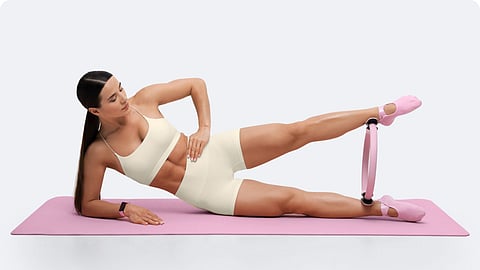
The Pilates Ring, often called the Magic Circle, was invented by Joseph Pilates himself. It is a flexible ring, usually made of metal or rubber, with padded handles on either side.
Purpose: The ring is primarily used to find your centerline. By squeezing it (adduction), you fire up the inner thighs, chest (pectorals), and deep pelvic floor muscles. Conversely, pushing outward (abduction) targets the outer hips and glutes.
Why you need it: It turns passive movements into active ones. Holding a bridge? Good. Holding a bridge while squeezing a ring between your knees? That engages the adductors and pelvic floor, turning a simple glute exercise into a full core integration challenge. If you are looking to tone stubborn areas, understanding pilates ring benefits is key - it isolates muscles that are often hard to reach with bodyweight alone.
This is a small, squishy ball (usually 7-10 inches in diameter) that is partially inflated. It is distinct from the large Swiss exercise balls you sit on at a desk.
Purpose: The ball is the king of instability. Placing it under your sacrum (tailbone) during abdominal work forces your deep stabilizing muscles (transversus abdominis) to kick into overdrive to keep you from wobbling.
Why you need it: It builds intelligent strength. It’s not just about "feeling the burn"; it's about control. It can also be used as a tactile cue - placing it behind your knee during donkey kicks ensures you are using your hamstring and not cheating with momentum. As a piece of home Pilates gear, it’s unmatched for core activation and balance training.
These are stretchy bands that come in various lengths and resistance levels. In a studio setting, the springs on a Reformer provide resistance. At home, bands are your best substitute.
Purpose: They mimic the tension of Reformer springs. They provide concentric resistance (when you pull) and eccentric resistance (when you release), which controls the muscle through the full range of motion.
Why you need it: Resistance bands for pilates are essential for upper body strengthening (rows, pulls, presses) and for adding load to leg work without weights. They are also fantastic for stretching, acting as an extension of your arms to help you reach your feet in hamstring stretches.
Building a home studio is as much about mindset as it is about equipment. If your gear is shoved in a dusty closet, you probably won't use it. If it is beautiful and accessible, it becomes an invitation to move.
Start Small: You do not need to buy everything at once. Start with one prop that addresses your biggest need (e.g., a ball for core stability) and master it. Then, layer in resistance bands for pilates or a ring as you progress.
Quality Matters: Cheap equipment tends to break. A band that snaps mid-stretch or a ring that loses its shape after a month is frustrating and dangerous. To get the most benefits (and aesthetic enjoyment) from your workouts, choose high-quality Pilates equipment that lasts a long time and complements your interior.
Think of your equipment as part of your home decor. Soft colors, durable materials, and sleek designs make your practice space feel like a sanctuary rather than a gym. When your environment feels good, your workout feels better.
Ready to test the waters? Here is a quick circuit using these pilates props. Perform each exercise for 45-60 seconds or 10-12 repetitions.
This move leverages pilates ring benefits to target the adductors and glutes simultaneously.
Setup: Lie on your back with knees bent and feet flat on the floor, hip-width apart. Place the Pilates Ring between your thighs, just above the knees.
Action: Exhale to tuck your tailbone and peel your spine off the mat into a bridge.
Challenge: At the top of the bridge, squeeze the ring inward 10 times with small pulses.
Return: Inhale to roll your spine back down, one vertebra at a time.
This variation uses small pilates equipment to increase coordination and upper body engagement.
Setup: Lie on your back. Curl your head and shoulders up. Hug your knees into your chest, holding the ball in your hands against your shins.
Action: Inhale as you extend your legs forward and reach your arms (holding the ball) backward overhead. Keep your lower back anchored to the mat.
Challenge: Pass the ball from your hands to between your ankles.
Return: Exhale to circle your arms around and tuck your knees back in, grabbing the ball from your ankles. Repeat, passing the ball back and forth.
One of the most effective uses of resistance bands for pilates is targeting the glute medius.
Setup: Tie your band in a loop around your thighs, just above your knees. Lie on your side, knees bent at 90 degrees, feet aligned with your hips. Stack your hips.
Action: Keep your feet touching. Exhale to open your top knee toward the ceiling, fighting the resistance of the band.
Focus: Do not let your hips roll backward. Keep the movement purely in the hip socket.
Return: Slowly lower the knee with control - don't let the band snap your leg down.
Upgrading your home practice doesn't require a renovation. It requires intention. By integrating Pilates equipment like rings, balls, and bands, you aren't just buying "stuff"—you are investing in a deeper, more challenging, and more sustainable movement practice.
Inspired by what you read?
Get more stories like this—plus exclusive guides and resident recommendations—delivered to your inbox. Subscribe to our exclusive newsletter
The products and experiences featured on RESIDENT™ are independently selected by our editorial team. We may receive compensation from retailers and partners when readers engage with or make purchases through certain links.