
- Locations
- Interviews
- Luxury Home
- Luxury Lifestyle
- Luxury Travel
- Luxury News
- Events
- More
- Magazine

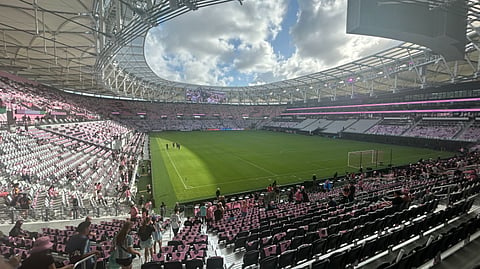
In Miami, transformation rarely arrives quietly. It pulses, it radiates, it announces itself with confidence. NU Stadium does exactly that, rising not simply as a venue but as a declaration of intent. Anchored within the expansive Miami Freedom Park development, the stadium signals a shift in how cities express influence in the modern era. No longer confined to steel and seating charts, this is a layered environment where architecture, commerce, and culture converge into a single, curated experience.
The energy surrounding the opening reflects something deeper than fandom. It reveals Miami stepping fully into its role as a global capital, one that blends Latin rhythm, financial ambition, and luxury lifestyle into a unified identity. NU Stadium does not exist in isolation. It is surrounded by a carefully designed ecosystem meant to sustain relevance long after the final whistle fades.
At the center of this transformation stands Lionel Messi, whose presence has elevated Inter Miami from a promising franchise into a global phenomenon. His arrival did not just boost attendance. It altered the gravitational pull of the sport in the United States, drawing international attention and redefining expectations. Inside NU Stadium, that impact becomes tangible.
Every match feels less like a scheduled event and more like a cultural gathering, where celebrity, sport, and spectacle merge seamlessly. The crowd is not merely watching a game. It is participating in a shared moment tied to legacy. Miami, long celebrated for its nightlife and beaches, now holds a new kind of attraction. The stadium becomes a stage where history unfolds in real time, with Messi acting as both performer and catalyst in a broader narrative of global relevance.
NU Stadium’s true power reveals itself in what surrounds it. Miami Freedom Park is not an accessory but an extension of the experience, a billion-dollar vision that integrates retail, dining, hospitality, and open green space into a cohesive lifestyle district. This approach reflects a growing trend in urban planning where destinations are no longer single-purpose. Instead, they function as immersive environments designed to capture attention across multiple dimensions.
Visitors arrive for a match but remain for the atmosphere, the restaurants, and the sense of belonging within a curated social landscape. The development mirrors the ambition seen in global hubs, positioning Miami alongside cities that understand the value of experience as currency. In this context, the stadium becomes a centerpiece within a much larger narrative about how people live, interact, and define status.
Unlike oversized arenas that prioritize capacity over connection, NU Stadium is engineered for emotional intensity. Its design emphasizes proximity, drawing spectators closer to the action and amplifying every movement on the pitch. This creates an atmosphere reminiscent of South American– and European-style traditions, where energy is contained and redirected rather than dispersed. The visual language of the structure reflects Miami itself, combining sleek modern lines with an undercurrent of vibrancy and motion. Light, color, and spatial flow work together to produce a setting that feels both refined and alive.
The result is a venue that does not simply host events but enhances them, transforming each match into an immersive experience. This balance between architectural precision and cultural expression positions the stadium as a benchmark for future developments seeking to merge design with emotional impact.
Luxury within NU Stadium is not confined to aesthetics. It is embedded in the way the space is experienced. Premium lounges, curated seating areas, and exclusive access zones create a hierarchy that mirrors the structure of high-end hospitality environments. Guests are not just attending an event. They are entering a carefully orchestrated setting where comfort, visibility, and social positioning intersect.
The distinction between spectator and participant begins to blur, as the environment encourages interaction and presence rather than passive observation. This approach reflects a broader shift in luxury consumption, where value is derived from experience rather than ownership. In NU Stadium, the concept of a ticket evolves into something more nuanced. It becomes an entry point into a world defined by access, perception, and the ability to exist within a space where culture and status converge seamlessly.
Miami has long been a city of reinvention, but NU Stadium marks a definitive moment in its evolution. The venue encapsulates a broader transformation in which culture, sport, and real estate intersect to create a new kind of influence. It challenges traditional boundaries, positioning itself not just as a destination for events but as a symbol of modern urban identity. The stadium competes not with other arenas but with global lifestyle hubs, aligning Miami with destinations known for their ability to blend entertainment with prestige. This shift reflects a deeper understanding of how cities build relevance in a connected world. NU Stadium stands as both a physical structure and a cultural signal, one that announces Miami’s arrival on a stage where experience defines value and presence becomes its own form of currency.
Inspired by what you read?
Get more stories like this—plus exclusive guides and resident recommendations—delivered to your inbox. Subscribe to our exclusive newsletter
The products and experiences featured on RESIDENT™ are independently selected by our editorial team. We may receive compensation from retailers and partners when readers engage with or make purchases through certain links.