
- Locations
- Interviews
- Luxury Home
- Luxury Lifestyle
- Luxury Travel
- Luxury News
- Events
- More
- Magazine

The conversation around 3D-printed homes is no longer theoretical. It’s becoming tangible, livable, and increasingly desirable. Companies like Azure Printed Homes are pushing the category forward, turning what once felt experimental into something you can actually own, transport, and live in today. What makes this moment particularly interesting is the shift in perception.
These homes are no longer just about affordability or emergency housing solutions. They’re entering the lifestyle conversation, appealing to buyers who value design, efficiency, and flexibility in equal measure. It’s a subtle but important evolution—one that signals 3D-printed housing is moving beyond novelty and into a legitimate segment of modern real estate.
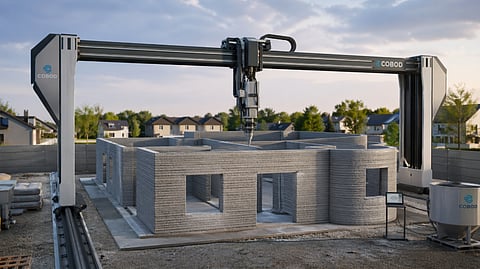
At a glance, the concept is simple: a large-scale printer builds a home layer by layer using specialized materials. But what companies like Azure are doing is refining that process into something far more practical and design-conscious. Their approach leans toward modular construction, where components are printed with precision and then assembled into fully realized living spaces.
This allows for better quality control and scalability, while still maintaining the efficiency that defines 3D printing. The result is a home that feels more intentional than experimental. You’re not sacrificing comfort or aesthetics for innovation. Instead, the technology fades into the background, supporting a living experience that feels surprisingly familiar, yet distinctly modern.
Let’s address the shift in cost, because it’s real. Early narratives around 3D-printed homes promised ultra-low price points, often under $50,000. Today, that number has moved. With companies like Azure Printed Homes, pricing varies depending on size, customization, and finishes, but generally lands in a range that reflects both innovation and demand.
Smaller units may still fall into accessible territory, while larger, design-forward models can climb significantly higher. What’s important is context. Even as costs rise, these homes often remain more efficient to produce than traditional builds, with reduced labor and shorter timelines. In a market where delays and material costs continue to climb, that efficiency becomes part of the value proposition.
This is where things get genuinely interesting. Many of the printed homes are designed with mobility in mind; compact, modular structures that can be transported with relative ease. In some cases, these homes are small enough to be towed by a standard pickup truck, the kind you’d see every day, like a Toyota Tundra or a Ford Ranger. That single detail changes the entire equation. A home is no longer fixed to a single location. It becomes something you can move, reposition, or adapt based on your lifestyle. Whether it’s a coastal retreat, a mountain escape, or a flexible backyard addition, the idea of mobility introduces a level of freedom that traditional real estate has never fully offered.
This mobility opens the door to new forms of ownership. For some, it’s about downsizing into a more intentional way of living; less space, but more purpose. For others, it’s about flexibility: a home that can evolve with changing needs or opportunities. There’s also a growing interest from investors, who see these units as short-term rental properties, guest accommodations, or even pop-up hospitality concepts.
The relatively fast production timeline makes it possible to deploy these homes quickly, turning ideas into revenue-generating assets in a fraction of the time required for traditional construction. It’s not just a housing solution, it’s a platform for rethinking how space can be used, monetized, and experienced.
One of the biggest misconceptions about 3D-printed homes is that they feel temporary or utilitarian. That’s changing rapidly. Azure Printed Homes, in particular, leans into clean lines, modern finishes, and thoughtful layouts that elevate the experience beyond basic shelter. Interiors are designed to maximize space without feeling constrained, often incorporating large windows, open-plan living areas, and smart storage solutions. The goal is not just efficiency, but livability. These are spaces you want to spend time in, not just pass through. As the design language continues to evolve, the gap between traditional and 3D-printed homes becomes less about quality and more about philosophy.
If there’s one takeaway from the rise of companies like Azure Printed Homes, it’s that the definition of a home is changing. It’s becoming more adaptable, more efficient, and more aligned with how people actually want to live today. Costs may continue to rise as demand grows and designs become more sophisticated, but so will the level of refinement. What we’re seeing is the early stage of a broader shift where homes are not just built differently, but experienced differently. A home that can be printed, delivered, and even towed behind a truck isn’t just a novelty. It’s a glimpse into a future where living is less about permanence and more about possibility.
Inspired by what you read?
Get more stories like this—plus exclusive guides and resident recommendations—delivered to your inbox. Subscribe to our exclusive newsletter
The products and experiences featured on RESIDENT™ are independently selected by our editorial team. We may receive compensation from retailers and partners when readers engage with or make purchases through certain links.